UPI Merchants Alert: Law Now Allows Government to Bring MDR
Overview
India is paving the way to potentially end its zero-fee policy for UPI payments. The recently passed Taxation and Other Laws (Amendment) Bill, 2026, allows the government to introduce Merchant Discount Rates (MDR) for UPI transactions. While no immediate fees are in effect, officials aim to create a sustainable revenue model for payment providers. Current proposals suggest fees may only apply to transactions over ₹2,000 for larger businesses, likely exempting 90% of small merchants and kirana stores. The government retains the flexibility to determine when and how these charges, if any, will be implemented.
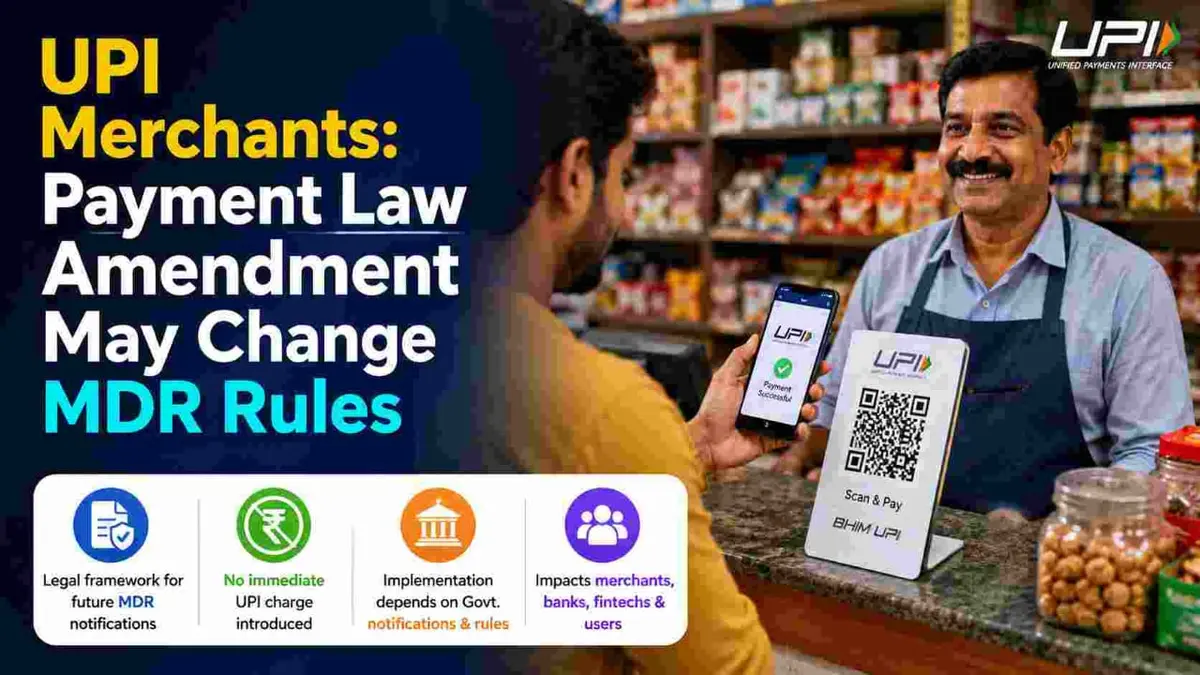

Parliament has cleared the way for the government to bring back merchant charges on UPI payments, ending the six-year-old blanket ban that has kept the country's most popular payment method free for merchants since 2020.
The Lok Sabha passed the Taxation and Other Laws (Amendment) Bill, 2026, on August 6, which amends Section 10A of the Payment and Settlement Systems Act, 2007. This is the same legal provision that, since a December 2019 Gazette notification, has barred banks and payment service providers from charging Merchant Discount Rate (MDR) on UPI and RuPay debit card transactions.
It's important to be clear about what actually changed. The amendment does not impose any charge on UPI right now. What it does is remove the blanket, automatic exemption written into law, and replace it with a system where the central government can decide — through a future notification — which payment modes stay free and which ones may attract a fee. In simple terms, Parliament has handed the government the legal switch to turn MDR on for UPI. Whether, when, and how that switch gets used is still an open question.
Why This Change Was Made
UPI has grown from a niche payment rail into the backbone of India's digital economy, with transaction values rising from roughly ₹21.3 lakh crore in FY2019-20 to over ₹260 lakh crore by March 2025. But that scale comes at a cost. Banks, payment aggregators, and app providers like PhonePe and Google Pay still bear real expenses for switching, fraud prevention, cybersecurity, and dispute resolution — costs that zero-MDR policy has forced them to absorb since 2020.
Officials moving the Bill said the goal is to build a sustainable revenue model for banks and payment service providers, while shielding ordinary consumers and small merchants from any new burden.
What's Actually Being Considered
Although the law itself sets no rate, government sources and industry reports point to a likely structure that could eventually be notified:
- Threshold: MDR would apply only to individual UPI transactions above ₹2,000
- Merchant size: The fee is expected to target larger businesses, with proposals discussing an annual turnover cut-off in the range of ₹1 crore to ₹1.5 crore
- Rate range: Industry estimates suggest a possible MDR of around 0.25% to 0.4%
- Person-to-person transfers: Expected to remain completely free, regardless of amount
If this structure goes through, industry estimates suggest roughly 90% of merchants currently accepting UPI — largely kirana stores, street vendors, and small local businesses — would fall below the threshold and stay unaffected.
Large Merchants vs Small Merchants: The Real Difference
This is where the impact splits sharply.
Small and micro merchants — think local kirana stores, vegetable vendors, tea stalls, and small shop owners — are expected to continue enjoying zero-MDR UPI acceptance. Most of their transactions are low-value and would sit below the proposed ₹2,000 threshold in any case.
Large and mid-sized merchants — businesses crossing the turnover threshold and processing higher-value transactions — could eventually see a small percentage fee deducted on qualifying UPI payments, similar to what already happens with card payments today.
Industry voices, including trade bodies like ASSOCHAM, have argued that MSMEs should be kept out of any MDR regime entirely, while larger businesses — which already pay processing charges through other banking and card channels — are better placed to absorb a UPI fee.
Busting a Few Myths
Given how fast this news has spread, a few myths need clearing up:
- Myth: UPI payments will get costlier for everyone starting now. Fact: The Bill only creates the legal room for MDR. No fee has been notified, and none applies today.
- Myth: Customers will be charged for scanning a QR code. Fact: Current proposals point to charges on merchants, not customers, and only above ₹2,000 on qualifying transactions.
- Myth: Small shopkeepers will lose UPI's biggest advantage. Fact: Small merchants and low-value transactions are expected to remain protected under the threshold-based approach being discussed.
- Myth: This is final and rates are already fixed. Fact: Any actual MDR would still require a formal notification, RBI-level guidelines on rates and categories, and possibly a follow-up Gazette notification — none of which has happened yet.
What Happens Next
For any MDR to actually apply on UPI, three more steps are typically needed: a government notification specifying which payment modes lose their exemption, detailed RBI guidelines on transaction categories and rates, and industry-wide implementation timelines from NPCI and banks. RBI Governor Sanjay Malhotra has himself indicated it would be premature to say exactly how the final cost structure will play out.
What Merchants Should Do Now
- Track your annual UPI transaction turnover against the discussed ₹1 crore–₹1.5 crore range
- Watch for an official government notification before assuming any charge applies to your business
- If you run a growing business, it may help to review your overall borrowing and cash-flow planning — LabhGrow's Business Loan EMI Calculator can help you plan ahead in case operating costs shift
- Avoid acting on unverified WhatsApp forwards or social media claims about "UPI charges starting from [a specific date]" — rely only on official RBI/Finance Ministry notifications
Conclusion
Parliament has opened the legal door for UPI merchant charges to return after a six-year gap, but the door hasn't been walked through yet. No MDR applies to UPI transactions today. What happens next depends entirely on the government's notification, expected to focus fees narrowly on high-value transactions at larger merchants, while keeping small businesses and everyday users protected. LabhGrow will continue tracking this story as official notifications are issued.
For More Information -
> Disclaimer: The content provided on LabhGrow is for educational and informational purposes only. We are not a SEBI-registered investment advisor. Please consult a qualified financial advisor before making any investment or financial decisions. LabhGrow is not responsible for any loss or damage arising from the use of this information.

Head of Content & Lead Writer
Senior financial & news writer specializing in Indian government schemes, market rates, and banking policies.
lakshyabhardwaj.hoc@labhgrow.in
Senior Research Analyst (Fact-Checker)
Dedicated researcher and data verifier ensuring 100% authenticity and fact-checking from primary government and financial feeds.
harshitsharma.sra@labhgrow.in