RBI to Trial Plastic ₹10, ₹20 Notes After Govt Nod
Overview
India is reviving its transition toward durable currency, with the government approving the Reserve Bank of India’s plan to trial polymer banknotes. The pilot will involve issuing one billion ₹10 and ₹20 notes designed to resist moisture, dirt, and wear. By utilizing plastic-based substrates, the RBI aims to improve longevity and enhance anti-counterfeiting security in the most frequently circulated denominations. While previous attempts stalled in 2012, this renewed initiative signals a strategic move toward modernizing India’s cash infrastructure. For now, paper notes remain legal tender as officials evaluate the feasibility of a long-term shift.
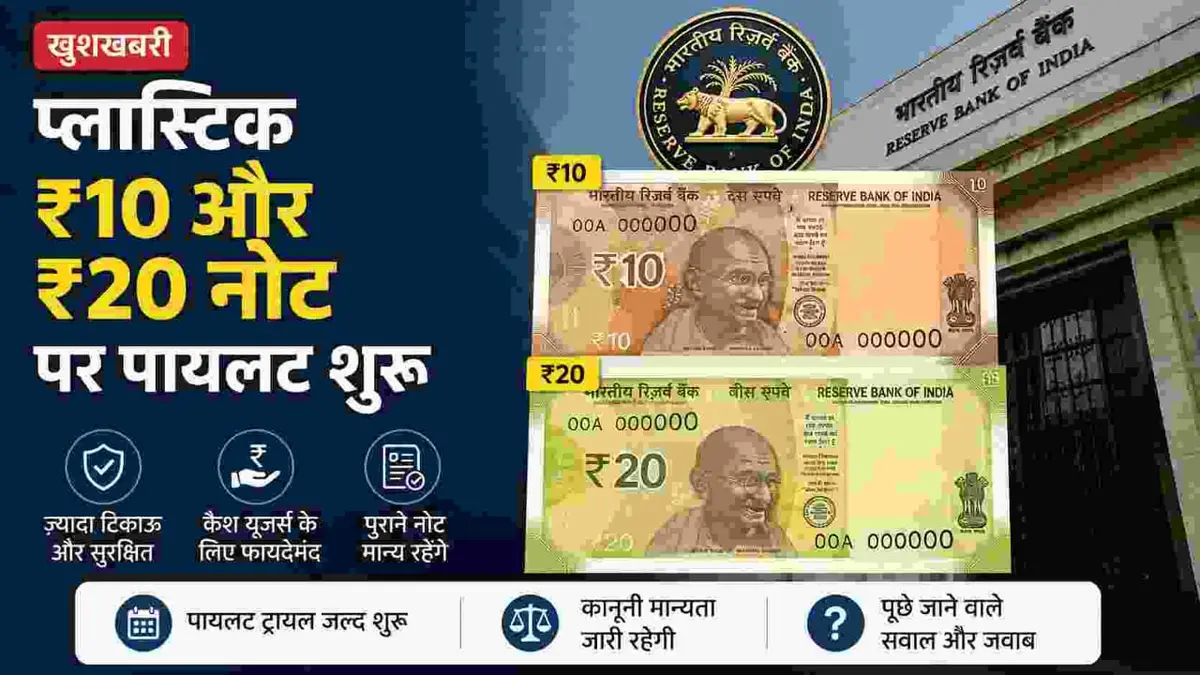

India's currency system is set to get its first real test of plastic money in over a decade. The central government has approved a proposal from the Reserve Bank of India to conduct field trials of polymer banknotes in the ₹10 and ₹20 denominations, marking a fresh attempt at introducing more durable currency into everyday circulation.
The approval was confirmed in Parliament, where the Minister of State for Finance told the Lok Sabha in a written reply that the RBI had sought permission to issue one billion polymer notes each of ₹10 and ₹20 for field testing. The government has cleared this request, but made clear that regular, large-scale issuance will only begin once the trial phase is completed successfully.
What Exactly Is Being Tested
Polymer notes are made from a plastic-based substrate instead of the cotton-paper blend used in India's current currency. They are built to survive rougher handling, resist moisture, dirt and tearing, and generally last much longer in circulation than paper notes. Because they hold up better under wear, several countries have found them more cost-effective over time, even though the initial printing cost is higher.
The RBI has chosen ₹10 and ₹20 notes for this pilot because these are the most heavily used denominations in daily cash transactions. Low-value notes pass through the most hands, wear out fastest, and need frequent reprinting — so testing durability here makes practical sense before any wider rollout is considered.
Bharatiya Reserve Bank Note Mudran Private Limited, the RBI's currency-printing arm, has already begun procuring polymer substrate fitted with advanced security features ahead of the trial. These notes are expected to carry stronger anti-counterfeiting measures, including elements like clear windows and complex security patterns that are harder to replicate than those on standard paper currency.
Why Now, and Why This Isn't New
This isn't India's first attempt at polymer currency. Back in December 2012, the government had cleared a similar plan to trial one billion ₹10 polymer notes across five cities picked for their varied climates — Jaipur, Shimla, Bhubaneswar, Mysore and Kochi. That effort reached the tendering stage by 2017 but was eventually shelved before notes reached the public.
This time, the push has RBI's backing at a more advanced stage. RBI Governor Sanjay Malhotra had earlier indicated the central bank was actively studying the pros and cons of polymer currency, though he had described those discussions as still preliminary at the time. The latest government approval, based on a recommendation from the RBI's Central Board under Section 25 of the RBI Act, 1934, moves the process from discussion to an actual field trial.
What This Means for Cash Users
For now, nothing changes at the wallet level. There is no decision to replace paper currency, and existing ₹10 and ₹20 paper notes remain fully valid legal tender. The polymer notes, once printed and distributed, will circulate alongside paper currency during the trial period rather than replacing it outright.
If the trial goes well, the RBI will use the findings to decide whether polymer notes should move into regular circulation. Only after that decision would a broader rollout — potentially covering other denominations — even come under consideration. Until then, this remains strictly a testing exercise, not a currency changeover.
For everyday users, the eventual benefit could be sturdier, cleaner, harder-to-fake notes that last longer between reprints. But that's a question for after the trial concludes — for now, it's simply a matter of watching how the pilot unfolds over the coming months.
Conclusion
The government's approval gives RBI the green light to test plastic ₹10 and ₹20 notes on a meaningful scale — one billion pieces of each. It's an important step, but only a first one. Paper currency isn't going anywhere yet, and any large-scale shift will depend entirely on how these polymer notes perform in real-world conditions across the country.
For More Information -
> Disclaimer: The content provided on LabhGrow is for educational and informational purposes only. We are not a SEBI-registered investment advisor. Please consult a qualified financial advisor before making any investment or financial decisions. LabhGrow is not responsible for any loss or damage arising from the use of this information.

Head of Content & Lead Writer
Senior financial & news writer specializing in Indian government schemes, market rates, and banking policies.
lakshyabhardwaj.hoc@labhgrow.in
Senior Research Analyst (Fact-Checker)
Dedicated researcher and data verifier ensuring 100% authenticity and fact-checking from primary government and financial feeds.
harshitsharma.sra@labhgrow.in