RBI ₹7 Lakh Cr VRRR Auction 2026: Your FD Rate Change Guide
Overview
India's RBI will conduct a massive ₹7 lakh crore, 30-day Variable Rate Reverse Repo (VRRR) auction on September 7, 2026, to absorb substantial surplus cash from the banking system. This aims to manage liquidity, stemming from earlier foreign-currency inflows, potentially influencing FD rates and loan EMIs for ordinary customers.
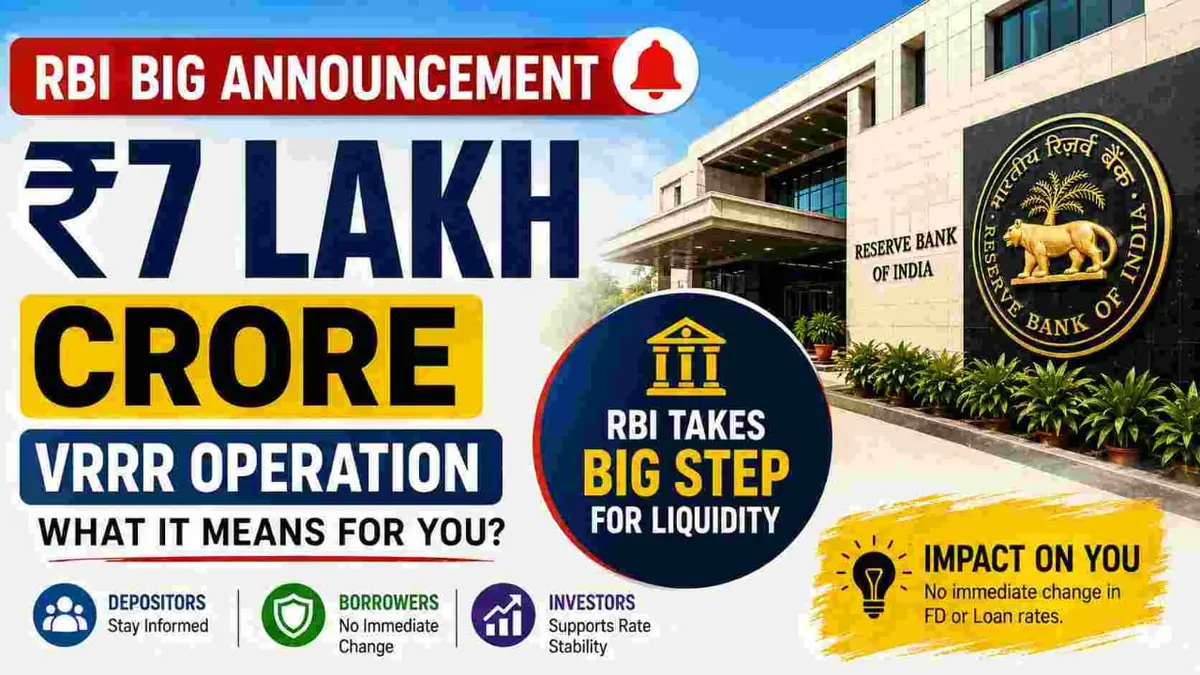

The Reserve Bank of India is about to pull off one of its biggest liquidity operations in recent memory. On September 7, 2026, the central bank will run a 30-day Variable Rate Reverse Repo (VRRR) auction worth ₹7 lakh crore, aimed at soaking up an unusually large pile of surplus cash sitting inside India's banking system.
For an ordinary bank customer, an RBI liquidity auction can sound like something that only economists need to track. But when the central bank moves money at this scale, it eventually touches things people actually care about — how much interest their fixed deposit earns, and how quickly their next loan EMI might move.
What RBI Has Announced
Here's a quick snapshot of the operation:
| Detail | Figure |
|---|---|
| Auction amount | ₹7 lakh crore |
| Tenure | 30 days |
| Auction date | September 7, 2026 |
| Scheduled reversal | Around October 7, 2026 |
| Banking-system surplus (as of Sept 3) | About ₹10.3 lakh crore |
| Early exit option | Yes — premature or partial withdrawal allowed |
A VRRR auction works like a temporary parking facility for banks. Instead of letting extra cash sit idle or push short-term interest rates too low, banks bid to place their surplus funds with the RBI for a fixed period and earn a market-determined rate in return. This time, the RBI has chosen a full month instead of its usual shorter 1-to-14-day window — a sign of how large and persistent the current surplus has become.
Why Is There So Much Surplus Cash Right Now?
The surplus didn't build up overnight. Earlier this year, the RBI ran a special foreign-currency deposit scheme to shore up the rupee and rebuild reserves. That scheme pulled in far more money than expected — reportedly over $127 billion in foreign-currency inflows. As banks converted and swapped these dollars with the RBI, a large amount of rupee liquidity flowed back into the domestic banking system.
The result: India's forex reserves hit a record high, but domestic banks suddenly found themselves holding far more spare cash than usual. That's the surplus the RBI is now trying to manage.
Quick Fact: A month ago, the RBI tried to absorb ₹8.5 lakh crore through VRRR but banks only parked around ₹6.02 lakh crore — showing that lenders don't always rush to lock away funds for long periods. The early-exit option in this latest auction is designed to make the 30-day commitment more attractive.
How This VRRR Auction Works — Step by Step
1. RBI notifies the auction. The central bank announces the amount (₹7 lakh crore), tenure (30 days) and bidding window ahead of the auction date.
2. Banks submit bids. Participating banks bid the rate at which they're willing to park surplus funds with the RBI for 30 days.
3. RBI sets the cut-off rate. The central bank accepts bids up to the notified amount, with the cut-off rate reflecting where short-term money-market conditions currently stand.
4. Funds are locked with RBI. Successful bidders transfer the agreed amount to the RBI in exchange for a return, temporarily removing that cash from active circulation.
5. Early exit window (if needed). Banks that need funds back sooner can use the premature or partial redemption facility instead of waiting the full 30 days.
6. Reversal on maturity. Around October 7, 2026, the RBI returns the funds to the banks along with the agreed interest, completing the cycle.
What This Means for FD Holders, Borrowers and Investors
This is where the operation actually reaches the average bank customer:
- Fixed deposit holders: When banks have less surplus cash chasing deposits, there's less pressure for FD rates to fall further in the near term. It doesn't guarantee a hike, but it can support existing rates.
- Borrowers: Loan pricing is linked more closely to the RBI's repo rate and each bank's cost of funds than to a single VRRR auction. A one-time liquidity operation is unlikely to move your EMI on its own.
- Investors and markets: Absorbing surplus liquidity helps keep short-term money-market rates aligned with the RBI's policy stance, which indirectly supports stability in bond and debt markets.
Will FD and Loan Rates Change Immediately?
Not necessarily. A VRRR auction is a liquidity management tool, not a rate-setting decision like a repo rate change. Banks review deposit and lending rates based on multiple factors — overall liquidity, credit demand, and RBI policy signals — over weeks and months, not overnight. Customers should treat this as one input among many, not an instant trigger for rate revisions.
If you're planning a new FD or comparing loan offers around this period, it's worth checking updated rates before locking in, since liquidity conditions can shift bank-level pricing over the following weeks.
Key Takeaways
- RBI will run a ₹7 lakh crore, 30-day VRRR auction on September 7, 2026.
- The move comes as banking-system liquidity surplus touched roughly ₹10.3 lakh crore.
- The surplus is largely linked to unexpectedly large foreign-currency inflows earlier this year.
- Funds are due for reversal around October 7, 2026, with an early-exit option for banks.
- The auction itself does not guarantee immediate FD or loan rate changes.
Conclusion
RBI's ₹7 lakh crore VRRR auction is less about any single number and more about the central bank managing an unusually large liquidity surplus without letting short-term rates drift too far from its policy stance. For everyday bank customers, the direct impact may be limited for now, but it's a useful signal to keep an eye on FD rates and loan pricing over the coming weeks as banks adjust to changing liquidity conditions.
For More Information -
The Market News and News section of LabhGrow covers general updates related to the economy, companies, government policies, and financial markets, compiled from publicly available sources for informational purposes only. This content does not constitute financial, investment, trading, or business advice of any kind, nor should it be interpreted as a recommendation to buy, sell, hold, or avoid any stock, fund, scheme, commodity, or financial instrument. LabhGrow is not a SEBI-registered research analyst, investment advisor, or financial institution, and does not guarantee the accuracy, completeness, or timeliness of the news or data presented. Market conditions are subject to constant and rapid change, and past updates or trends do not guarantee future outcomes. Readers are strongly advised to cross-verify information through official or regulatory sources and consult a qualified, registered financial advisor before making any financial or investment decision based on news covered here. LabhGrow and its team accept no liability for any loss or damage resulting from the use of this information.

Head of Content & Lead Writer
Senior financial & news writer specializing in Indian government schemes, market rates, and banking policies.
lakshyabhardwaj.hoc@labhgrow.in
Senior Research Analyst (Fact-Checker)
Dedicated researcher and data verifier ensuring 100% authenticity and fact-checking from primary government and financial feeds.
harshitsharma.sra@labhgrow.in