₹15,000 Per Acre: Chhattisgarh Announces New Incentives for Farmers Diversifying Away from Paddy
Overview
Chhattisgarh farmers can now earn ₹15,000 per acre by switching from paddy to pulses, oilseeds, or maize. Here is how you can register before the deadline.
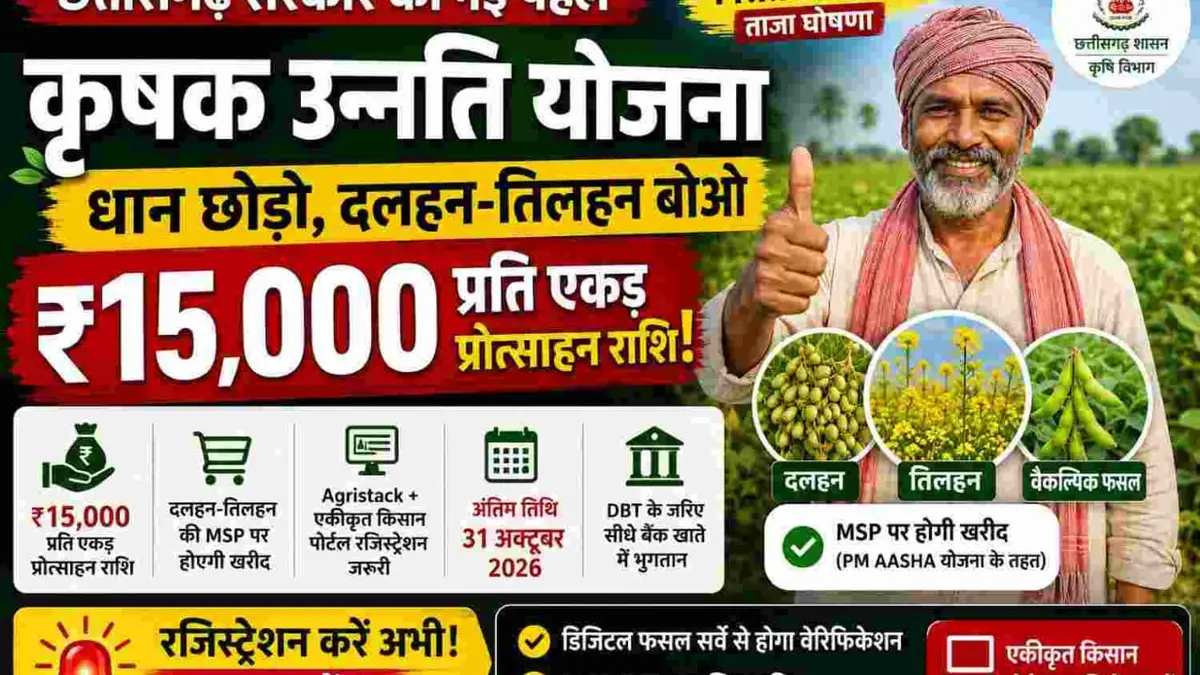

Farmers in Chhattisgarh have a fresh reason to rethink their kharif cropping plan this season. The state government has raised the incentive under its flagship Krishak Unnati Yojana from ₹10,000 to ₹15,000 per acre for those who move away from paddy and grow pulses, oilseeds, maize, cotton or minor millets instead.
The decision was formalised through the state agriculture department's latest notification and comes into effect from the ongoing Kharif 2026 season. For a state where paddy has long dominated cropping patterns, this is one of the more direct financial pushes yet toward diversification.
What Exactly Has Changed
Until now, farmers who switched from paddy to alternative crops such as arhar, moong, soybean, mustard, maize, kodo, kutki, ragi or cotton received ₹10,000 per acre as input assistance. That amount has now been raised by 50 percent to ₹15,000 per acre under the revised Krishak Unnati Yojana framework.
Alongside the higher payout, the government has also assured that pulses and oilseeds grown under this scheme will be procured at Minimum Support Price (MSP) through the PM-AASHA scheme run by the Ministry of Agriculture & Farmers Welfare. This effectively gives farmers two layers of financial security — the per-acre incentive for switching crops, plus an assured price when they sell the produce.
Quick Highlight
Incentive increased from ₹10,000 to ₹15,000 per acre
Applicable to pulses, oilseeds, maize, cotton and minor millets grown instead of paddy
MSP procurement assured under PM AASHA
Agristack + Ekikrit Kisan Portal registration mandatory
Registration/amendment deadline for Kharif 2026: 31 October 2026
Amount transferred directly via DBT after digital crop survey verification
Why the State Is Pushing This
Chhattisgarh's agriculture department has repeatedly flagged the risk of over-dependence on a single crop, both for soil health and for farmer income stability. Continuous paddy cultivation in the same fields season after season tends to deplete groundwater and soil nutrients over time, while also leaving farmers exposed if paddy prices or procurement conditions shift unfavourably in any given year.
By making pulses and oilseeds more financially attractive than they've been in previous years, the state is trying to nudge farmers toward crops that use less water, improve soil fertility, and still come with an income guarantee through MSP.
Who Can Claim the ₹15,000 Per Acre Benefit
To be eligible for the enhanced incentive under Krishak Unnati Yojana, a farmer generally needs to meet these conditions:
- Land records should reflect the farmer as the cultivator for the relevant plot
- The farmer must grow an eligible alternative crop (pulses, oilseeds, maize, cotton, or minor millets like kodo, kutki, ragi) instead of paddy on that plot during Kharif 2026
- Registration on the Ekikrit Kisan Portal (Integrated Farmer Portal) under Agristack is mandatory
- Bank account must be linked and verified for Direct Benefit Transfer (DBT)
- Actual sowing will be cross-checked through a digital crop survey before payment is released
Step-by-Step: How to Register on the Ekikrit Kisan Portal
This is the part most news reports have skipped over, even though it's the one action every eligible farmer actually needs to take before the deadline.
1. Visit the official portal. Go to the Chhattisgarh Ekikrit Kisan Portal at kisan.cg.nic.in or check with your local Krishi Vibhag office for the current registration link.
2. Log in or create your farmer profile. Use your Aadhaar number and registered mobile number. If you're already registered under PM-KISAN or a previous Kharif cycle, check whether your existing profile needs an update rather than a fresh registration.
3. Update your land and crop details. Enter the khasra/plot details for the land where you're growing the alternative crop, and clearly select the crop type (pulses, oilseeds, maize, cotton, or minor millets) instead of paddy.
4. Link and verify your bank account. Since payment comes through DBT, make sure your bank account is Aadhaar-linked and the details on the portal match your bank records exactly — mismatches are one of the most common reasons for delayed payments.
5. Submit before 31 October 2026. This is the closing date for new registrations as well as amendments to existing Kharif 2026 records. Applications submitted after this date may not be considered for this season's incentive.
6. Keep your acknowledgment/reference number. Save the confirmation you receive after submission — you may need it later if there's a discrepancy during the digital crop survey verification.
7. Cooperate with the digital crop survey. Officials will cross-verify actual sowing against your portal declaration. Any mismatch between what you registered and what's actually grown on the field can affect your eligibility.
What Happens After Registration
Once registration is complete and the digital crop survey confirms that the declared alternative crop has actually been sown, the ₹15,000 per acre assistance is credited directly to the farmer's linked bank account through DBT. There is no separate cash disbursement or middleman involved in the process, which is meant to reduce delays and leakages that have affected similar schemes in the past.
For pulses and oilseeds specifically, farmers also get the option to sell their produce at MSP under PM AASHA once it's ready for market, rather than relying entirely on open market rates.
The Bigger Picture for Chhattisgarh's Farmers
For many small and marginal farmers in Chhattisgarh, paddy has been the safer, more familiar choice simply because the procurement system around it is well established. This revised incentive doesn't remove that option, but it does make the alternative meaningfully more attractive — both through a higher upfront payout and an assured buyback through MSP.
Farmers who were on the fence about diversifying, especially in areas where paddy yields have plateaued or water availability is tightening, now have a clearer financial case to try pulses, oilseeds, or millets on at least part of their land this season.
Conclusion
Chhattisgarh's decision to raise the Krishak Unnati Yojana incentive to ₹15,000 per acre marks one of the more significant course corrections toward crop diversification in the state's recent agricultural policy. The real value for farmers, though, lies in acting on it — registering on the Ekikrit Kisan Portal before 31 October 2026, keeping land and bank details accurate, and following through with the digital crop survey verification. Missing the registration window would mean missing out on the incentive entirely for this Kharif season.
For More Information -
https://kisansamadhan.com/paddy-alternative-crops-15000-per-acre-assistance-chhattisgarh-2026/
The Market News and News section of LabhGrow covers general updates related to the economy, companies, government policies, and financial markets, compiled from publicly available sources for informational purposes only. This content does not constitute financial, investment, trading, or business advice of any kind, nor should it be interpreted as a recommendation to buy, sell, hold, or avoid any stock, fund, scheme, commodity, or financial instrument. LabhGrow is not a SEBI-registered research analyst, investment advisor, or financial institution, and does not guarantee the accuracy, completeness, or timeliness of the news or data presented. Market conditions are subject to constant and rapid change, and past updates or trends do not guarantee future outcomes. Readers are strongly advised to cross-verify information through official or regulatory sources and consult a qualified, registered financial advisor before making any financial or investment decision based on news covered here. LabhGrow and its team accept no liability for any loss or damage resulting from the use of this information.

Head of Content & Lead Writer
Senior financial & news writer specializing in Indian government schemes, market rates, and banking policies.
lakshyabhardwaj.hoc@labhgrow.in
Senior Research Analyst (Fact-Checker)
Dedicated researcher and data verifier ensuring 100% authenticity and fact-checking from primary government and financial feeds.
harshitsharma.sra@labhgrow.in