UPI MDR 2026: What Changes for Payments Above ₹2,000
Overview
From October 15, 2026, a 0.4% UPI MDR applies to select merchant payments above ₹2,000. P2P transfers stay free. Here's who actually pays.
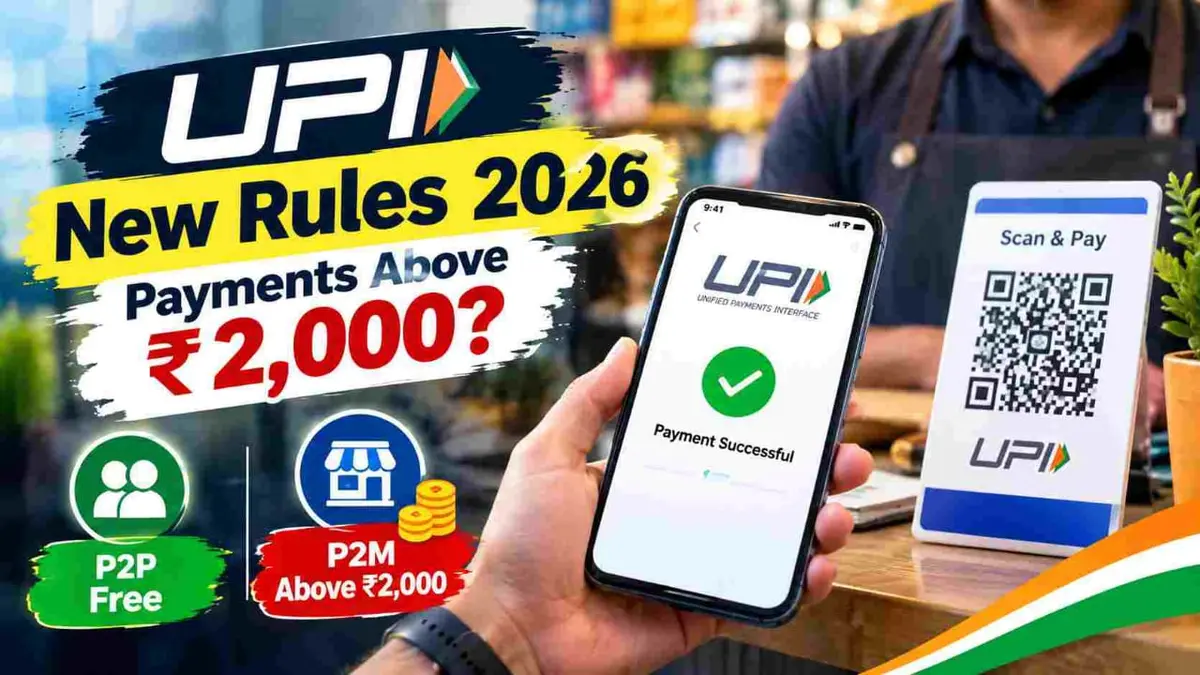

Starting October 15, 2026, a small but important change is coming to how India's most-used payment system handles certain transactions. The National Payments Corporation of India (NPCI) has introduced a Merchant Discount Rate, or MDR, on select person-to-merchant UPI payments above ₹2,000. For the vast majority of UPI users, day-to-day usage will look exactly the same. But for merchants accepting larger digital payments, the arithmetic behind every transaction is about to shift.
Here's what the UPI MDR 2026 framework actually covers, who pays it, and where the exemptions lie.
What Is Changing From October 15
Until now, UPI has been free for everyone — no charge for sending money to a friend, and no charge for paying a shopkeeper, regardless of the amount. That changes only on one side of the transaction. From October 15, 2026, a 0.4% MDR will apply to specified UPI person-to-merchant (P2M) payments above ₹2,000.
Three things stay exactly as they were:
- Person-to-person (P2P) UPI transfers remain completely free, at any amount.
- Merchant payments up to ₹2,000 remain free.
- Small merchants receiving payments directly into their personal bank account, up to ₹1,00,000 a month, continue to pay zero MDR.
According to figures cited by the Ministry of Finance, roughly 96% of all P2M transactions fall below the ₹2,000 mark or qualify for exemption, meaning the overwhelming majority of everyday UPI payments — groceries, autos, tea stalls, small retail — are untouched by this rule.
How the 0.4% MDR Actually Works
The MDR is charged as a percentage of the transaction value, with a cap so it doesn't spiral on very large payments. Here's how it plays out in practice:
| Transaction Amount | MDR (0.4%) | Amount Merchant Pays |
|---|---|---|
| ₹3,000 | 0.4% | ₹12 |
| ₹5,000 | 0.4% | ₹20 |
| ₹50,000 | 0.4% | ₹200 |
| ₹75,000 and above | Capped | ₹300 (maximum) |
For transactions of ₹75,000 or more, the charge is capped at ₹300 per transaction, so it never climbs beyond that regardless of how large the payment is.
Certain categories don't follow the standard 0.4% structure at all. Fuel, railways, telecom, and insurance payments attract a flat ₹5 fee instead of a percentage. Capital market transactions — mutual funds, securities, and stockbroking — carry a much lower 0.02% MDR, also capped at ₹300.
Quick Note: The MDR is not a government tax, and it does not go to the government or to NPCI. It is a processing fee that moves within the payment ecosystem — between the merchant's bank, the payment service provider, and the app provider — to help fund the infrastructure, security, and upkeep of UPI.
Who Actually Pays the Charge
This is the part causing the most confusion, so it's worth being direct about it: customers are not meant to pay this fee. The charge sits entirely on the merchant's side.
When an eligible merchant receives a UPI payment above ₹2,000, the MDR is deducted by the acquiring bank before the remaining amount is credited to the merchant's account. The customer pays the exact amount shown at checkout — nothing extra is added on top.
Merchants are also barred from passing this cost directly onto shoppers as a separate UPI surcharge, and UPI app providers cannot levy any platform fee of their own on top of this.
That said, real-world behaviour doesn't always follow the rulebook. Some merchants may choose to build the cost into their listed prices over time, or in a few cases, stop accepting UPI for higher-value transactions altogether — something that has been observed before with RuPay credit cards, which carry a similar MDR structure.
Step-by-Step: What This Means for Your Next UPI Payment
If you want to know exactly how this affects you the next time you pay through UPI, here's the simple way to check it:
1. Check who you're paying. If it's a friend, family member, or any individual — the payment stays free, no matter the amount.
2. Check the amount. If you're paying a merchant ₹2,000 or less, there's no MDR involved at all.
3. Check the merchant type. Small vendors receiving under ₹1,00,000 a month via UPI QR codes remain fully exempt, so many local shops and stalls won't be affected.
4. If it's a larger merchant payment above ₹2,000, the 0.4% MDR (or the sector-specific rate) applies — but it's deducted from the merchant's settlement, not added to your bill.
5. If you run a business, reach out to your payment aggregator or acquiring bank before October 15 to understand exactly how the fee will reflect in your monthly reconciliation.
Why NPCI Introduced This Fee
UPI has operated as a zero-MDR system for merchants since 2020, when the government made it free to encourage adoption. That worked — UPI now processes billions of transactions a month. But running that infrastructure, from fraud detection to server capacity to constant security upgrades, isn't free, and it has largely depended on continued government incentives.
The new MDR framework is designed to give the ecosystem its own revenue mechanism, reducing that dependence on public funding while keeping the payments that matter most to ordinary users — small daily transactions and P2P transfers — completely free.
The Bigger Picture
For context, UPI merchant payments through other digital instruments already carry far steeper charges. A ₹50,000 payment via credit card typically costs a merchant between ₹750 and ₹1,250 in MDR, and up to ₹450 via debit card. The same transaction through UPI, even after October 15, works out to just ₹200. Even with the new fee, UPI remains by far the cheapest digital payment rail for merchants in India.
Key Takeaways
- P2P UPI transfers: free, always.
- Merchant payments up to ₹2,000: free.
- Small merchants under ₹1,00,000/month via UPI QR: exempt.
- Above ₹2,000 at eligible merchants: 0.4% MDR, capped at ₹300.
- The fee is paid by merchants, not customers, and is not a government tax.
Conclusion
The UPI MDR 2026 update is narrower than the headlines suggest. It touches a specific slice of merchant payments above ₹2,000, leaves personal transfers and small daily purchases untouched, and keeps the cost on the merchant's side rather than the customer's. For most UPI users, October 15 will pass without any visible change. For merchants handling larger-ticket payments, the smart move is to check in with your bank or payment aggregator now, so there are no surprises when the new settlement structure kicks in.
The Market News and News section of LabhGrow covers general updates related to the economy, companies, government policies, and financial markets, compiled from publicly available sources for informational purposes only. This content does not constitute financial, investment, trading, or business advice of any kind, nor should it be interpreted as a recommendation to buy, sell, hold, or avoid any stock, fund, scheme, commodity, or financial instrument. LabhGrow is not a SEBI-registered research analyst, investment advisor, or financial institution, and does not guarantee the accuracy, completeness, or timeliness of the news or data presented. Market conditions are subject to constant and rapid change, and past updates or trends do not guarantee future outcomes. Readers are strongly advised to cross-verify information through official or regulatory sources and consult a qualified, registered financial advisor before making any financial or investment decision based on news covered here. LabhGrow and its team accept no liability for any loss or damage resulting from the use of this information.

Head of Content & Lead Writer
Senior financial & news writer specializing in Indian government schemes, market rates, and banking policies.
lakshyabhardwaj.hoc@labhgrow.in
Senior Research Analyst (Fact-Checker)
Dedicated researcher and data verifier ensuring 100% authenticity and fact-checking from primary government and financial feeds.
harshitsharma.sra@labhgrow.in