RBI Holds Repo Rate at 5.25%: Impact on Your Home Loan EMI
Overview
The Reserve Bank of India has held the repo rate steady at 5.25%, offering welcome stability for home loan borrowers. In a unanimous decision, the MPC maintained a "neutral" stance, citing global geopolitical risks and persistent inflation. While the RBI anticipates a near-term spike in inflation, it has slightly raised its FY27 GDP growth forecast to 6.7%. For now, existing floating-rate EMIs remain unchanged. This pause provides breathing room, but with inflation risks looming, borrowers should monitor future policy meetings, starting in October, to gauge the long-term outlook for their loan costs.
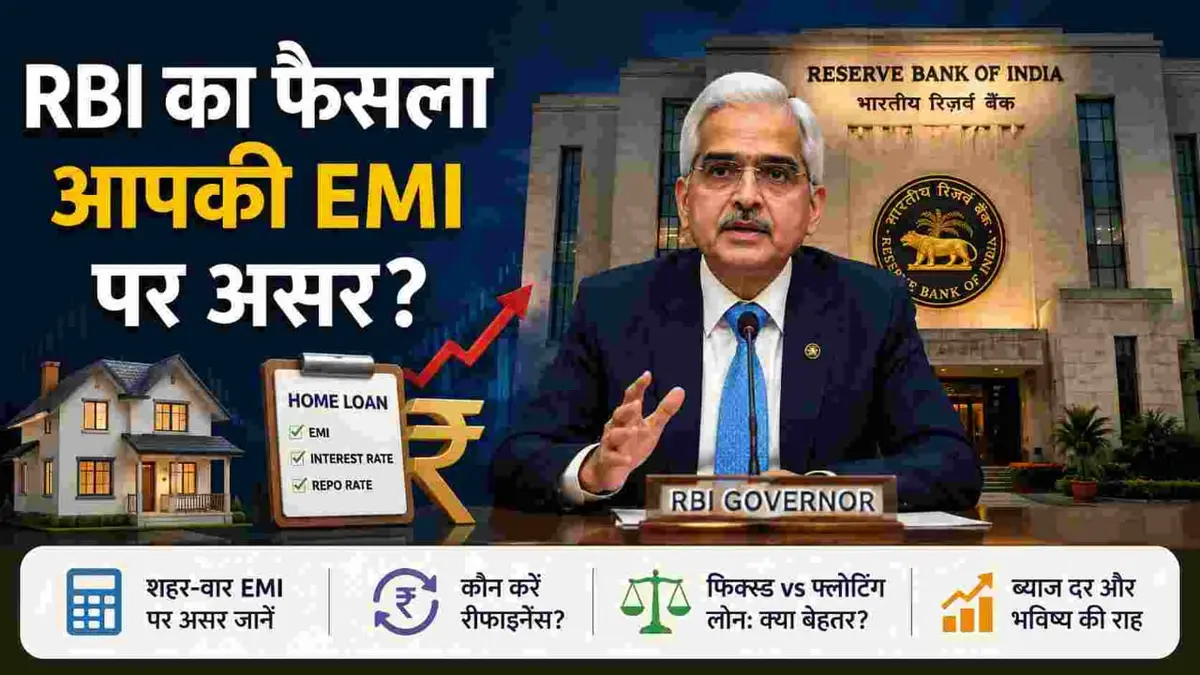

The Reserve Bank of India's Monetary Policy Committee has kept the repo rate unchanged at 5.25 percent, offering home loan borrowers a breather even as the central bank flagged near-term inflation pressures. Governor Sanjay Malhotra announced the decision on Wednesday, August 5, at the end of the three-day MPC meeting held between August 3 and 5, 2026.
All six members of the committee voted unanimously to hold rates steady and retain the "neutral" policy stance, a position the RBI has maintained since December 2025, when it last revised the repo rate.
For anyone tracking their EMI, this is the headline number that matters. Since banks generally price floating-rate home loans off external benchmarks linked to the repo rate, an unchanged repo rate means your existing EMI is unlikely to move immediately following this announcement.
Why the RBI chose to hold
Malhotra said the committee's approach was neither dovish nor hawkish, and that future decisions would continue to be guided closely by how headline inflation behaves. The central bank pointed to a mix of factors behind the status quo call: escalating geopolitical tensions, volatile crude oil prices, and persistent inflationary risks tied to food and fuel costs.
The RBI now expects headline inflation to rise further in the near term and peak in the third quarter of FY27, before easing again. Even so, the central bank trimmed its full-year CPI inflation projection slightly to 5 percent for FY27, down from the 5.1 percent estimate given in June. Quarter-wise, the RBI expects inflation at 5.3 percent in Q1, 4.7 percent in Q2, 5.9 percent in Q3, and 5.5 percent in Q4.
On growth, the outlook improved marginally. The MPC raised its real GDP growth forecast for FY27 to 6.7 percent, up from the earlier estimate of 6.6 percent, citing resilient domestic demand despite global headwinds.
What this means for your EMI
For existing floating-rate home loan borrowers, an unchanged repo rate generally translates into unchanged EMIs, at least until the next review. The RBI's next MPC meeting is scheduled for October 5-7, 2026, and that is the next point at which the rate could move.
For those still deciding between a fixed and a floating rate loan, the current pause offers some breathing room, but it isn't a signal either way. A floating rate loan remains linked to future RBI decisions, meaning your EMI could still rise or fall depending on how inflation and growth data evolve over the next few months. A fixed rate loan locks in certainty but usually comes at a higher starting rate. Borrowers weighing this choice should compare the total cost over the loan tenure rather than just the current rate, since banks often reprice fixed-rate offers periodically as well.
If you took your home loan when rates were higher and haven't reviewed your terms since, this is also a reasonable moment to check whether refinancing makes sense. Even without a change in the repo rate, banks periodically revise their spreads and risk premiums, so your current lender's rate may no longer be the most competitive one available. A quick way to check where you stand is to run your loan details through the LabhGrow Home Loan EMI Calculator, which lets you compare your existing EMI against current market rates and see the potential savings from refinancing before you approach a bank.
Impact beyond home loans
The rate hold also affects other borrowers and savers. Businesses and MSMEs relying on working capital loans linked to the repo rate will see borrowing costs stay where they are for now. Fixed deposit investors, on the other hand, are unlikely to see banks raise deposit rates in the immediate term, since the cost of funds for lenders hasn't changed.
For gold loan and personal loan borrowers, the impact is more indirect, as these products are often priced with wider spreads over the benchmark and may not move in lockstep with every MPC decision.
What to watch next
The RBI's commentary suggests policy will stay data-dependent through the rest of the year. With inflation expected to peak later in FY27 before cooling, and growth holding up, the central bank appears in no hurry to change direction. Borrowers should watch the October MPC meeting closely, along with monthly inflation prints, for early signs of where rates might head next.
Conclusion
For now, the RBI's decision to hold the repo rate at 5.25 percent means stability for existing borrowers and little immediate change for new loan seekers. The bigger takeaway is the RBI's cautious, data-dependent tone, which suggests borrowers shouldn't expect a rate cut in the immediate future. Those with older, higher-rate loans may still find value in reviewing their options now rather than waiting for the next policy cycle.
For More Information -
> Disclaimer: The content provided on LabhGrow is for educational and informational purposes only. We are not a SEBI-registered investment advisor. Please consult a qualified financial advisor before making any investment or financial decisions. LabhGrow is not responsible for any loss or damage arising from the use of this information.

Head of Content & Lead Writer
Senior financial & news writer specializing in Indian government schemes, market rates, and banking policies.
lakshyabhardwaj.hoc@labhgrow.in
Senior Research Analyst (Fact-Checker)
Dedicated researcher and data verifier ensuring 100% authenticity and fact-checking from primary government and financial feeds.
harshitsharma.sra@labhgrow.in