The Ram Mandir Donation Controversy: Why Are Questions Being Raised Now? Here's What We Know
Overview
The Ram Mandir donation controversy has once again become a national talking point. Questions related to donation management, transparency, and financial accountability are being widely discussed online. While supporters argue that many claims are unverified or misleading, critics continue to demand greater disclosure. The debate highlights the growing public expectation for transparency in large-scale donation-driven initiatives.
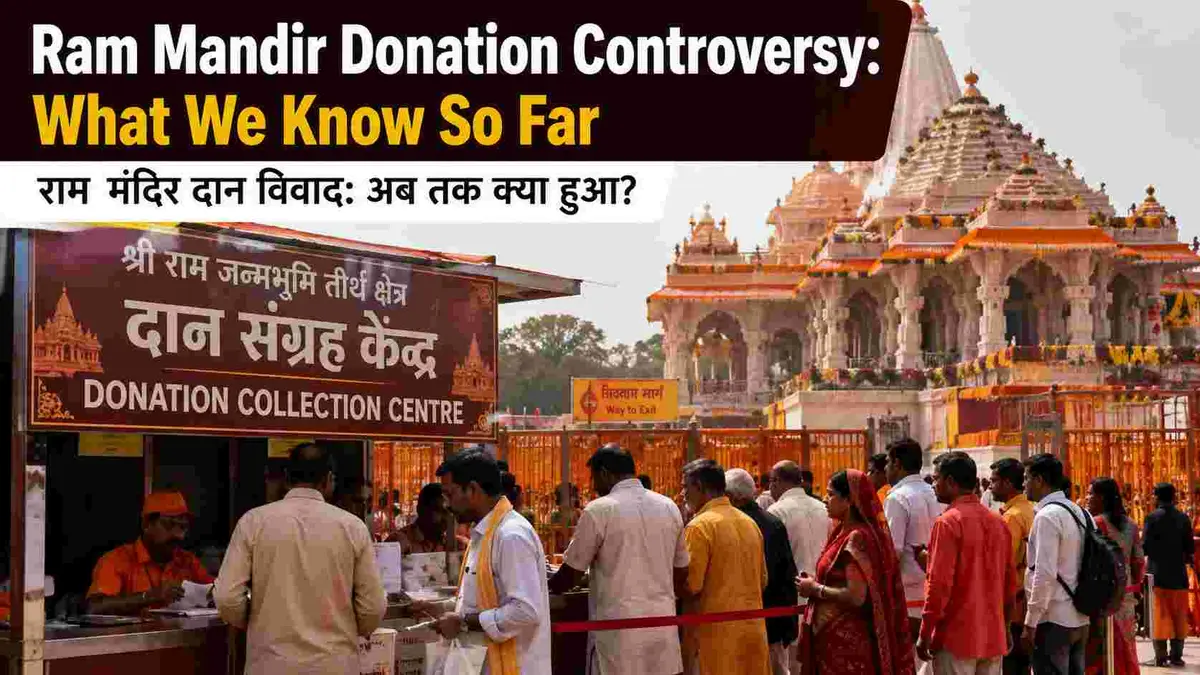

The Ram Mandir Donation Controversy: Why Are Questions Being Raised Now?
A temple donation is usually seen as an act of faith. People contribute quietly, often without expecting anything in return. But when a religious project becomes one of the most discussed public initiatives in the country, questions about transparency, management, and accountability naturally follow.
That is exactly why the recent discussions surrounding Ram Mandir donations have caught so much attention online.
Over the last few weeks, social media posts, videos, and opinion pieces have reignited debate around how donations linked to the Ram Mandir project are collected, managed, and reported. Some claims have gone viral, while others have been challenged by officials and independent observers.
For many ordinary Indians, the situation has become confusing. People want simple answers. What exactly is the controversy? Are the allegations proven? What have authorities said? And why has the issue become a talking point again?
Let's break it down in simple language.
Why Ram Mandir Donations Matter Beyond Religion
The Ram Mandir in Ayodhya is not just a temple project.
For millions of devotees, it represents a deeply emotional and cultural milestone. Many families contributed small amounts during donation drives. Some donated ₹100, others ₹1,000, and some offered much larger sums.
Think of a typical Indian household.
A retired father may contribute part of his pension. A salaried employee may donate after receiving a bonus. A shopkeeper may contribute during a festive season. These contributions carry emotional value, not just financial value.
That is why any discussion about donation management quickly attracts public attention.
People are not merely asking where money went. They are asking whether everything is being handled in a transparent and accountable manner.
What Triggered the Latest Debate?
The latest controversy did not emerge from a single event.
Instead, it grew through a combination of social media discussions, old allegations being reshared, questions regarding land transactions, and debates over financial transparency.
Several posts claimed that there were irregularities involving donation funds or land purchases connected to the temple project. Some critics argued that more detailed public disclosures would help increase confidence.
Supporters, on the other hand, responded by saying that many allegations were either old, politically motivated, or lacked complete evidence.
This created a familiar situation that Indians often see in major public issues.
One side asks for greater transparency.
The other side argues that misinformation is being spread without verified facts.
As a result, the discussion moved beyond religion and entered the broader debate about public accountability.
The Difference Between Allegations and Proven Facts
One of the biggest challenges in any controversy is separating claims from verified information.
In today's digital world, a WhatsApp forward can reach thousands of people within minutes. A viral video can create strong opinions before all facts become available.
This is why it is important to understand a basic principle:
An allegation is not the same as proof.
Several concerns raised around Ram Mandir donations have generated headlines and social media debates. However, not every claim circulating online has been officially established as fact.
Whenever such issues arise, responsible reporting requires looking at:
- Official statements
- Financial disclosures
- Court proceedings, if any
- Independent investigations
- Documentary evidence
Without these elements, conclusions can become premature.
For readers, this distinction is extremely important.
Just because a claim is trending does not automatically make it true.
Why Transparency Matters in Large Donation Projects
Whether it is a temple trust, charity organization, educational institution, or relief fund, transparency plays a critical role.
Imagine investing in a mutual fund.
You would want to know where your money is being invested.
Similarly, when citizens donate to a large public religious project, many naturally expect clear information about fund utilization.
Transparency generally includes:
- Donation reporting
- Audit mechanisms
- Expenditure records
- Governance structures
- Regulatory compliance
The expectation becomes even stronger when donations come from millions of people across the country.
In fact, this discussion is not unique to India.
Around the world, large religious and charitable organizations regularly face questions about financial reporting. Public trust often increases when institutions voluntarily share detailed information.
How Social Media Is Shaping Public Opinion
An interesting aspect of this controversy is the role of social media.
A decade ago, discussions like these would largely remain confined to newspapers and television debates.
Today, a single post can become national news within hours.
The challenge is that social media rewards speed, while truth often requires time.
Many users encounter a screenshot, a short video clip, or a partial document and immediately form an opinion. Later, additional context may emerge, but the first impression often remains.
This phenomenon is not limited to the Ram Mandir issue.
We have seen similar patterns in discussions involving banking reforms, government schemes, stock market rumours, and even gold prices.
The lesson for readers is simple:
Before forwarding or believing any claim, check whether credible evidence exists.
What Have Supporters and Critics Been Saying?
The debate has broadly split into two viewpoints.
Critics argue that:
- Greater disclosure can improve public confidence.
- Questions regarding financial transactions deserve clear answers.
- Transparency strengthens institutions.
Supporters argue that:
- Many claims have been exaggerated online.
- Official mechanisms already exist.
- Religious projects often become targets of political debates.
Interestingly, both sides frequently mention public trust.
The disagreement is mainly about how trust should be demonstrated and maintained.
That is why the conversation continues to attract attention.
What Ordinary Indians Can Learn From This
Beyond the controversy itself, there is a larger lesson.
Whenever money is collected from the public—whether for a temple, NGO, crowdfunding campaign, cooperative society, or welfare initiative—transparency becomes important.
For example:
If someone contributes to a community fund in their local area, they usually expect periodic updates.
If investors put money into a company, they expect financial reports.
If citizens donate to a large cause, they often expect accountability.
These expectations are not signs of distrust.
They are part of modern governance and financial responsibility.
In many ways, India's growing interest in transparency reflects a positive change. People today are more informed, more financially aware, and more willing to ask questions.
The Road Ahead
At this stage, the most important thing is patience and reliance on verified information.
The controversy has generated strong emotions because it involves faith, public participation, and large-scale donations. Such combinations naturally attract scrutiny and debate.
However, responsible discussion requires facts rather than assumptions.
As more information becomes available through official disclosures, reports, and statements, public understanding is likely to become clearer.
Until then, readers should remain cautious about sensational claims and focus on verified developments.
The Ram Mandir remains one of the most significant cultural projects in modern India. The ongoing discussion around donations is ultimately part of a larger conversation about transparency, accountability, and public trust.
And perhaps that is the real story behind the headlines.
| Topic | What We Know |
|---|---|
| Donations | Large contributions received from devotees across India |
| Controversy | Questions raised regarding transparency and financial reporting |
| Social Media Role | Viral posts amplified public discussion |
| Official Position | Various claims have been disputed or clarified by supporters and officials |
| Public Concern | Accountability and trust in fund management |
| Current Status | Debate continues, with focus on verified information |
The Ram Mandir donation controversy revolves around questions regarding transparency, financial reporting, and management of funds linked to the temple project. While various allegations have circulated online, not all claims have been officially proven. The debate highlights the broader importance of accountability and public trust in large donation-driven initiatives.
For more Information -
What’s the multi-crore donation ‘scam’ at Ayodhya’s Ram Mandir being probed by SIT? – Firstpost
Disclaimer: The information provided on Labhgrow.in is for educational purposes only. We are not affiliated with the Income Tax Department, NSDL (Protean), or UTIITSL. Delivery times and tracking processes are subject to government portal functionality. Please never share your PAN details or OTPs with unauthorized third-party websites.

Head of Content & Lead Writer
Senior financial & news writer specializing in Indian government schemes, market rates, and banking policies.
lakshyabhardwaj.hoc@labhgrow.in
Senior Research Analyst (Fact-Checker)
Dedicated researcher and data verifier ensuring 100% authenticity and fact-checking from primary government and financial feeds.
harshitsharma.sra@labhgrow.in