Rajasthan Farmer Schemes 2026: Full Subsidy Guide
Overview
Rajasthan is streamlining agricultural support, moving government services online to eliminate bureaucratic hurdles for farmers. Through the Jan Soochna and RajKisanSathi portals, farmers can now verify eligibility for over 350 schemes and apply for subsidies on equipment, micro-irrigation, and infrastructure from a single platform. These digital tools prioritize transparency, offering tiered subsidy rates that provide higher financial benefits for small, marginal, and SC/ST farmers. By centralizing access to services like sprinkler irrigation and machinery grants, the state’s “Ease of Doing Farming” initiative is making it significantly faster and easier to secure vital financial aid.
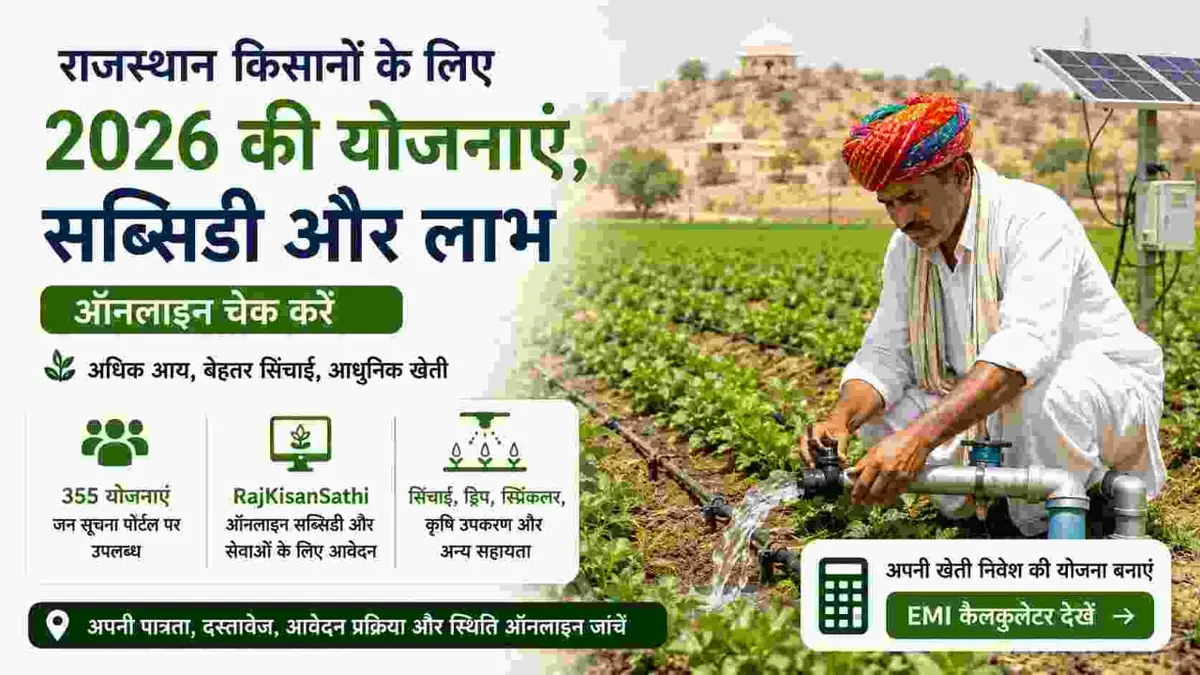

Rajasthan's farmers no longer need to run between government offices to find out which schemes they qualify for. Two portals run by the state government — Jan Soochna and RajKisanSathi — now bring scheme information, eligibility checks and subsidy applications onto a single screen. For a state where irrigation costs and input prices weigh heavily on farm income, knowing which of these benefits apply to your land can make a real financial difference.
Here's a practical look at what's available, who qualifies, and how to actually apply.
What Is the Jan Soochna Portal?
Jan Soochna Portal (jansoochna.rajasthan.gov.in) is the Rajasthan government's public disclosure platform, built to give citizens direct access to scheme and service information without having to file an RTI application. The portal currently lists <cite index="2-1">355 schemes and 755 information services</cite> spanning multiple state departments, including agriculture, horticulture, animal husbandry and rural development.
For farmers, this portal is primarily a discovery and verification tool — it lets you check which schemes exist, review eligibility conditions, and in many cases see beneficiary status without registering for an account or paying any fee.
What Is RajKisanSathi?
RajKisanSathi (rajkisan.rajasthan.gov.in) is the actual application gateway. Built under the state's "Ease of Doing Farming" initiative, it is a single-window platform where farmers can apply online for subsidies and services covering agriculture, horticulture, agricultural marketing, cooperatives, animal husbandry, fisheries, seed corporation, organic certification and agri-processing.
In practice, the two portals work together: use Jan Soochna to check what you're eligible for, then use RajKisanSathi to submit the actual application.
Key Farmer Services Currently Available
- Micro-irrigation support — drip and sprinkler irrigation systems, including the state's Fawara Sanyantra (sprinkler subsidy) component
- Farm equipment and machinery subsidies — tractors, power tillers and other mechanisation support
- Farm ponds, diggi construction and irrigation pipelines under water-conservation schemes
- Horticulture support — polyhouses, shade-net houses and orchard development
- Agri-processing and agri-export subsidies, including capital investment and freight subsidy components
Subsidy Rates: What to Expect
Subsidy percentages on irrigation and farm equipment in Rajasthan are not fixed for every farmer — they vary by category. As a general pattern seen across current state schemes:
- General category farmers typically receive a lower subsidy slab
- Small and marginal farmers, women farmers, and farmers from Scheduled Caste/Scheduled Tribe categories typically receive a higher subsidy slab, often several percentage points above the general rate
For example, under the state's sprinkler-irrigation component, general farmers have been eligible for around 70% of unit cost, while small, marginal, SC/ST and women farmers have been eligible for around <cite index="22-1">75% of the unit cost</cite>. Rates for other equipment and under central schemes like PMKSY's micro-irrigation component can differ. Because these percentages are revised periodically in the state budget, farmers should always confirm the current applicable rate on RajKisanSathi before applying, rather than relying on last year's figures.
Eligibility Basics
While exact conditions vary scheme-by-scheme, most Rajasthan farmer subsidies share common eligibility ground:
- Applicant must be a resident farmer or livestock keeper of Rajasthan
- Land records must be in the applicant's name (or joint holding, depending on the scheme)
- A valid Jan Aadhaar card is mandatory for most applications
- Some schemes cap eligible landholding size — for instance, sprinkler subsidy schemes have specified minimum landholding thresholds
- Category-based benefits (SC/ST, small/marginal, women farmers) require supporting documents to claim the higher subsidy slab
Documents You'll Need
- Aadhaar card
- Jan Aadhaar card
- Land ownership records (Jamabandi/Khasra)
- Bank passbook linked to Aadhaar (for DBT transfer)
- SSO ID (Single Sign-On) for portal login
- Caste certificate, where applicable, for category-based subsidy claims
How to Apply — Step by Step
1. Create or log in to your account at sso.rajasthan.gov.in
2. From the SSO dashboard, open RajKisan Saathi
3. Select the relevant department and scheme (for example, "Micro Irrigation" or "Farm Machinery Subsidy")
4. Fill in the application form with land and bank details
5. Upload the required documents
6. Submit the application — you'll receive SMS updates on your registered mobile number as it moves through approval stages
7. Use Jan Soochna Portal separately to track scheme-wide beneficiary data or verify your application status
Farmers without smartphone access or digital literacy can complete the same process at a nearby e-Mitra kiosk, where an operator assists with the online submission.
Common Application Mistakes to Avoid
- Applying with mismatched Aadhaar and bank account names — even a minor spelling difference can delay DBT credit
- Uploading blurry or incomplete land documents — this is one of the most frequent reasons for rejection
- Missing the category proof for SC/ST or women-farmer subsidy slabs, which results in the application being processed at the lower general rate
- Applying after equipment purchase in schemes that require pre-approval — always check whether a scheme needs approval before or after purchase
- Ignoring SMS/portal status updates, which often flag document corrections needed before final approval
Practical Impact for Farmers
For a farmer planning to install drip or sprinkler irrigation, the subsidy can cover a large share of the upfront cost — but the remaining amount, along with related expenses like land levelling or a water source, often still needs financing. Many farmers use a bank loan or Kisan Credit Card facility to bridge this gap. Before taking on that additional cost, it's worth working out the monthly repayment using an <cite index="0-0">EMI Calculator</cite> so the loan portion fits comfortably alongside the subsidised equipment cost — LabhGrow's EMI Calculator can help with that estimate before you commit to a loan amount.
Key Takeaways
- Jan Soochna Portal is for checking scheme details and eligibility; RajKisanSathi is for applying
- Subsidy rates differ by farmer category — small, marginal, SC/ST and women farmers generally get a higher slab
- Jan Aadhaar, land records and a linked bank account are the core documents needed across most schemes
- Both portals require no registration fee, and e-Mitra kiosks are available for offline assistance
- Always verify current subsidy percentages on the official portal before applying, since rates are revised periodically
Conclusion
Rajasthan's push to digitise farmer welfare through Jan Soochna and RajKisanSathi has made scheme information far more accessible than it was even a few years ago. The bigger opportunity for farmers now lies in using both portals together — checking eligibility on one, applying on the other — and keeping documents like Jan Aadhaar and land records ready in advance. Doing this correctly, and avoiding the common mistakes that cause rejections, is often what separates a smooth subsidy approval from months of delay.
> Disclaimer: The content provided on LabhGrow is for educational and informational purposes only. We are not a SEBI-registered investment advisor. Please consult a qualified financial advisor before making any investment or financial decisions. LabhGrow is not responsible for any loss or damage arising from the use of this information.

Head of Content & Lead Writer
Senior financial & news writer specializing in Indian government schemes, market rates, and banking policies.
lakshyabhardwaj.hoc@labhgrow.in
Senior Research Analyst (Fact-Checker)
Dedicated researcher and data verifier ensuring 100% authenticity and fact-checking from primary government and financial feeds.
harshitsharma.sra@labhgrow.in