New Railway Fines 2026: Essential Guide for Every Traveler
Overview
Indian Railways has doubled the minimum fine for ticketless travel to ₹500 and raised cleanliness penalties to ₹1,000 under the 2026 Jan Vishwas Act. These strict, uniform mandates apply across all zones to streamline enforcement. Passengers are urged to carry valid tickets and follow station hygiene rules to avoid heavy on-the-spot charges or potential legal proceedings.
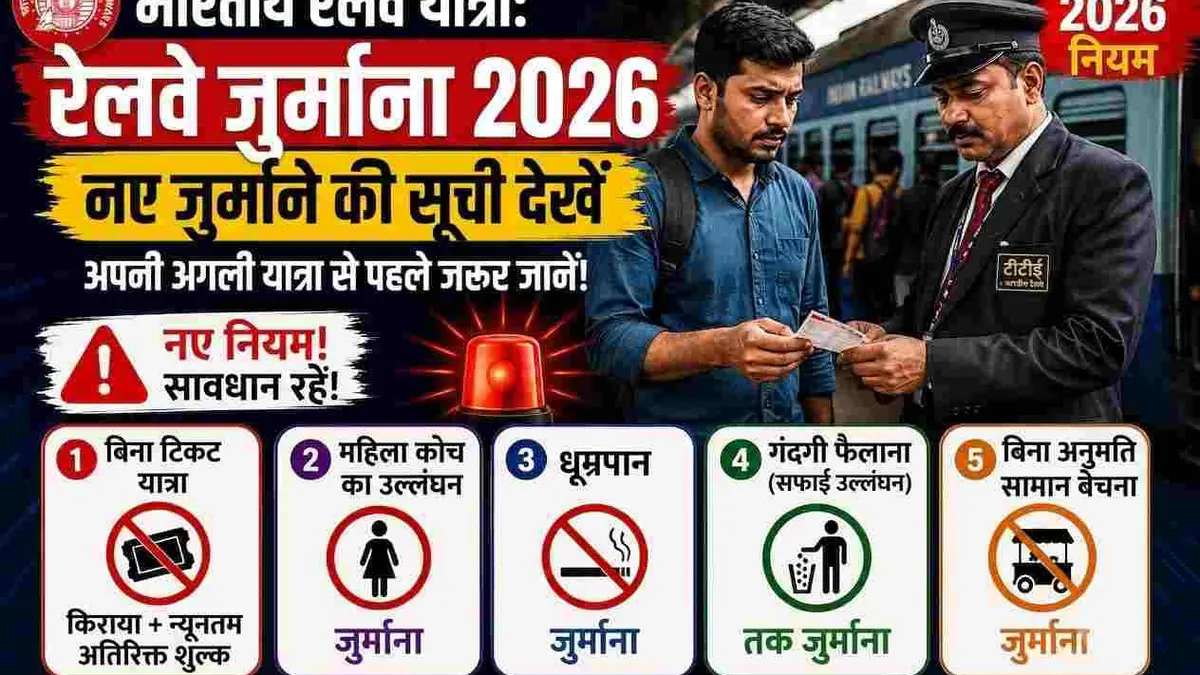

If you travel by train regularly, this is one update you cannot afford to miss. Indian Railways has revised its penalty structure twice this year, and the changes directly hit the wallet of ordinary passengers. Under the Jan Vishwas (Amendment of Provisions) Act, 2026, several fines under the Railways Act, 1989 have gone up sharply, and a separate notification in August 2026 pushed cleanliness penalties higher as well.
Together, these Railway Fines 2026 changes cover everything from ticketless travel and reserved ladies coaches to smoking, hawking, and littering. Here is what has actually changed, who it affects, and what you should do if you are caught on the wrong side of the rules.
What Is the Jan Vishwas Act Railway Update About?
The Jan Vishwas (Amendment of Provisions) Act, 2026 came into effect on June 19, 2026, and it revised Sections 137 and 138 of the Railways Act, 1989. The stated aim is to allow railway staff to settle more offences through on-the-spot penalties instead of pushing every case into lengthy court proceedings.
As part of the amendment, the minimum penalty for ticketless and irregular travel was doubled from ₹250 to ₹500. Officials at the Railway Board have said the enforcement of these updated rules applies uniformly across all zones, including suburban, mail, express, and passenger services.
Separately, the Ministry of Railways issued a Gazette notification on August 24, 2026, under the Indian Railways (Penalties for Activities Affecting Cleanliness at Railway Premises) Amendment Rules, 2026. This raised the maximum cleanliness-related penalty from ₹500 to ₹1,000. Passengers can check official updates and notifications directly on the Indian Railways website.
Railway Fines 2026: Full List of Revised Penalties
Here is a quick look at the major violations and their updated penalty amounts under the Railway Fines 2026 structure.
| Violation | Revised Penalty (2026) |
|---|---|
| Ticketless / irregular travel | Fare + minimum ₹500 excess charge |
| Travelling in ladies-reserved coach (men) | ₹2,500 |
| Smoking on railway premises | ₹2,000 |
| Unauthorised hawking (first offence) | ₹2,000 |
| Unauthorised hawking (repeat offence) | ₹5,000 |
| Carrying dangerous or prohibited goods | Minimum ₹10,000 |
| Littering, spitting, or cleanliness violation | Up to ₹1,000 |
| Non-payment of cleanliness fine (court referral) | Up to ₹2,000 |
Quick Alert: The maximum penalty under Section 137 for fraudulent travel can still go up to ₹1,000 with imprisonment of up to six months in serious cases, even though the routine minimum fine is now ₹500. Always carry a valid ticket to avoid this altogether.
What Counts as a Cleanliness Violation Now?
The August 2026 amendment widened what railway staff can penalise under cleanliness rules. It is not limited to throwing garbage on the platform or inside a coach. The rules also cover:
- Spitting, urinating, or defecating outside designated facilities
- Cooking or bathing in unauthorised areas
- Washing clothes, utensils, or vehicles at railway premises
- Feeding animals or birds on railway property
- Storing goods or luggage in unauthorised spaces
- Pasting posters or writing and drawing on coaches or station property without permission
If a passenger refuses to pay the ₹1,000 fine on the spot, the matter can be taken to a court with jurisdiction, where the fine can go up to ₹2,000.
Step-by-Step Guide: What to Do If You Are Fined on a Train
1. Stay calm and ask for identification Request the Travelling Ticket Examiner (TTE) or Railway Protection Force (RPF) official to show identification before discussing the violation.
2. Understand the exact charge Ask which section of the Railways Act, 1989 is being applied and what the exact penalty amount is, so there is no confusion later.
3. Pay the on-the-spot fine where possible Most penalties under the revised Railway Fines 2026 rules, including ticketless travel and cleanliness violations, can be settled immediately with a receipt.
4. Collect your receipt Always insist on an official receipt for any payment made. This protects you if the same issue is raised again during the journey.
5. Know your escalation option If you believe the fine was wrongly imposed, you can raise a complaint later through the official Indian Railways grievance portal, Rail Madad, rather than arguing on the spot.
Why Are These Rules Being Tightened?
Indian Railways carries millions of passengers daily, and ticketless travel alone has historically cost the network hundreds of crores in lost revenue every year. Officials linked to the Jan Vishwas Act changes say the higher penalties are meant to act as a stronger deterrent while also simplifying enforcement, since more cases can now be closed on the spot rather than through prosecution.
The cleanliness penalty hike fits into the broader push around station modernisation under schemes like Amrit Bharat, where cleaner stations and coaches are treated as a core passenger amenity, not an afterthought.
Impact on Passengers
For the average commuter who travels with a valid ticket and follows basic rules, none of this changes daily life. But for passengers who occasionally skip buying a ticket, board the wrong coach, or are careless about littering, the cost of getting caught has gone up noticeably in 2026.
Before your next journey, it helps to plan your ticket and route in advance. You can use LabhGrow's Travel Cost Calculator to estimate fare and excess charges ahead of time, so there are no surprises at the ticket counter or with the TTE.
Conclusion
The Railway Fines 2026 changes bring two separate updates together: higher penalties under the Jan Vishwas Act for offences like ticketless travel, ladies coach misuse, smoking, and hawking, and a doubled cleanliness fine from the August 2026 Gazette notification. None of these rules are difficult to avoid. Carrying a valid ticket, travelling in the correct coach, and keeping stations and trains clean is all it takes to stay on the right side of the law.
For More Information -
https://www.railrestro.com/blog/indian-railways-penalty-rules-guide-passengers
The Market News and News section of LabhGrow (labhgrow.in) covers general updates related to the economy, companies, government policies, and financial markets, compiled from publicly available sources for informational purposes only. This content does not constitute financial, investment, trading, or business advice of any kind, nor should it be interpreted as a recommendation to buy, sell, hold, or avoid any stock, fund, scheme, commodity, or financial instrument. LabhGrow is not a SEBI-registered research analyst, investment advisor, or financial institution, and does not guarantee the accuracy, completeness, or timeliness of the news or data presented. Market conditions are subject to constant and rapid change, and past updates or trends do not guarantee future outcomes. Readers are strongly advised to cross-verify information through official or regulatory sources and consult a qualified, registered financial advisor before making any financial or investment decision based on news covered here. LabhGrow and its team accept no liability for any loss or damage resulting from the use of this information.

Head of Content & Lead Writer
Senior financial & news writer specializing in Indian government schemes, market rates, and banking policies.
lakshyabhardwaj.hoc@labhgrow.in
Senior Research Analyst (Fact-Checker)
Dedicated researcher and data verifier ensuring 100% authenticity and fact-checking from primary government and financial feeds.
harshitsharma.sra@labhgrow.in