E20 Petrol Costs More to Produce Than Crude Oil: Govt Data
Overview
Think E20 petrol is cheaper? Think again. Government data reveals that ethanol procurement for the E20 mandate cost oil companies ₹70.27 per litre—nearly ₹25 more than the ₹45.31 cost of crude oil. While the price gap is significant, officials clarify that ethanol blending is a strategic policy to slash import dependency, not a retail price-cutting tool. Ethanol remains costlier at current crude prices, only becoming economical if oil hits $120–$130 per barrel. Despite higher input costs, India is doubling down on E20 to secure long-term energy independence over immediate market savings.
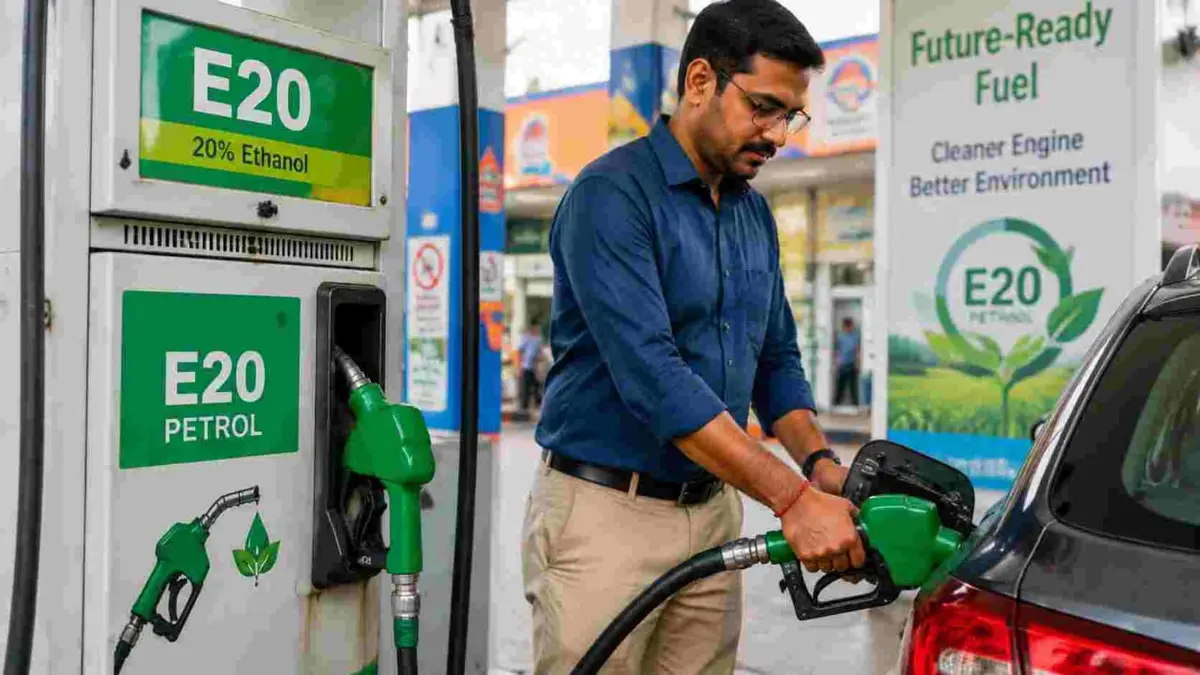

If you've been filling up on E20 petrol assuming the ethanol blend is the cheaper option, government figures tell a different story.
Data shared by the Ministry of Petroleum and Natural Gas shows that oil marketing companies procured ethanol for the E20 programme at an average price of about ₹70.27 per litre between April 2025 and June 2026. In that same period, the estimated procurement cost of crude oil used for producing petrol worked out to roughly ₹45.31 per litre. That's a gap of nearly ₹25 per litre at the raw input stage — before any refining, blending, transport, or taxes come into the picture.
The scale of the numbers is what has caught attention. Oil marketing companies bought around 705.43 crore litres of ethanol during this period, at a total cost that crossed ₹49,000 crore. That volume reflects just how central ethanol has become to India's fuel mix, now that E20 — petrol blended with 20% ethanol — is the standard fuel sold at pumps across most of the country.
Why Ethanol Costs More Right Now
The core reason comes down to how the two inputs are priced. Crude oil is bought on the international market, where prices move daily based on global demand, geopolitical developments, and supply disruptions. Ethanol, on the other hand, is procured domestically at a fixed, government-set rate designed to guarantee remunerative returns to sugarcane and grain farmers who supply the feedstock.
That fixed pricing is a deliberate policy choice, not a market outcome. The ministry has been direct about the current math: at international crude oil prices of around $70 a barrel, producing E20 works out costlier than producing pure petrol. Maize-based ethanol alone is procured at close to ₹71.86 per litre before GST, transportation, and handling charges are even added.
The government has also pointed out when the equation would flip. If crude oil climbs to somewhere in the $120–130 per barrel range, ethanol would become the cheaper input by comparison. At today's crude prices, that trigger point hasn't been reached.
This Isn't About Retail Petrol Prices
It's worth being clear about what this comparison does and doesn't tell you. These are procurement costs — what oil companies pay to acquire the raw ethanol and crude — not the price you pay at the pump. Retail fuel prices are shaped separately by refining costs, blending costs, marketing margins, and a heavy layer of central and state taxes that apply uniformly regardless of the blend.
So while the input-cost gap is real, it doesn't automatically mean E20 petrol costs you more at the pump than pure petrol would, since pure petrol without any ethanol blend isn't widely sold in the retail market to compare against directly.
Why the Government Is Sticking With Ethanol Blending
Officials have maintained that the ethanol blending programme was never designed purely to cut petrol prices. Its stated goals are broader: reducing India's dependence on imported crude oil, insulating the country from global price shocks, supporting farm incomes, and cutting vehicle emissions.
Average ethanol blending touched 20% between November 2025 and June 2026, up from 19.2% in the previous supply year, according to the ministry's release — meaning India hit its 20% blending target roughly on schedule. For now, the government has said there's no proposal to push blending levels beyond 20% until further scientific and stakeholder review is completed.
What This Means for Flex-Fuel and Regular Vehicle Owners
For everyday vehicle owners, the immediate impact isn't a change in what you pay at the pump — it's a clearer picture of the trade-offs behind the fuel you're already using.
- E20 is now the default petrol at most outlets, so most owners aren't choosing between E10, E20, and pure petrol at the pump.
- Ethanol has slightly lower energy content than pure petrol, which is why some vehicles report marginally lower mileage on E20 — a separate issue from the procurement-cost debate.
- Flex-fuel vehicles, built to run efficiently on higher ethanol blends, are better positioned to make the most of the ethanol supply chain as it scales up.
- The procurement cost gap doesn't change your fuel bill directly, but it does explain why calls for E20-linked tax relief have been raised by policy bodies, including in a NITI Aayog report that recommended tax incentives to offset any mileage loss for consumers.
If you want to work out how blend ratios and mileage differences affect your actual monthly fuel spend, LabhGrow's Fuel Cost Calculator can help you run the numbers based on your vehicle and driving pattern.
Conclusion
The ₹70.27 versus ₹45.31 per litre gap is a real and verified figure, but it describes procurement economics, not what you pay at the pump. Ethanol's fixed pricing protects farmers and reduces India's exposure to volatile global crude markets — a trade-off the government has been upfront about, even while acknowledging it currently makes ethanol the costlier input. Where fuel policy goes next will likely depend on whether crude prices stay range-bound or climb toward the level at which ethanol starts paying for itself.
For More Information -
E20 Petrol Prices: Why It's Not Cheaper Than Pure Petrol Explained by Government, ETEnergyworld
Disclaimer: The information provided on Labhgrow.in is for educational purposes only. We are not affiliated with the Income Tax Department, NSDL (Protean), or UTIITSL. Delivery times and tracking processes are subject to government portal functionality. Please never share your PAN details or OTPs with unauthorized third-party websites.
Pandit Ji

Head of Content & Lead Writer
Senior financial & news writer specializing in Indian government schemes, market rates, and banking policies.
lakshyabhardwaj.hoc@labhgrow.in
Senior Research Analyst (Fact-Checker)
Dedicated researcher and data verifier ensuring 100% authenticity and fact-checking from primary government and financial feeds.
harshitsharma.sra@labhgrow.in