August 2026: Key Rule Changes for Indian Households
Overview
August brings a wave of regulatory and financial shifts starting today. Key updates include the launch of CKYC 2.0, streamlining customer verification for banks and insurers, and tightened GST e-invoicing compliance for businesses, requiring mandatory Ship-to GSTIN details. Meanwhile, households and small businesses should check local LPG cylinder rates, which remain subject to monthly price revisions based on global trends. Additionally, railway passengers should look out for a new token-based update for Tatkal bookings. Stay updated on these changes to ensure your personal finances and business operations remain compliant and cost-effective throughout the month.
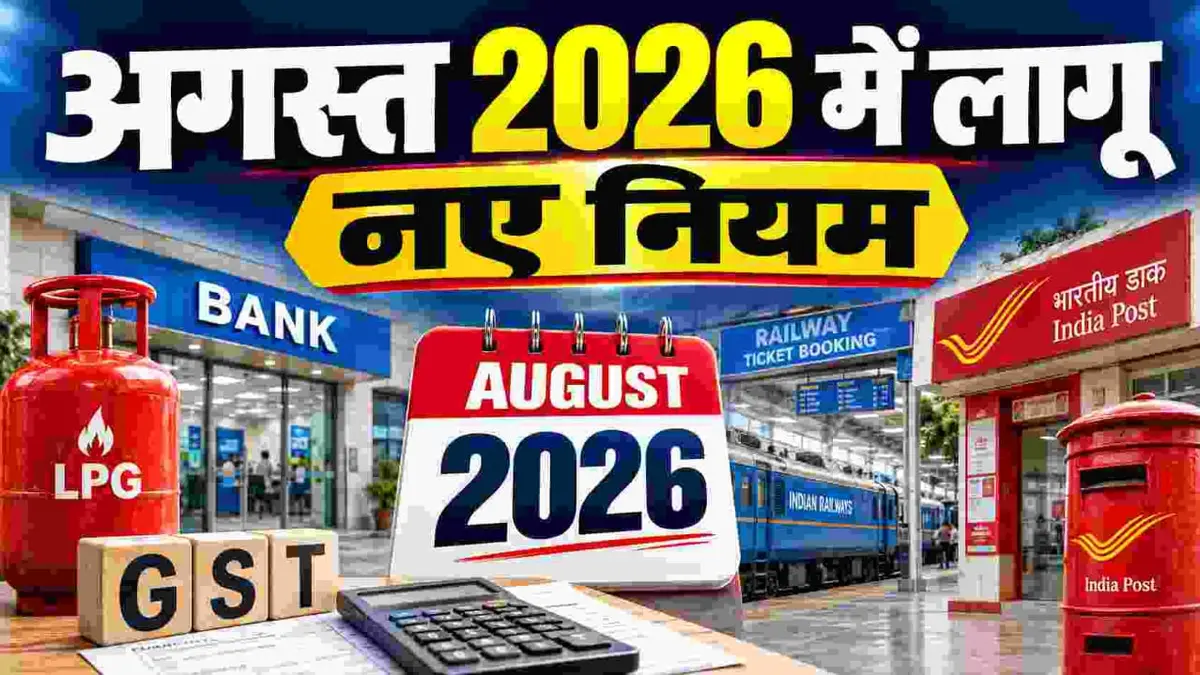

August is opening with a fresh set of rule changes that will touch bank customers, taxpayers, LPG consumers, railway passengers and small businesses across the country. From a new customer verification system in banking to fresh GST compliance requirements for e-invoicing, several of these changes are officially notified and take effect from August 1, 2026.
Here is a state-of-play look at what is changing, who it affects, and what action, if any, you may need to take.
LPG cylinder prices revised for August -
As happens on the first of every month, oil marketing companies such as Indian Oil, HPCL and BPCL have reviewed domestic and commercial LPG cylinder rates for August. Through July, the 14.2 kg domestic cylinder held steady in most cities — priced at roughly ₹942 in Delhi and similar levels in Mumbai, Kolkata and Chennai — while the 19 kg commercial cylinder saw a sharp cut of over ₹170 per cylinder across major metros. Since India imports a large share of its LPG requirement, rates continue to move with international crude prices and currency fluctuations. Households and small businesses using commercial cylinders — restaurants, caterers and hotels among them — should check the revised rate in their city before their next booking, as prices can vary meaningfully by state due to local taxes and delivery charges.
CKYC 2.0 begins for banks and insurers -
One of the more significant changes this month is the phased rollout of Central KYC 2.0, an upgraded version of India's central KYC registry. Under the new system, customers completing a one-time detailed KYC will be issued a unique 14-digit CKYC number, which banks and insurance companies can then access with the customer's consent — removing the need to resubmit identity and address proof at every institution. The initiative is being driven jointly by the RBI, SEBI and IRDAI, with banks and insurers onboarding first and mutual funds and brokerages expected to join later in the year. For everyday customers, this should eventually mean faster account opening, insurance purchases and investment onboarding, though the regulators have not issued a joint public confirmation of the exact rollout date, so timelines may vary by institution.
GST: e-invoicing and e-way bill changes for businesses
For GST-registered businesses, the GST Network's revised e-invoice and e-way bill rules take effect from August 1. Ship-to GSTIN details are now mandatory wherever applicable during e-way bill generation linked to an Invoice Reference Number, along with tighter validation checks and a new voluntary e-way bill closure facility. Businesses dealing in bill-to-ship-to transactions will need updated ERP and billing systems to stay compliant, since e-way bills will not generate without the required Ship-to GSTIN field. Businesses working out tax and invoice values under the new structure can use LabhGrow's GST Calculator to quickly estimate applicable GST before filing.
Railway Tatkal booking gets a token system update
Indian Railways is adjusting how Tatkal booking tokens are distributed at reservation counters, aligning token issuance more closely with the actual opening time of Tatkal bookings. The change is meant to reduce the need for passengers to queue up and collect tokens well ahead of booking hours. This sits alongside the Aadhaar-based OTP verification for Tatkal bookings that has been in force since mid-2025, which remains mandatory across online bookings, PRS counters and authorised agents.
Speed Post tariffs and rules revised
India Post has also updated its Speed Post pricing structure ahead of the festive season. For the first time, the department has formally distinguished between "documents" and "parcels" for tariff purposes, with new bulk-booking rates introduced for the documents category. Individual retail customers will continue paying existing rates, but businesses and bulk senders should check the revised slabs, which vary by weight and distance.
ITR deadline and late fees
Separately, July 31, 2026 was the last date to file income tax returns without a late fee for many categories of taxpayers. Those who missed this deadline may now face late fees and interest charges when filing in August, along with possible procedural complications, so it is worth completing pending filings at the earliest.
Conclusion
Taken together, August 2026's changes span everyday essentials — from what a gas cylinder costs to how quickly a bank account can be opened — and compliance-heavy shifts for businesses handling GST invoicing. None of these require panic, but a quick check of your bank's KYC process, your business's e-way bill workflow, and your city's LPG rate can help you avoid last-minute surprises.
For More Information -
> Disclaimer: The content provided on LabhGrow is for educational and informational purposes only. We are not a SEBI-registered investment advisor. Please consult a qualified financial advisor before making any investment or financial decisions. LabhGrow is not responsible for any loss or damage arising from the use of this information.

Head of Content & Lead Writer
Senior financial & news writer specializing in Indian government schemes, market rates, and banking policies.
lakshyabhardwaj.hoc@labhgrow.in
Senior Research Analyst (Fact-Checker)
Dedicated researcher and data verifier ensuring 100% authenticity and fact-checking from primary government and financial feeds.
harshitsharma.sra@labhgrow.in