Telangana Farmers: Check Irrigation Subsidy Benefits
Overview
Telangana farmers can get up to 100% subsidy on drip and sprinkler systems under TGMIP. Check eligibility, documents and MeeSeva application steps.
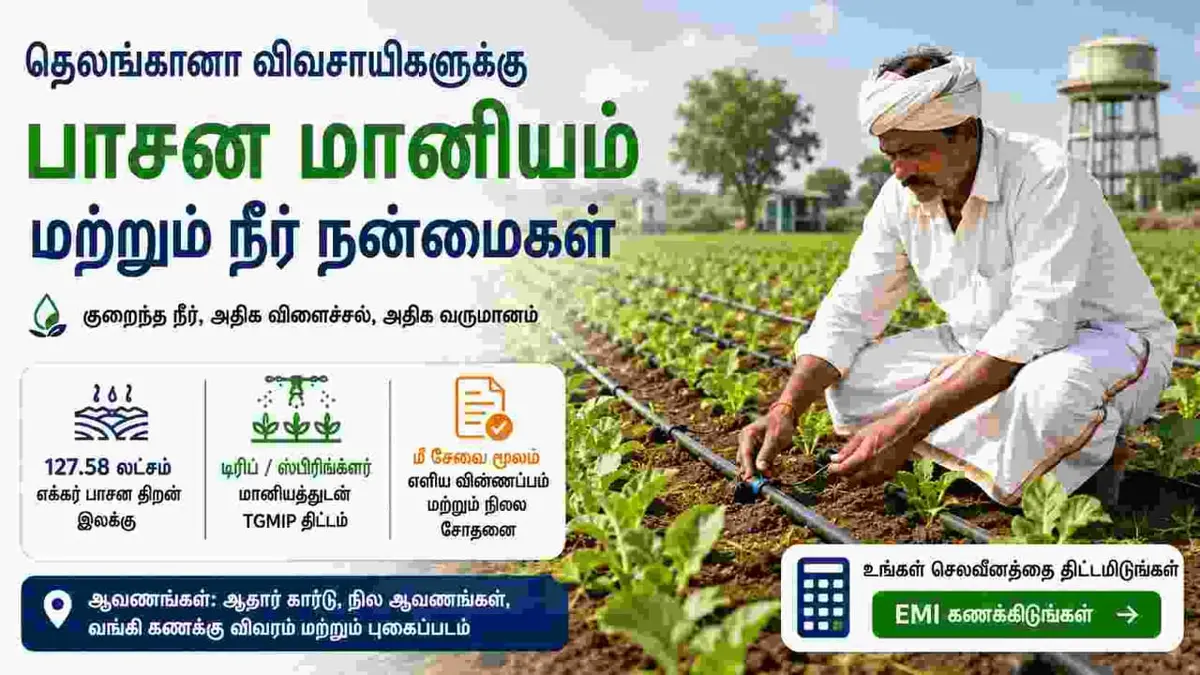

Water has always decided the fate of Telangana's farmers. Large parts of the state depend on borewells and erratic rainfall, which is why the government's irrigation push, running alongside major reservoir projects, has become central to farm planning across districts. Alongside big infrastructure like canals and lift schemes, the state runs a dedicated micro-irrigation programme that puts money directly into a farmer's hands to install drip and sprinkler systems on their own land.
For farmers trying to make sense of what's on offer, here is a clear look at the irrigation support available, who qualifies, and how to apply.
The Bigger Picture: Telangana's Irrigation Push
The state's irrigation department works with an ambitious target of creating irrigation potential across 127.58 lakh acres, alongside providing drinking water in drought-prone and upland areas and improving water use efficiency on existing projects. This target is pursued through a mix of major projects, medium irrigation schemes, and minor irrigation tanks spread across the state.
Big infrastructure projects like Kaleshwaram feed water into canals and reservoirs, but getting that water efficiently onto individual fields is a separate challenge. That's where the Telangana Micro Irrigation Project, commonly known as TGMIP, comes in.
What Is TGMIP and Who Runs It
TGMIP is a comprehensive irrigation project currently being implemented across 32 districts of Telangana. Since the 2023-24 financial year, the micro-irrigation programme has been run under the Rashtriya Krishi Vikas Yojana (RKVY) - Per Drop More Crop initiative, which is the central scheme promoting water-efficient farming nationwide. The programme is administered by the state's Horticulture Department.
The core idea is simple: instead of flood irrigation that wastes water, farmers install drip lines or sprinklers that deliver water directly to the root zone, and the government subsidises a large share of the cost.
Who Is Eligible
All category farmers in a revenue village, irrespective of their economic status, are eligible for drip or micro-irrigation systems, up to 12.50 acres or the actual land holding shown in their title deed, whichever is lower. For portable sprinklers, all category farmers are eligible, with the benefit limited to a 2.50-acre unit.
There is no requirement to belong to a specific caste category to apply, though the subsidy percentage does vary based on social category, as outlined below.
Subsidy Rates: How Much Support Farmers Get
This is the part most farmers want clarity on. Under TGMIP, the subsidy pattern for drip irrigation systems works as follows:
| Farmer Category | Drip Irrigation Subsidy |
|---|---|
| SC/ST farmers | 100% subsidy |
| BC farmers | 90% subsidy |
| Small/Marginal farmers (other than SC/ST) | 90% subsidy |
| All other category farmers | 80% subsidy |
For portable sprinklers, all category farmers are eligible for a 75% subsidy, limited to a 2.50-acre unit.
The actual subsidy amount in rupees depends on the crop spacing, pipe specification, and system type selected. For instance, government cost sheets show that for a standard drip layout, the unit cost and corresponding subsidy amounts are fixed per hectare, and vary based on whether the farmer chooses 12mm or 16mm pipe and the exact spacing pattern for their crop.
Choosing a Vendor: The 28 Empanelled Companies
Farmers don't need to search for equipment on their own. 28 micro-irrigation companies have been empanelled under the Telangana State Micro Irrigation Project, and selection of the company is left to the farmer's choice. This is meant to introduce some competition on quality and after-sales service, since the equipment carries a multi-year usage requirement once subsidised.
Documents and Registration Process
Applying for the subsidy does not require visiting a government office repeatedly. Farmers can register their application using biometric verification and their Aadhaar card, either through a Mee-Seva centre or directly through the official website with Aadhaar-linked OTP verification.
Broadly, farmers should keep the following ready before applying:
- Aadhaar card (linked to mobile number for OTP verification)
- Land title deed / Pattadar Passbook showing the extent of land holding
- Bank account details for subsidy transfer
- Caste certificate, where applicable, to claim the relevant subsidy slab
Once registered, farmers receive five SMS alerts to track the status of their application. This system also involves technical verification of the farm location. Geo-coordinates are captured for every beneficiary's field, and geo-fencing is used to avoid duplicate claims and to make monitoring easier. Separately, every micro-irrigation system installed with government subsidy is geo-tagged through the Bhuvan app, which allows monitoring at the central government level as well.
Farmers should also be aware that the subsidised system comes with a usage commitment; those availing the benefit are generally required to declare that they will maintain the system for a set number of years and will not misuse or resell the subsidised equipment.
District-Wise Availability
Because TGMIP is active in 32 districts, the exact target allocation and processing timelines can vary from one district to another depending on demand and the annual budget released under RKVY. Farmers are advised to check with their local Horticulture Department office or Mandal Agriculture Officer for district-specific targets and current-year allocation status before applying, since these figures are revised periodically.
The Real Impact on the Ground
Historical data from the department shows the scale of what this programme has achieved. Government figures reported in earlier years show that in the years following the launch of the micro-irrigation push, drip systems were installed across roughly 5.42 lakh acres and sprinklers across 2.36 lakh acres, with tens of thousands of SC and ST farmers among the beneficiaries. This reflects a programme that has, over time, reached a meaningful share of small and marginal farmers rather than only large landholders.
For an individual farmer, the practical benefit is straightforward: lower water usage, reduced electricity costs for pumping, and often better yields because water and fertigation reach the crop more precisely. For water-stressed districts, this can be the difference between a viable crop cycle and a failed one.
A Quick Note on Loans and Farm Investment
Even with a subsidy covering a large share of the system cost, farmers often need to arrange the remaining amount, along with other input costs for the season. If you're planning your budget around a drip or sprinkler installation, it helps to work out your repayment capacity in advance using a tool like LabhGrow's EMI Calculator before taking on any farm equipment loan.
Conclusion
Telangana's micro-irrigation subsidy under TGMIP remains one of the more accessible support schemes for farmers, with subsidy rates ranging from 75% to a full 100% depending on category and system type. The application process runs largely through MeeSeva and Aadhaar verification, keeping paperwork relatively light. Farmers considering an application should confirm current-year district targets with their local Horticulture office, since allocations are reviewed annually.
> Disclaimer: The content provided on LabhGrow is for educational and informational purposes only. We are not a SEBI-registered investment advisor. Please consult a qualified financial advisor before making any investment or financial decisions. LabhGrow is not responsible for any loss or damage arising from the use of this information.

Head of Content & Lead Writer
Senior financial & news writer specializing in Indian government schemes, market rates, and banking policies.
lakshyabhardwaj.hoc@labhgrow.in
Senior Research Analyst (Fact-Checker)
Dedicated researcher and data verifier ensuring 100% authenticity and fact-checking from primary government and financial feeds.
harshitsharma.sra@labhgrow.in