PMFBY 2026: Premium, Claim Process & Eligibility Guide
Overview
PMFBY protects farmers from crop losses at just 2% premium. Know eligibility, claim process, documents needed and common reasons claims get rejected.
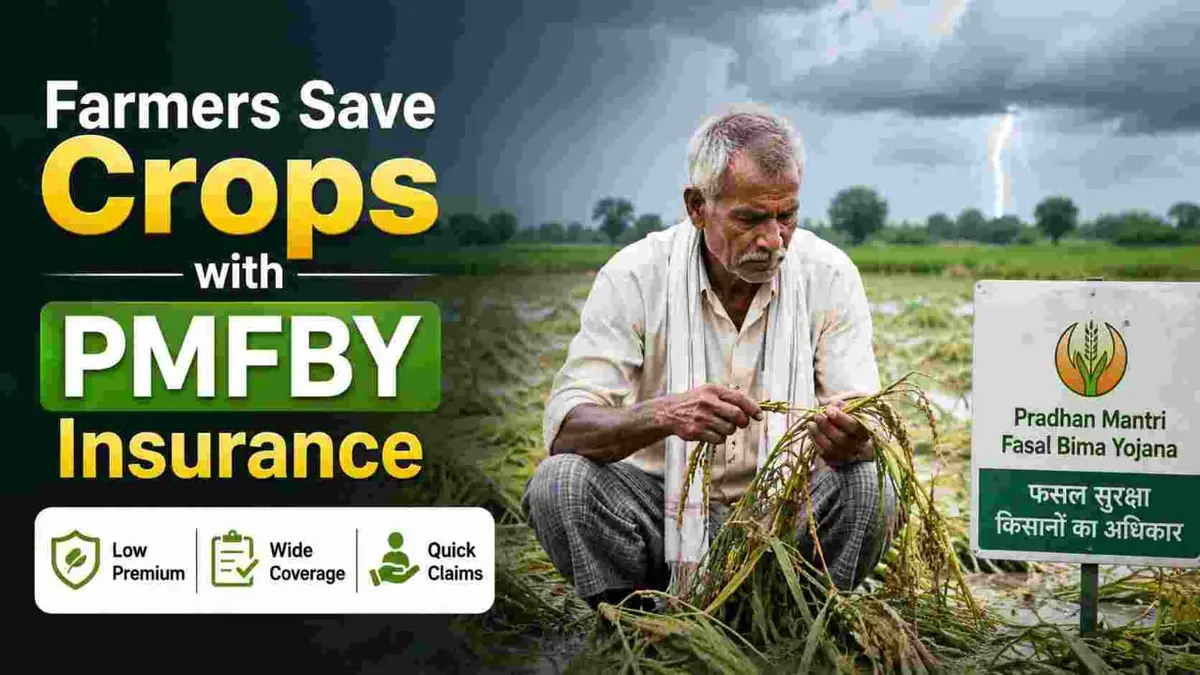

When hailstorms flatten a standing wheat crop or unseasonal rain floods a paddy field just before harvest, the financial blow can wipe out months of a farmer's investment in a single night. This is exactly the gap the Pradhan Mantri Fasal Bima Yojana (PMFBY) was designed to fill, and nearly a decade after its launch, the scheme continues to be one of the largest safety nets for Indian farmers against crop damage.
PMFBY is a central government crop insurance scheme that covers losses from natural calamities, pest attacks and disease, while asking farmers to pay only a small share of the actual premium. The rest is split between the Centre and the respective state government. The scheme is active across participating states for both the Kharif and Rabi crop seasons, and it remains one of the most widely used tools for managing agricultural risk in India.
How Much Premium Do Farmers Actually Pay
One of the biggest reasons PMFBY has stayed relevant is its low premium structure. Farmers pay a fixed, uniform rate regardless of the actual risk profile of their crop or region:
- Kharif crops (paddy, maize, cotton, soybean, groundnut and similar): 2% of the sum insured
- Rabi crops (wheat, mustard, gram and similar): 1.5% of the sum insured
- Annual commercial and horticultural crops: 5% of the sum insured
The remaining actuarial premium, which can otherwise run much higher, is shared between the central and state governments. This is what keeps the scheme affordable even for small and marginal farmers who may be growing crops on just one or two hectares.
Who Can Apply Under PMFBY
Eligibility under PMFBY is fairly broad, covering both farmers with loans and those without:
- Farmers growing notified crops in notified areas are eligible.
- Loanee farmers who have taken crop loans through banks are enrolled automatically by their lending institution.
- Non-loanee farmers can apply voluntarily through the PMFBY portal or their nearest Common Service Centre (CSC).
- Both owner-cultivators and tenant farmers or sharecroppers can apply, subject to the respective state's documentation norms.
Since 2020, enrolment under PMFBY has been made voluntary for all categories of farmers, including those with crop loans, giving them the choice to opt in or out based on their own risk assessment.
Documents Required for Enrolment
Farmers applying on their own, particularly non-loanee farmers, typically need to keep the following ready:
- Aadhaar card
- Land ownership or tenancy records (khasra/khatauni or equivalent land documents)
- Bank account passbook with IFSC details, since claim amounts are credited directly to the linked account
- Sowing declaration or proof of the crop sown
- Passport-size photograph, in some states
Loanee farmers usually do not need to submit these separately, as their bank handles the enrolment using existing loan account records.
State-Wise Premium and Coverage Variation
While the premium percentage paid by farmers stays uniform nationally, the sum insured, notified crops and cut-off dates vary from state to state. Each state government, in coordination with the district-level technical committee, notifies which crops are covered in which areas for a given season, and the scale of finance that determines the insured amount. This means the exact benefit a farmer receives can differ depending on their state and district, even though the premium slab remains the same.
Farmers are advised to check their respective state agriculture department's notification or the PMFBY portal to confirm which crops and areas are covered for the season they wish to insure.
How the Claim Process Works
Reporting crop loss quickly is one of the most important parts of the scheme, particularly for localised damage.
1. Report within 72 hours: For localised calamities such as hailstorm, landslide or flooding of a specific field, farmers must report the loss within 72 hours of the event.
2. Use the Crop Insurance App or helpline: The loss can be reported through the official mobile app or by contacting the insurance company or helpline number mentioned on the policy document.
3. Inform local revenue officials: Farmers are also advised to inform the local Patwari or equivalent revenue official in writing, which helps in official assessment.
4. Assessment and verification: An agricultural inspector or the insurance company's surveyor visits the affected field to assess the extent of damage.
5. Claim settlement: Once the loss is verified against scheme guidelines, the claim amount is credited directly to the farmer's Aadhaar-linked bank account.
For widespread calamities affecting an entire notified area, assessment is typically done through Crop Cutting Experiments (CCE) conducted by the state agriculture department, rather than individual field visits.
Common Reasons Claims Get Rejected
A number of farmers who are otherwise eligible still face claim rejection, usually due to avoidable issues rather than the scheme's terms themselves:
- Delayed reporting: Missing the 72-hour window for localised losses is one of the most common reasons for rejection.
- Crop not notified for that area: If the specific crop grown is not on the notified list for that district or season, the claim cannot be processed.
- Mismatch in land records: Differences between the land area declared during enrolment and actual records can cause disputes.
- Incomplete documentation: Missing bank details, incorrect Aadhaar linkage, or absent sowing certificates can delay or block settlement.
- Loss due to non-notified risk: Damage caused by reasons not covered under the scheme's list of notified risks is not eligible for compensation.
Farmers can reduce the chance of rejection by enrolling before the season's cut-off date, keeping land and bank records updated, and reporting any damage immediately rather than waiting.
Why This Matters for Farmers
For a farmer, PMFBY is essentially a low-cost cushion against the unpredictability of Indian agriculture. A single failed crop season due to drought or flooding can push a farming household into debt, especially where crop loans are already outstanding. By capping the farmer's share of the premium and linking claim payouts to actual assessed loss, the scheme aims to stabilise farm income and reduce dependence on informal borrowing after a bad season.
Farmers who also rely on crop loans to fund sowing and inputs may find it useful to plan their loan repayment schedule alongside their insurance cover, so that a claim payout, when due, can be applied toward outstanding instalments. LabhGrow's Crop Loan EMI Calculator can help farmers estimate their repayment obligations and plan finances more effectively around the crop season.
Conclusion
PMFBY continues to serve as one of the most accessible financial protection tools available to Indian farmers, largely because of its low, fixed premium structure and direct claim settlement process. The scheme's real value, however, depends heavily on farmers understanding their state's notified crops, enrolling before the cut-off date, and reporting losses within the required timeframe. Staying informed about these details can make the difference between a smooth claim settlement and unnecessary rejection.
For More Information -
Pradhan Mantri Fasal Bima Yojana - Crop Insurance | PMFBY - Crop Insurance
> Disclaimer: The content provided on LabhGrow is for educational and informational purposes only. We are not a SEBI-registered investment advisor. Please consult a qualified financial advisor before making any investment or financial decisions. LabhGrow is not responsible for any loss or damage arising from the use of this information.

Head of Content & Lead Writer
Senior financial & news writer specializing in Indian government schemes, market rates, and banking policies.
lakshyabhardwaj.hoc@labhgrow.in
Senior Research Analyst (Fact-Checker)
Dedicated researcher and data verifier ensuring 100% authenticity and fact-checking from primary government and financial feeds.
harshitsharma.sra@labhgrow.in