PM-KISAN Rejection: Checklist to Avoid Payment Delays
Overview
Avoid PM-KISAN instalment rejection. Check e-KYC, Aadhaar-bank linking and land record errors with this simple checklist for farmers.
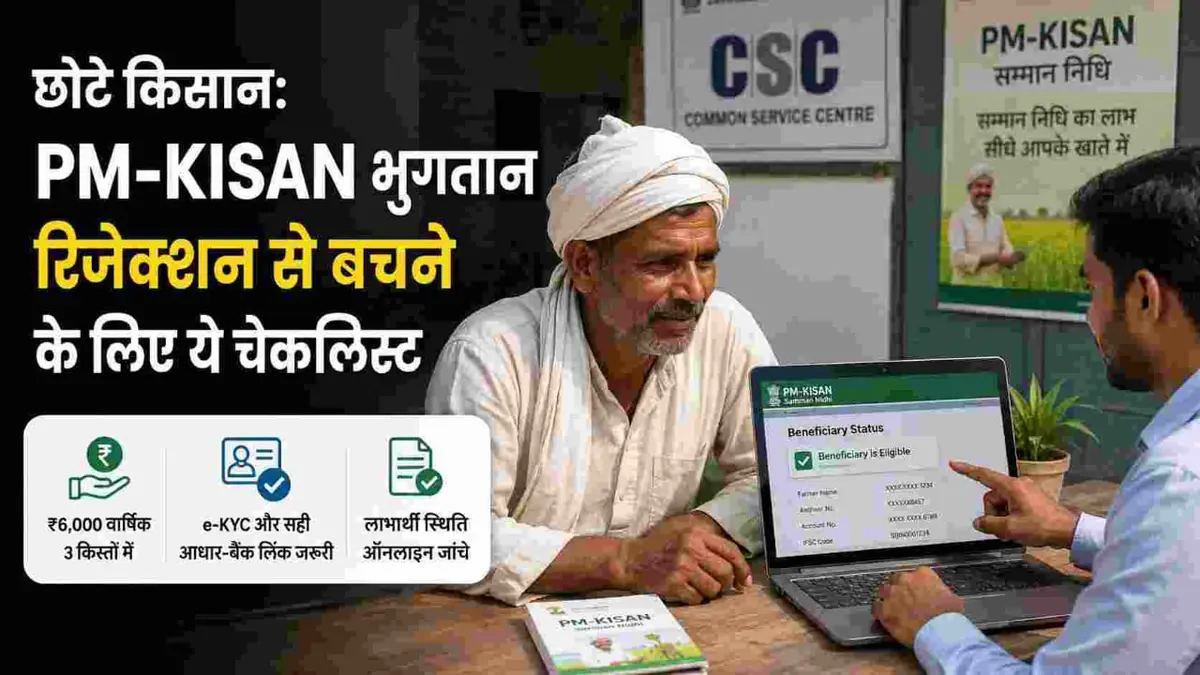

Every instalment cycle, a section of PM-KISAN beneficiaries finds their name missing from the payment list, even though they believe they qualify for the scheme. Government data has shown large swings in beneficiary numbers over past years, and pending e-KYC along with land record mismatches remain the most cited reasons behind such drops.
For small and marginal farmers who depend on this support, a rejected or delayed instalment can mean an unexpected financial gap. The good news is that most rejections trace back to a handful of fixable issues. Going through them before the next instalment window closes can save farmers a trip back and forth to the Common Service Centre (CSC).
How Much Farmers Get Under PM-KISAN
Eligible farmer families receive ₹6,000 every year, paid out in three instalments of ₹2,000 each, directly into their Aadhaar-linked bank accounts through Direct Benefit Transfer. The scheme continues to be one of the largest DBT programmes run by the central government, covering landholding farmer families, including husband, wife, and minor children who jointly own cultivable land.
Why Instalments Get Rejected or Delayed
Based on patterns seen across recent instalment cycles, a few issues repeatedly show up:
- Pending or incomplete e-KYC: e-KYC is mandatory for every registered beneficiary. Without it, an instalment simply does not get processed, regardless of eligibility.
- Aadhaar-bank account mismatch: Payments only reach Aadhaar-seeded accounts. If the bank account is not linked to Aadhaar, or if the name on the bank record does not match Aadhaar details exactly, the transaction can fail.
- Outdated or incorrect land records: Since eligibility is tied to land ownership as per state revenue records, any discrepancy between the farmer's registered land details and current state records can lead to exclusion from the beneficiary list.
- Inactive or unlinked mobile number: OTP-based e-KYC needs an active mobile number linked to Aadhaar. If this link is broken, online e-KYC will not go through.
- Missing Farmer ID: For new registrations in several states, Farmer ID under the AgriStack initiative has become mandatory, and its absence can hold up fresh applications.
The Pre-Instalment Checklist
Farmers can go through this list before every instalment date to reduce the chance of rejection:
1. Visit the official PM-KISAN portal and use the "Know Your Status" option to check current beneficiary status using Aadhaar number, mobile number, or registration number.
2. Confirm e-KYC status. If it shows pending, complete it through OTP verification on the portal, the PM-KISAN mobile app using face authentication, or biometric verification at a CSC.
3. Check that the bank account is Aadhaar-seeded and that the name matches Aadhaar records exactly, including spelling and initials.
4. Verify land records match what is registered with the scheme, particularly if there has been any recent land transfer, inheritance, or correction in revenue records.
5. Ensure the Aadhaar-linked mobile number is active, since several verification steps depend on OTP delivery.
6. Check the village-wise beneficiary list on the portal by selecting state, district, sub-district, block, and village to confirm inclusion.
Checking the Village-Wise Beneficiary List
Farmers who want to confirm their status at the village level can go to the Beneficiary List section on the PM-KISAN portal, select their state, district, sub-district, block, and village, and generate the report. If a name does not appear, it usually points to one of the issues listed above, and the discrepancy should be corrected as soon as possible rather than waiting for the next cycle.
What To Do If Rejected
If an instalment has been missed, the first step is identifying the exact reason through the status check tool rather than assuming the cause. Most corrections, such as updating bank details or completing e-KYC, can be done directly through the portal. Land record corrections, however, usually need a visit to the local revenue office, since these records are maintained at the state level and not by the PM-KISAN system itself.
For farmers unable to complete verification online, the nearest Common Service Centre remains the most reliable option, offering both biometric e-KYC and general assistance with status checks.
Farmers who want a quick way to check their eligibility status before heading to a CSC can use the PM-KISAN Eligibility Checker available on LabhGrow which helps identify likely gaps before an official visit.
Conclusion
Most PM-KISAN payment rejections come down to a small set of recurring issues, pending e-KYC, Aadhaar-bank mismatches, or land record errors, that can usually be fixed well before the next instalment date. A quick status check on the official portal, combined with this checklist, can help eligible farmers avoid unnecessary delays and receive their instalments on time.
For More Information -
PM Kisan Rejected Application Solution 2026 – How to Fix Rejected PM Kisan Application
> Disclaimer: The content provided on LabhGrow is for educational and informational purposes only. We are not a SEBI-registered investment advisor. Please consult a qualified financial advisor before making any investment or financial decisions. LabhGrow is not responsible for any loss or damage arising from the use of this information.

Head of Content & Lead Writer
Senior financial & news writer specializing in Indian government schemes, market rates, and banking policies.
lakshyabhardwaj.hoc@labhgrow.in
Senior Research Analyst (Fact-Checker)
Dedicated researcher and data verifier ensuring 100% authenticity and fact-checking from primary government and financial feeds.
harshitsharma.sra@labhgrow.in