PM Surya Ghar Yojana: Get Rs 78,000 Solar Subsidy Now
Overview
Apply for PM Surya Ghar Muft Bijli Yojana at pmsuryaghar.gov.in. Use the subsidy calculator, check eligibility and get up to Rs 78,000 for rooftop solar.
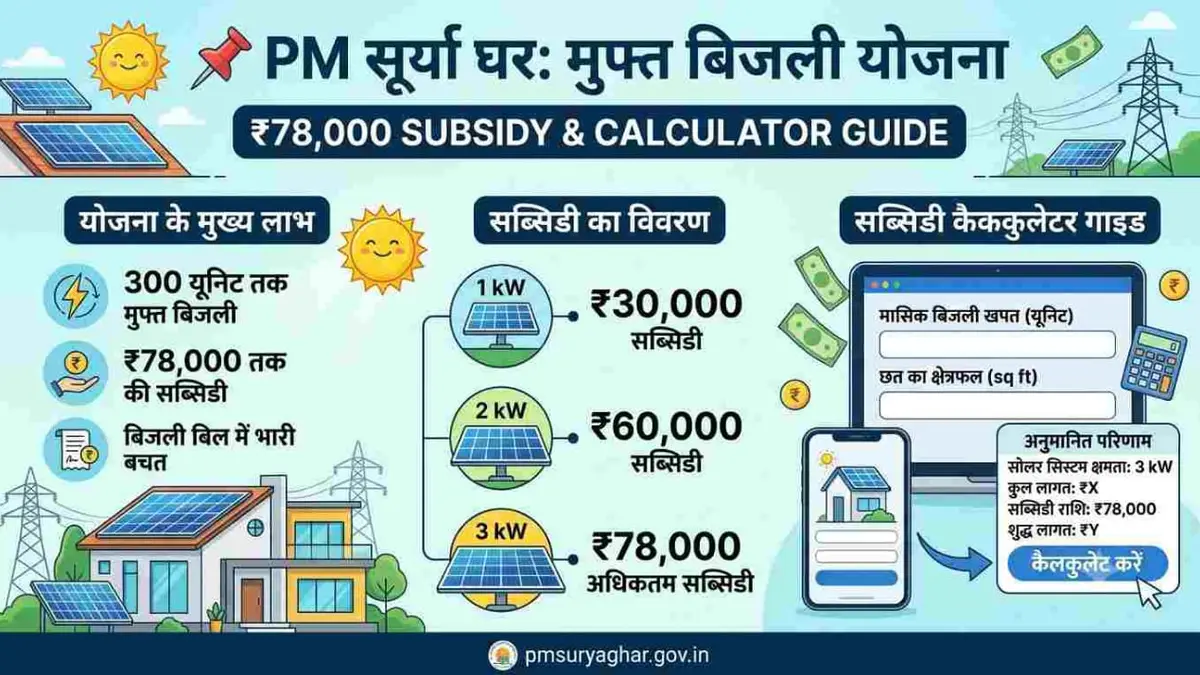

For millions of Indian households, the monthly electricity bill has quietly become one of the biggest recurring expenses. The PM Surya Ghar Muft Bijli Yojana was designed to change that equation, and two years after its launch, it has become one of the most talked-about government schemes in the energy space. Under the scheme, eligible homeowners can receive a subsidy of up to Rs 78,000 for installing a rooftop solar system, along with the possibility of monthly electricity bills dropping close to zero.
The scheme, run by the Ministry of New and Renewable Energy (MNRE), was launched in February 2024 with a target of covering one crore households across the country. It has since expanded into one of the largest residential solar subsidy programmes in the world, with applications now open at the national portal, pmsuryaghar.gov.in.
What Is PM Surya Ghar Muft Bijli Yojana
The scheme allows homeowners to install a grid-connected rooftop solar system on their property. Once the system is commissioned by the local electricity distribution company (DISCOM), the government transfers the subsidy amount directly into the applicant's bank account. A correctly sized 3kW system can generate close to 300 units of electricity a month, which is enough to cover the average consumption of many urban households, though actual output depends on sunlight, location and system efficiency.
How Much Subsidy Can You Get
The subsidy is calculated on a per-kilowatt basis, and this is where the solar subsidy calculator on the official portal becomes useful for homeowners trying to plan their budget.
- For the first 2kW of capacity: Rs 30,000 per kW, covering up to 60 percent of the system cost
- For the third kW: an additional Rs 18,000
- Maximum subsidy for a 3kW or larger residential system: Rs 78,000
Households in special category states, including northeastern and hill states, are eligible for a higher subsidy slab that can go up to Rs 1,17,000 for a comparable system. Some states, including Uttar Pradesh, Bihar and Rajasthan, also offer additional top-up subsidies on top of the central government amount.
Quick Fact Box
- Scheme launched: February 2024, under MNRE
- Maximum central subsidy: Rs 78,000 (3kW system)
- Free electricity potential: up to 300 units per month
- Subsidy credited: 30–45 days after DISCOM inspection, directly to bank account
- Application portal: pmsuryaghar.gov.in
Who Can Apply
Eligibility for the scheme is fairly straightforward, but a few conditions need to be met before applying.
- The applicant must be an Indian citizen with a residential property that has a suitable roof for solar panel installation
- The property must already have a valid electricity connection with a registered consumer number
- The electricity bill and the Aadhaar used for application should belong to the same person; if the bill is in a family member's name, the application has to be made under that person's Aadhaar
- The rooftop should not already have an existing subsidised solar installation
Documents Required
Applicants are typically asked to keep the following ready before starting the registration:
- Aadhaar card
- Latest electricity bill with consumer number
- Bank account details, including a cancelled cheque or passbook copy
- Property ownership or residence proof
- Passport-size photograph
How to Apply: Step-by-Step Guide
1. Visit the official portal. Go to pmsuryaghar.gov.in and click on "Apply for Rooftop Solar."
2. Register your details. Enter your state, DISCOM name, electricity consumer number and Aadhaar-linked mobile number, then verify using an OTP.
3. Log in and fill the form. Once registered, log in with your consumer number and mobile number, then complete the application, selecting the system capacity you want installed.
4. Get feasibility approval. The DISCOM reviews the application and issues feasibility approval for the rooftop installation.
5. Choose a vendor and install. Select an empanelled vendor from the portal's list and get the solar system installed using MNRE-approved equipment.
6. Apply for net metering. After installation, submit a net meter application through the portal.
7. Commissioning certificate. Once the DISCOM inspects and commissions the plant, a commissioning certificate is generated on the portal.
8. Submit bank details and claim subsidy. Upload your bank account details on the portal; the subsidy is credited within 30 to 45 days of commissioning.
Using the Subsidy Calculator
The portal's built-in calculator lets users enter their monthly electricity consumption and rough roof area to estimate the ideal system size, likely subsidy amount, and approximate payback period. For most urban households consuming around 250–300 units a month, a 3kW system tends to be the sweet spot, both for maximising the subsidy and for meeting typical consumption needs.
Loan Facility for Homeowners
For those who cannot pay the upfront cost even after subsidy, the scheme also enables collateral-free loans through several public and private sector banks. These loans are offered at concessional interest rates for residential rooftop solar, and combined with the subsidy, they significantly reduce the initial financial burden of going solar.
Why This Matters for Homeowners
For a household with an average monthly bill of Rs 2,000–2,500, a correctly sized rooftop system can bring that bill down substantially, and in some cases close to zero, once the subsidy and net metering benefits are factored in. Beyond the financial angle, the scheme also pushes India's broader clean energy targets, with solar already contributing a growing share of the country's total power generation.
Conclusion
PM Surya Ghar Muft Bijli Yojana remains one of the more practical entry points for Indian households looking to cut their electricity costs while contributing to cleaner energy use. With a subsidy of up to Rs 78,000, an accessible online application process, and loan support for those who need it, the scheme has made rooftop solar a realistic option for a much wider set of homeowners than before. Anyone considering the switch would do well to start with the subsidy calculator on pmsuryaghar.gov.in to get a clear, personalised estimate before applying.
For More Information -
https://www.sarkaridarapan.com/sarkari-yojana/pm-surya-ghar-muft-bijli-yojana-rooftop-solar-2026
> Disclaimer: The content provided on LabhGrow is for educational and informational purposes only. We are not a SEBI-registered investment advisor. Please consult a qualified financial advisor before making any investment or financial decisions. LabhGrow is not responsible for any loss or damage arising from the use of this information.

Head of Content & Lead Writer
Senior financial & news writer specializing in Indian government schemes, market rates, and banking policies.
lakshyabhardwaj.hoc@labhgrow.in
Senior Research Analyst (Fact-Checker)
Dedicated researcher and data verifier ensuring 100% authenticity and fact-checking from primary government and financial feeds.
harshitsharma.sra@labhgrow.in