Saubhagya Scheme: Free Electricity for Rural Homes
Overview
Saubhagya Scheme gave free electricity connections to crores of rural households. Know its eligibility, benefits, current status and what replaced it.
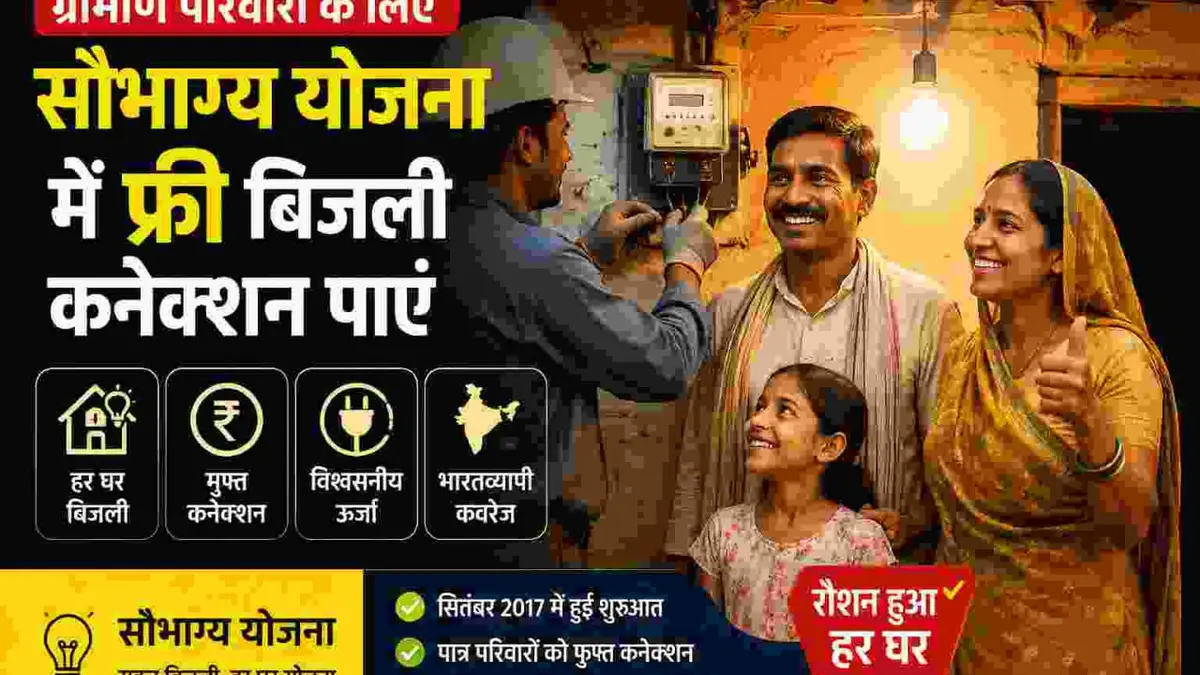

For millions of rural Indian families, a working light bulb after sunset was once a distant dream. The Pradhan Mantri Sahaj Bijli Har Ghar Yojana, better known as Saubhagya, was the government's answer to that gap. Launched on September 25, 2017, the scheme set out to give a free, last-mile electricity connection to every willing household in the country that still didn't have one.
Nearly nine years on, the scheme has run its full course, achieved most of its targets, and officially closed. Here's what Saubhagya actually delivered, who benefited from it, and what rural households without a connection should do today.
What Was the Saubhagya Scheme
Saubhagya was designed to complete India's electrification story. An earlier scheme, the Deen Dayal Upadhyaya Gram Jyoti Yojana (DDUGJY), had already worked on electrifying entire villages. Saubhagya picked up from there, focusing on individual households that villages had left behind, both in rural and urban pockets.
The Rural Electrification Corporation (REC) was named the nodal agency for the scheme, and a dedicated portal, saubhagya.gov.in, was set up to track household-level progress across states and districts.
Objective of the Scheme
The core goal was universal household electrification. Practically, this meant:
- Connecting every willing un-electrified household in rural India, regardless of income category.
- Connecting every willing poor household in urban areas.
- Doing this through a mix of free connections and low-cost, instalment-based connections for households that weren't classified as poor.
The original deadline was December 2018, which was later extended to March 31, 2019.
Who Was Eligible
Eligibility under Saubhagya was based on the Socio-Economic and Caste Census (SECC) of 2011:
- Households identified as poor under the SECC 2011 data were entitled to a completely free electricity connection.
- Households that did not fall under the SECC-identified poor category could still get connected, but at a nominal cost of Rs. 500, recoverable in easy instalments through their electricity bill.
This structure ensured that cost was not a barrier for genuinely poor families, while still extending the scheme's reach to other un-electrified homes willing to pay a small amount.
What Beneficiaries Received
A household that got connected under Saubhagya wasn't just handed a wire and a meter. The scheme bundled in basic essentials so families could put the connection to immediate use, including LED lights, a DC fan, and a DC power plug, along with meter repair and maintenance support for five years.
How the Application Process Worked
While the scheme was active, the process was fairly simple:
1. State electricity distribution companies (discoms) conducted surveys to identify un-electrified households using SECC 2011 data and on-ground verification.
2. Willing households were approached by discom field staff or could apply through camps organised at the village or ward level.
3. Basic documents such as an identity proof, address proof, and, where applicable, a document supporting SECC/poor household status were collected.
4. Once verified, the connection, along with the meter and starter kit, was installed at the household's premises.
Saubhagya's Progress and Coverage
Government data shows the scheme made substantial headway. By March 2019, states reported that nearly all identified households had been electrified, with a small pocket of about 18,734 households in Left Wing Extremism-affected parts of Chhattisgarh remaining unconnected due to security constraints at the time.
In the years that followed, seven states, Assam, Chhattisgarh, Jharkhand, Karnataka, Manipur, Rajasthan, and Uttar Pradesh, reported that lakhs of households which had earlier declined a connection later came forward wanting one. These were also sanctioned and connected. By March 2021, all seven states reported 100 percent household electrification.
Overall, around 2.86 crore households were electrified under Saubhagya over its lifetime, according to figures shared by the Ministry of Power.
Current Status: The Scheme Is Now Closed
This is the part many people searching for Saubhagya in 2026 need to know clearly: the scheme is no longer accepting new applications. All sanctioned work under Saubhagya was completed, and the scheme formally stood closed as of March 31, 2022, once the government assessed that its 100 percent household electrification target had been met.
That doesn't mean the government's work on electrification has stopped. The Revamped Distribution Sector Scheme (RDSS), launched in 2021, has taken over this responsibility. Under RDSS, states continue to identify and connect any remaining un-electrified households, alongside broader work on strengthening distribution infrastructure. If your household still doesn't have an electricity connection, RDSS, applied for through your state's electricity distribution company, is the relevant scheme to approach today, not Saubhagya.
It's also worth noting that independent assessments have pointed out a nuance in how "universal electrification" was measured. Some households that did not apply for a connection at the time, whether due to lack of awareness, affordability concerns after the free connection period, or other reasons, were not counted against the scheme's target. So while the coverage numbers are impressive, a small number of households on the ground may still be without a working connection.
Real Impact on Rural and Poor Families
For lakhs of families, Saubhagya meant children could study after dark, small home-based work could continue into the evening, and something as basic as a fan during summer nights became possible for the first time. In many villages, it also indirectly supported better access to mobile charging, television, and radio, improving connectivity to information and services.
That said, electrification is only the first step. A working connection doesn't automatically mean uninterrupted power supply, and households still need to budget for their monthly electricity usage. This is where checking your expected bill in advance can help avoid surprises, something LabhGrow's Electricity Bill Calculator can assist with based on your monthly unit consumption.
Key Takeaways
- Saubhagya was launched on September 25, 2017, to provide last-mile electricity connections to un-electrified households.
- Poor households, as identified under SECC 2011, got free connections; others paid a nominal Rs. 500 in instalments.
- About 2.86 crore households were electrified under the scheme.
- The scheme officially closed on March 31, 2022, after meeting its targets.
- Households still without a connection should now approach their state discom under the RDSS scheme.
Conclusion
Saubhagya stands as one of the more successful last-mile welfare schemes in recent Indian history, having connected crores of homes that had never seen a legal electricity connection before. It has now completed its run and closed, with RDSS carrying the baton forward for any households still left out. If electricity access remains a concern in your area, reaching out to your local electricity distribution company under RDSS is the right next step.
For More Information -
How to Apply for Saubhagya Free Electricity Connection 2026 | PMCare
Disclaimer: The information provided on Labhgrow.in is for educational purposes only. We are not affiliated with the Income Tax Department, NSDL (Protean), or UTIITSL. Delivery times and tracking processes are subject to government portal functionality. Please never share your PAN details or OTPs with unauthorized third-party websites.

Head of Content & Lead Writer
Senior financial & news writer specializing in Indian government schemes, market rates, and banking policies.
lakshyabhardwaj.hoc@labhgrow.in
Senior Research Analyst (Fact-Checker)
Dedicated researcher and data verifier ensuring 100% authenticity and fact-checking from primary government and financial feeds.
harshitsharma.sra@labhgrow.in