Sukanya Samriddhi Yojana 2026: Guide to 8.2% Interest Rates
Overview
The Sukanya Samriddhi Yojana interest rate holds at 8.2% for Q2 2026. Learn about deposit limits, maturity calculations, and how to open your account today.
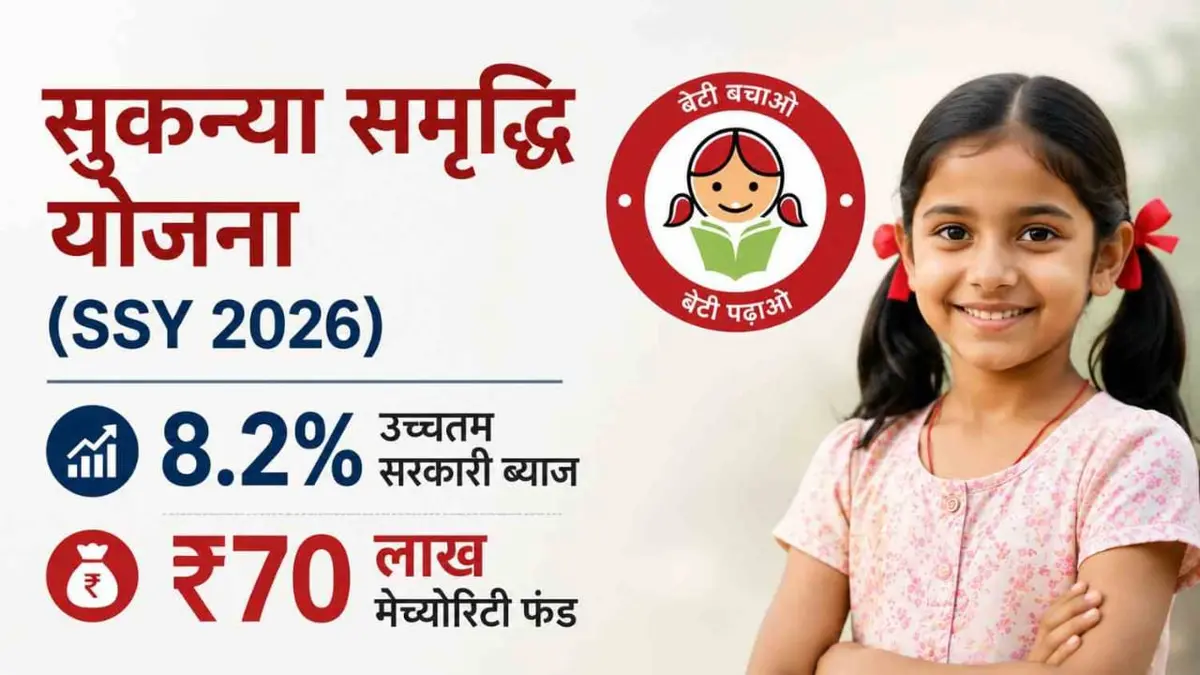

The Ministry of Finance has kept the Sukanya Samriddhi Yojana (SSY) interest rate unchanged at 8.2% per annum for the July–September 2026 quarter, continuing a streak that has held steady since April 2024. For parents already investing in the scheme, and for many who are still weighing whether to open an account before their daughter turns 10, this rate confirmation is the detail that shapes every calculation that follows — from monthly deposit planning to the final maturity corpus.
SSY remains the highest-paying option among all small savings instruments backed by the central government, comfortably ahead of the Public Provident Fund's 7.1% and most bank fixed deposits. That gap, combined with a full tax exemption on deposits, interest and maturity proceeds, is why the scheme continues to dominate search interest among parents planning for a daughter's higher education or wedding expenses.
What Is Sukanya Samriddhi Yojana
Launched in 2015 under the Beti Bachao Beti Padhao initiative, SSY is a government-backed savings account meant exclusively for a girl child. A parent or legal guardian can open the account any time from her birth until she turns 10 years old. The account matures 21 years from the date it was opened, though active deposits are required only for the first 15 years — after that, the balance continues earning interest on its own until maturity.
Because the scheme is sovereign-guaranteed, there is no market risk involved. The interest rate is reviewed and notified by the government every quarter based on prevailing government securities yields, which is why the July–September 2026 confirmation matters to anyone tracking returns closely.
Quick Snapshot: SSY in 2026
- Current interest rate: 8.2% per annum, compounded annually
- Minimum annual deposit: ₹250
- Maximum annual deposit: ₹1.5 lakh
- Deposit period: 15 years from account opening
- Maturity period: 21 years from account opening
- Tax status: Fully exempt (EEE) under Section 80C
Deposit Limits and Tenure Rules
A Sukanya Samriddhi account can be opened with as little as ₹250, making it accessible even for families with modest monthly budgets. The upper limit is ₹1.5 lakh in a financial year, which also happens to be the ceiling for the Section 80C deduction, so the scheme works efficiently as both a savings tool and a tax-planning instrument.
Deposits can be made in a lump sum or in instalments through the year, with no fixed monthly requirement — flexibility that has made the scheme popular among households with irregular income. Interest is calculated on the lowest balance held between the 5th and last day of each month and is credited once at the end of the financial year.
How Much Will Your Daughter Get: Maturity Calculation
The maturity amount depends entirely on how much is deposited each year and for how long, since the account continues compounding even after the 15-year deposit window closes. Based on the current 8.2% rate held constant, here is what different monthly deposit amounts would grow into by the time the account matures in 21 years.
| Monthly Deposit | Annual Deposit | Total Invested (15 yrs) | Approximate Maturity Value |
|---|---|---|---|
| ₹1,000 | ₹12,000 | ₹1.8 lakh | ₹5.7 lakh |
| ₹5,000 | ₹60,000 | ₹9 lakh | ₹28.7 lakh |
| ₹12,500 (maximum) | ₹1,50,000 | ₹22.5 lakh | ₹71.8 lakh |
These figures are illustrative and assume the 8.2% rate stays constant for the full 21-year period, which is unlikely given that rates are revised every quarter. Actual returns will vary depending on how the rate moves over time, but the table gives a realistic sense of scale — a household depositing close to the maximum limit every year can reasonably expect a fund in the ₹65–72 lakh range by maturity, entirely tax-free.
Step-by-Step: How to Open an SSY Account
1. Choose a post office or authorised bank. Most public sector banks and several private banks, along with every post office branch, are authorised to open SSY accounts.
2. Collect the required documents. You will need the girl child's birth certificate, identity and address proof of the parent or guardian (Aadhaar, PAN, passport or voter ID), and passport-size photographs.
3. Fill the SSY account opening form. This is available at the branch or can be downloaded from the India Post or respective bank's website.
4. Make the initial deposit. A minimum of ₹250 is needed to activate the account; you can deposit more if you plan to invest a larger amount right away.
5. Submit the form and documents at the branch. Full online account opening is not yet available; however, once the account is active, most banks allow subsequent deposits through net banking, mobile banking or the India Post Payments Bank app.
6. Collect the passbook. This records your deposits and the interest credited each year, similar to a regular savings account passbook.
Why This Matters for Parents Planning Ahead
For a family with a daughter under 10, the arithmetic is straightforward: starting early gives the deposit more years to compound, and the tax-free nature of the returns means the entire maturity amount — not just the principal — is available without any deduction. Compared to a recurring deposit or a child insurance plan, SSY's combination of a government guarantee, a high rate, and full tax exemption is difficult to match for this specific goal.
Withdrawals are also allowed for the girl's higher education once she turns 18, and the account can be closed early for her marriage after that age, giving families some flexibility if funds are needed before the full 21-year maturity period is complete.
Conclusion
With the 8.2% interest rate confirmed for the July–September 2026 quarter, Sukanya Samriddhi Yojana continues to be one of the most reliable, tax-efficient ways for parents to build a dedicated fund for their daughter's future. The scheme rewards consistency — the earlier an account is opened and the closer deposits stay to the annual limit, the larger the tax-free corpus at maturity. Since rates are reviewed every quarter, it is worth checking the latest notification before making a fresh deposit, but the underlying rules of the scheme have remained stable and dependable since its launch.
For More Information -
https://www.labhgrow.in/gov-schemes/sukanya-samriddhi-yojana-interest-rate-2026-update
> Disclaimer: The content provided on LabhGrow is for educational and informational purposes only. We are not a SEBI-registered investment advisor. Please consult a qualified financial advisor before making any investment or financial decisions. LabhGrow is not responsible for any loss or damage arising from the use of this information.

Head of Content & Lead Writer
Senior financial & news writer specializing in Indian government schemes, market rates, and banking policies.
lakshyabhardwaj.hoc@labhgrow.in
Senior Research Analyst (Fact-Checker)
Dedicated researcher and data verifier ensuring 100% authenticity and fact-checking from primary government and financial feeds.
harshitsharma.sra@labhgrow.in