Sukanya Samriddhi Yojana Interest Rate 2026: Latest Update
Overview
SSY interest rate for July-September 2026 stays at 8.2%. Check eligibility, deposit limits, maturity rules, tax benefits and FAQs in this updated guide.
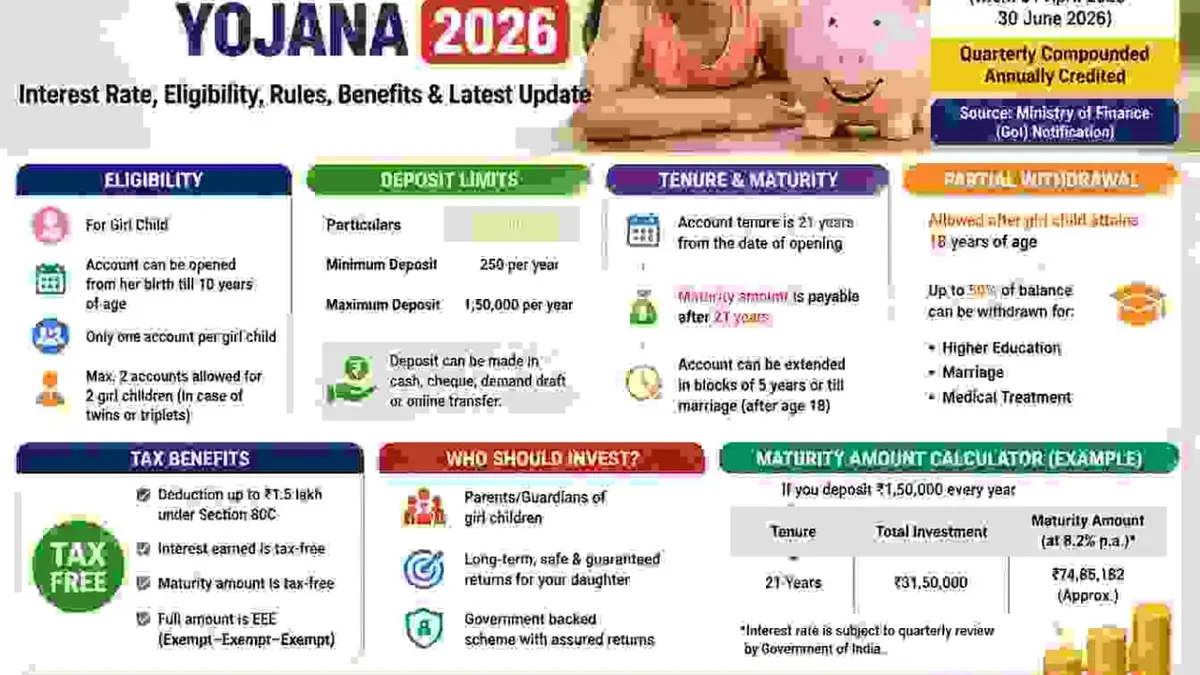

The Sukanya Samriddhi Yojana continues to remain one of the most rewarding government-backed savings options for parents planning ahead for their daughters. The scheme has held its position as a top performer among small savings instruments, and the latest rate announcement confirms that the trend continues into the second quarter of this financial year.
SSY Interest Rate for July-September 2026
The Ministry of Finance has kept the Sukanya Samriddhi Yojana interest rate unchanged at 8.2% per annum for the quarter running from July 1, 2026, to September 30, 2026. This rate applies to all small savings schemes for this period, and it mirrors the rate that was already in effect for the April-June 2026 quarter.
This is not a new development in terms of trend — the SSY rate has stayed at 8.2% since April 2024, making it the highest interest rate among all small savings schemes, on par with the Senior Citizen Savings Scheme. For comparison, the Public Provident Fund currently offers 7.1%, the National Savings Certificate offers 7.7%, and post office fixed deposits range between 6.9% and 7.5%, depending on tenure.
The government reviews and notifies small savings rates every quarter based on government securities yields, so investors should keep checking for updates, especially closer to each quarter-end.
| Scheme | Interest Rate (Jul-Sep 2026) |
|---|---|
| Sukanya Samriddhi Yojana | 8.2% |
| Senior Citizen Savings Scheme | 8.2% |
| National Savings Certificate | 7.7% |
| Kisan Vikas Patra | 7.5% |
| 5-Year Post Office Time Deposit | 7.5% |
| Monthly Income Scheme | 7.4% |
| Public Provident Fund | 7.1% |
Who Can Open an SSY Account: Eligibility and Age Limit
The scheme is meant exclusively for the benefit of a girl child, and the eligibility conditions are fairly simple:
- The account can be opened by a parent or legal guardian in the name of a girl child.
- The girl child must be below 10 years of age at the time the account is opened.
- A family can open a maximum of two SSY accounts, one per girl child. An exception is made in the case of twins or triplets born after the first girl child.
- The account can be opened at any post office branch or at authorised banks across India.
Minimum and Maximum Deposit Limits
One of the reasons the scheme works for families across income levels is its flexible deposit structure:
- The minimum deposit required to keep an SSY account active is Rs 250 in a financial year.
- The maximum amount that can be deposited in a financial year is Rs 1.5 lakh.
- Deposits can be made in lump sum or in multiple instalments throughout the year, in multiples of Rs 50.
- If the minimum deposit is not made in any year, the account becomes inactive and can be revived later by paying a small penalty along with the shortfall amount.
Maturity and Partial Withdrawal Rules
An SSY account matures 21 years from the date it was opened, or when the girl gets married after turning 18, whichever happens earlier.
Deposits are required only for the first 15 years from the date of account opening. After that, no further contributions are needed, but the balance continues to earn interest until the account matures.
Partial withdrawal is allowed once the girl turns 18 or has passed her 10th standard examination, whichever is earlier. Account holders can withdraw up to 50% of the balance available at the end of the preceding financial year, mainly to support higher education expenses.
Tax Benefits Under Section 80C
SSY carries an Exempt-Exempt-Exempt (EEE) tax status, which is one of its biggest draws for parents:
- Deposits made into the account qualify for a deduction of up to Rs 1.5 lakh under Section 80C of the Income Tax Act.
- The interest earned every year is completely tax-free.
- The maturity amount, including the final withdrawal, is also exempt from tax.
Who Should Consider Investing in SSY?
SSY works best for parents who are looking for a long-term, low-risk, goal-based savings option tied specifically to their daughter's education or marriage. Since the scheme is backed by the government, the principal and interest are secure, and the current 8.2% rate beats most fixed deposits and the PPF. However, since the money is locked in for a long tenure and withdrawal rules are strict, it should ideally be used alongside other investment options rather than as the only savings avenue for a family.
You can use an SSY calculator to check how your deposits will grow at the current interest rate before you start or continue contributing to the account.
Conclusion
The Sukanya Samriddhi Yojana remains unchanged at 8.2% for the July-September 2026 quarter, keeping it the most attractive small savings option currently available for parents of girl children. With tax-free returns, government backing, and flexible deposit limits, the scheme continues to be a dependable choice for long-term goals like higher education and marriage. Since rates are reviewed every quarter, it is worth checking back for updates before making fresh deposits.
For More Information -
Sukanya Samriddhi Yojana 2026: 8.2% Interest Rate, Details and Tax Benefits
> Disclaimer: The content provided on LabhGrow is for educational and informational purposes only. We are not a SEBI-registered investment advisor. Please consult a qualified financial advisor before making any investment or financial decisions. LabhGrow is not responsible for any loss or damage arising from the use of this information.

Head of Content & Lead Writer
Senior financial & news writer specializing in Indian government schemes, market rates, and banking policies.
lakshyabhardwaj.hoc@labhgrow.in
Senior Research Analyst (Fact-Checker)
Dedicated researcher and data verifier ensuring 100% authenticity and fact-checking from primary government and financial feeds.
harshitsharma.sra@labhgrow.in