How to Save Your First ₹1 Lakh by 25: Latest 2026 Guide
Overview
Want to save your first 1 Lakh by 25? Follow this step-by-step savings roadmap with smart habits and emergency fund plans. Start growing your wealth today!
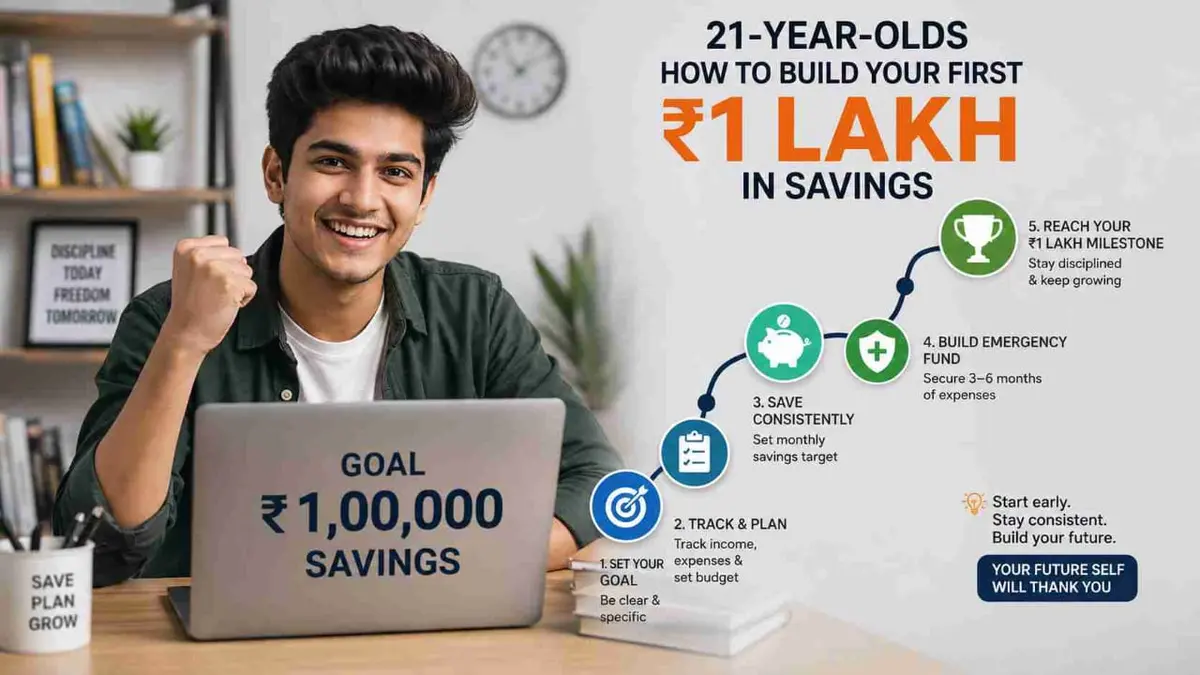

Turning 21 usually means your first payslip, your first taste of independence, and your first real chance to build money habits that will carry you for decades. It also means one very common question: how do you actually save your first ₹1 lakh when rent, EMIs, outings, and family expenses are already pulling at your salary?
The good news is that ₹1 lakh is not as far away as it feels. With the right structure, most 21-25 year olds can hit this milestone within 12 to 24 months, even on a modest salary. This guide breaks the goal down into simple, practical steps rather than vague advice like "save more."
Why Your Early 20s Are the Best Time to Start
Time is the one advantage young earners have that nobody else does. Money saved and invested at 21 has far longer to grow than money saved at 31, simply because of how compounding works over a longer runway.
Beyond the math, your 20s are also when spending habits get formed. Whether you build a habit of saving 20 percent of every salary or spending it all by the 25th of the month tends to repeat itself for years unless you consciously interrupt the pattern. Treating your first ₹1 lakh as a habit-building exercise, not just a number, makes the process far more sustainable.
Set a Realistic Monthly Savings Target
A goal like "save ₹1 lakh" feels abstract until you break it into monthly numbers.
- To reach ₹1 lakh in 12 months, you need to save roughly ₹8,300 a month.
- To reach it in 18 months, the target drops to about ₹5,550 a month.
- Over 24 months, it becomes a more manageable ₹4,150 a month.
Picking a timeline based on your actual income, rather than copying someone else's target, is what makes a savings plan for 21-25 year olds realistic instead of stressful. If your salary is between ₹20,000 and ₹35,000 a month, an 18 to 24 month timeline is usually more sustainable than trying to rush it in a year.
Quick Tip: Automate your savings on salary day itself. Set up an auto-transfer of your monthly savings target to a separate account within 24 hours of your salary credit, before the money has a chance to disappear into daily spending.
Build an Emergency Fund Before Big Purchases
One mistake young earners often make is jumping straight into investments or big-ticket purchases before having any safety net. Before your first ₹1 lakh becomes a wealth-building fund, a portion of it should function as an emergency cushion.
A good rule of thumb is to keep at least 3 months of essential expenses in an easily accessible savings account or liquid fund before locking money into long-term investments. This protects you from having to break investments or take a loan if a medical expense or job gap comes up unexpectedly.
Step-by-Step Guide to Save Your First ₹1 Lakh
Here is a simple sequence you can follow, in order, starting this month.
1. Calculate your real monthly surplus. List your salary, subtract fixed expenses (rent, bills, EMIs), and see what is genuinely left over.
2. Pick your timeline. Choose 12, 18, or 24 months based on the surplus you calculated, not on what feels impressive.
3. Automate the transfer. Set up a standing instruction so your savings amount moves out on salary day, before you spend.
4. Separate your emergency fund. Keep the first 3 months of expenses in a liquid, easily accessible account, separate from any investment.
5. Track progress monthly. Use a simple tracker or a tool like the SIP Calculator to see how your monthly contributions are adding up toward ₹1 lakh.
6. Review every 3 months. Adjust your monthly amount if your salary or expenses change, instead of abandoning the goal entirely.
7. Avoid dipping into it. Treat the fund as untouchable except for genuine emergencies, not for discretionary spending.
Common Mistakes That Delay the ₹1 Lakh Goal
A few habits quietly derail this goal for many young earners:
- Saving whatever is "left over" at month-end instead of saving first and spending the rest.
- Keeping savings in the same account used for daily spending, which makes it easy to dip into.
- Chasing high-risk investments too early, before building any base savings.
- Restarting the goal every time an unplanned expense comes up, instead of adjusting the timeline.
Fixing even one or two of these habits can meaningfully speed up how quickly you reach your first ₹1 lakh.
Using a SIP Calculator to Track Your Progress
Once your emergency fund is in place and you start investing part of your monthly savings, the SIP Calculator can help you see, in advance, how small monthly amounts grow over time. Entering your monthly contribution, expected timeline, and an assumed rate of return gives you a clear projection, which makes the goal feel far more concrete than a rough mental estimate.
This is particularly useful for young professionals who want to see whether shifting from, say, ₹4,000 to ₹5,000 a month meaningfully changes how soon they hit ₹1 lakh.
Conclusion:
Saving your first ₹1 lakh is less about finding extra income and more about structure: a realistic monthly target, an emergency fund before investments, and a habit of saving before spending. Most 21-25 year olds who follow this sequence consistently reach the milestone within 12 to 24 months, and more importantly, walk away with a savings habit that keeps compounding long after the first ₹1 lakh is done.
The content published under this Educational Guide / Blog category on LabhGrow is intended purely for general educational and informational purposes. It is based on publicly available information and presented in a simplified manner to help readers build awareness of personal finance concepts, calculators, and money-management practices. This content does not constitute professional, legal, tax, financial, or academic advice, and should not be treated as a substitute for guidance from a qualified expert. LabhGrow is not a SEBI-registered investment advisor, and nothing in this section should be interpreted as a recommendation to buy, sell, or hold any financial product. While every effort is made to keep information accurate and up to date, financial rules and guidelines can change without notice. Readers are advised to independently verify facts and consult a qualified financial advisor or relevant expert before acting on any information shared here. LabhGrow shall not be held liable for any loss, damage, or inconvenience arising from reliance on this content.

Head of Content & Lead Writer
Senior financial & news writer specializing in Indian government schemes, market rates, and banking policies.
lakshyabhardwaj.hoc@labhgrow.in
Senior Research Analyst (Fact-Checker)
Dedicated researcher and data verifier ensuring 100% authenticity and fact-checking from primary government and financial feeds.
harshitsharma.sra@labhgrow.in