KYC Fraud Alert: How to Spot and Avoid Fake Bank SMS
Overview
Fake KYC messages are tricking bank customers into sharing OTPs and PINs. Learn how to spot fraud messages, verify KYC safely, and protect your account.
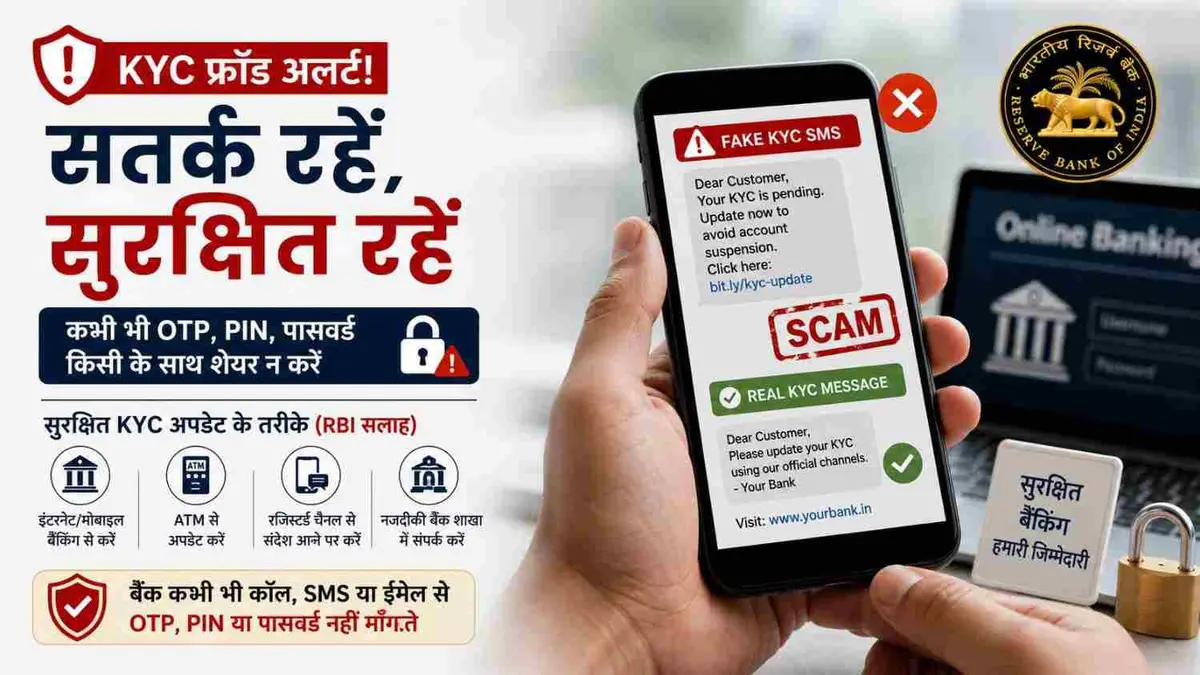

Bank customers across India are once again being targeted by a wave of fake KYC update messages. These texts usually claim that a bank account, debit card or UPI service will be blocked within hours unless the customer clicks a link and "completes" their KYC immediately. The pressure tactic works because KYC updation is a real banking requirement, and scammers are exploiting that familiarity to steal money.
The Reserve Bank of India has repeatedly reminded customers that banks never ask for OTPs, PINs, passwords or card details over SMS, WhatsApp or phone calls. Understanding how genuine KYC communication actually works is the simplest way to tell a real message from a scam.
Why This Scam Keeps Working
KYC, or Know Your Customer, updation is a standard requirement under RBI's banking regulations, and every account holder needs to complete it periodically. Because the process is genuine, fake messages that mimic it feel believable. Fraudsters send SMS or WhatsApp texts with urgent language, a shortened link, and sometimes a spoofed sender ID that looks similar to a bank's official ID. Clicking the link usually leads to a fake banking page designed to capture login credentials, card numbers or one-time passwords.
The urgency is the trap. Real KYC deadlines are communicated well in advance, not as a last-minute warning to click a link within a few hours.
How Genuine KYC Updates Actually Work
Under RBI's Know Your Customer Directions, banks are required to follow a structured, advance-notice process before treating any account as non-compliant. This is very different from how scam messages behave.
- Banks must send at least three advance intimations, including at least one formal letter, before the KYC due date.
- If a customer still hasn't updated their KYC after the due date, banks must send at least three reminders, again including one by letter, before taking any restrictive action.
- These communications are required to clearly explain how to update KYC, who to contact for help, and what happens if it isn't done in time.
- RBI also allows Re-KYC to be completed through multiple safe, verifiable channels — internet banking, mobile banking apps, ATMs, video KYC, or in person at a branch — so customers are never forced to rely on an unknown SMS link.
In short, a real KYC reminder comes with time, choice of channel, and a paper trail. A scam message offers none of that.
Your bank will never ask for your OTP, UPI PIN, CVV, or net banking password over call, SMS, or WhatsApp — not even to "update" or "verify" your KYC. If a message asks for this, it is a scam, regardless of how official it looks.
Warning Signs of a Fake KYC Message
A few patterns show up again and again in these scams:
- Extreme urgency, such as "account will be blocked in 2 hours."
- A shortened or unusual link instead of the bank's official website address.
- Spelling errors or slightly altered bank names in the sender ID.
- A request to enter OTP, PIN, or password on a page reached through the SMS link.
- Pressure to act immediately without any option to verify through official channels.
Step-by-Step: What to Do If You Get a KYC Message
1. Pause before clicking. Don't tap any link inside an unexpected KYC SMS or WhatsApp message, no matter how urgent it sounds.
2. Check the source directly. Open your bank's official app or type the bank's verified website address yourself instead of using the link provided.
3. Call the bank's listed helpline. Use the number printed on your passbook, debit card, or the bank's official website — never a number shared in the suspicious message.
4. Visit a branch if unsure. For higher-value accounts or if anything feels off, a quick branch visit settles the doubt safely.
5. Never share OTP or PIN. No verification step for KYC ever requires you to read out or type in an OTP sent for a transaction.
6. Report and block. If you suspect a scam message, report it to your bank's fraud helpline and to the National Cyber Crime Reporting Portal, then block the sender.
What to Do If You've Already Clicked
If a link has already been clicked or details shared, contact the bank's 24x7 fraud helpline immediately to block cards or freeze suspicious transactions, and change net banking and UPI passwords right away. Filing a complaint with the cyber crime portal or the nearest cyber cell as soon as possible also improves the chances of recovering funds, since banks and payment networks can sometimes block transactions if flagged quickly.
Who Should Be Extra Careful
This scam particularly targets digital banking users — anyone active on mobile banking, UPI apps, or net banking — since they're more likely to click a link expecting a genuine banking task. Senior citizens and first-time digital banking users are common targets because they may be less familiar with how banks actually communicate KYC deadlines.
The Bigger Picture
RBI's KYC framework is built around giving customers time and multiple safe channels to comply, not sudden ultimatums. Recognising that gap is what separates a real notice from a scam text. When in doubt, the safest response is always the same: don't click, verify independently, and use only official banking channels.
Conclusion
KYC fraud messages rely on urgency and familiarity to catch people off guard. Once you know that RBI-mandated KYC reminders always come with advance notice, multiple verified channels, and never ask for your OTP or PIN, spotting a fake message becomes much easier. The safest habit is simple: verify independently, never click unfamiliar links, and reach out to your bank directly whenever a KYC message feels off.
> Disclaimer: The content provided on LabhGrow is for educational and informational purposes only. We are not a SEBI-registered investment advisor. Please consult a qualified financial advisor before making any investment or financial decisions. LabhGrow is not responsible for any loss or damage arising from the use of this information.

Head of Content & Lead Writer
Senior financial & news writer specializing in Indian government schemes, market rates, and banking policies.
lakshyabhardwaj.hoc@labhgrow.in
Senior Research Analyst (Fact-Checker)
Dedicated researcher and data verifier ensuring 100% authenticity and fact-checking from primary government and financial feeds.
harshitsharma.sra@labhgrow.in