How to Find Your CKYC Number: A Simple Guide
Overview
New to banking? Here's how to find your 14-digit CKYC number, fix mismatches, and use it to skip repeat KYC paperwork at any bank.
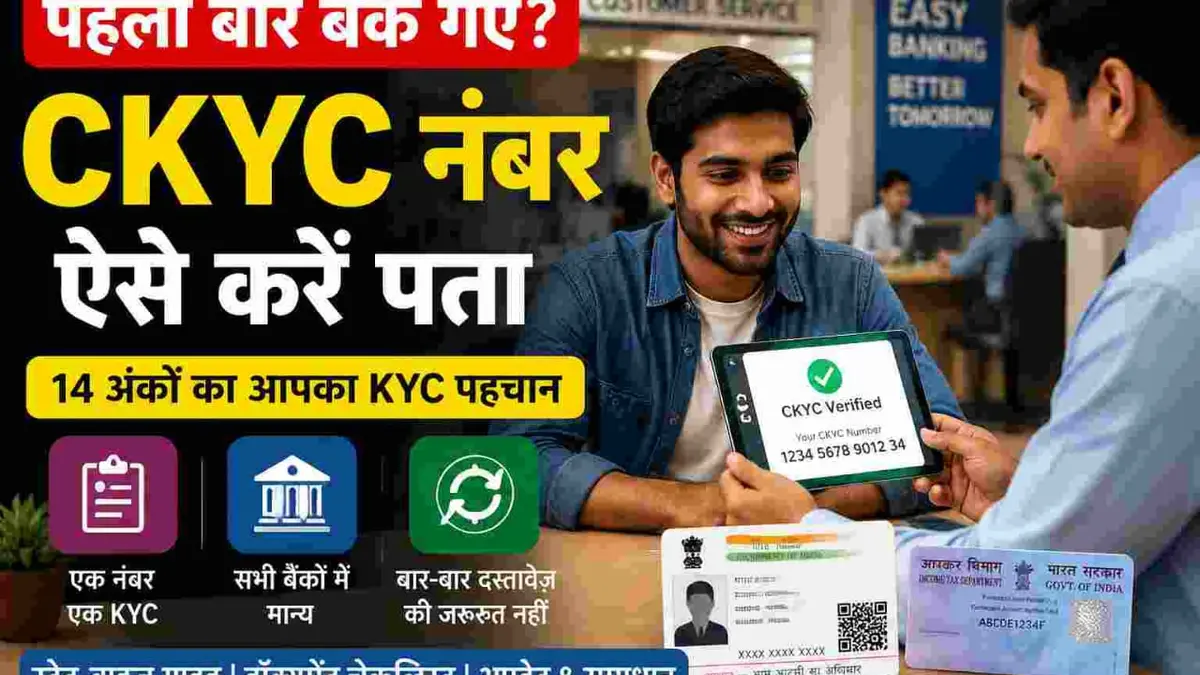

If you have opened a bank account, invested in a mutual fund, or bought an insurance policy in India in the last few years, there is a good chance you already have a CKYC number — even if nobody explicitly told you about it.
For first-time bank customers, this number often comes up during account opening without much explanation. The staff might ask, "Do you have a CKYC number?" and many people simply do not know how to answer. Here is what it means, how to track yours down, and what to do if something does not match.
What Exactly Is a CKYC Number
CKYC stands for Central KYC — a system set up under the Prevention of Money Laundering Act to stop Indians from submitting the same identity documents over and over at every bank, insurer, or mutual fund house they deal with.
When you complete KYC for the first time at any regulated financial institution, your verified details — PAN, Aadhaar, address proof, photograph — get uploaded to the Central KYC Registry (CKYCR). This registry is managed by CERSAI, the Central Registry of Securitisation Asset Reconstruction and Security Interest of India. In return, you are issued a unique 14-digit identifier. This is your CKYC number, also called the KIN, or KYC Identification Number.
Once you have it, any other bank, NBFC, mutual fund, or insurance company can pull your verified KYC record from the registry with your consent, instead of asking you to fill fresh forms and resubmit documents. It is not your PAN, your Aadhaar, or your bank account number — it is a separate reference code that points to your stored identity record.
How to Find Your CKYC Number
There is no public website where you can simply log in and look up your own CKYC number, since individual access to the registry is restricted to regulated entities, not customers directly. That said, there are a few reliable ways to track it down.
Check your KYC confirmation message. When CERSAI generates your KIN, it is usually sent by SMS or email to the mobile number and address you registered during KYC. Search your inbox or messages for terms like "CKYC" or "KIN."
Ask the institution where you first completed KYC. Your bank, insurer, or the mutual fund house that onboarded you can look up your CKYC number and share it with you on request.
Use a KRA portal if you have invested in mutual funds or stocks. KYC Registration Agencies such as CVL KRA, CAMS KRA, KARVY KRA, and NDML let you check your KYC status using your PAN. While these portals are built for KYC status verification rather than displaying the CKYC number directly, they will tell you whether your KYC is validated, registered, or on hold — useful context if you are trying to figure out why a new account opening is stuck.
Check your account opening documents or welcome kit. Some banks print the CKYC number or acknowledgment number on the KYC form copy or welcome letter they hand over after account opening.
If none of these work, the safest option is to visit the branch or contact the customer care of the institution and ask them to retrieve it against your PAN and date of birth.
Documents Needed If You Are Completing CKYC for the First Time
If you are a genuinely first-time customer with no prior KYC anywhere, you will need to complete the process fresh. The standard document checklist includes:
- PAN card
- Aadhaar card (or another officially valid document for identity and address proof)
- A recent passport-size photograph
- A cancelled cheque or bank statement, if requested for account-linking purposes
Most banks now also offer video KYC or Aadhaar-based e-KYC, which can shorten this to a same-day process instead of requiring physical document submission.
What Happens If Your CKYC Details Do Not Match
A common problem first-time and existing customers run into is a KYC "mismatch" — where your name, date of birth, address, or PAN details on the CKYC record do not line up with what a new institution has on file. This typically shows up as an "on hold" or "rejected" KYC status rather than a validated one, and it can stop you from opening an account or completing a transaction until it is fixed.
Common causes include:
- PAN not linked with Aadhaar
- Mismatched name spelling or date of birth between PAN and Aadhaar
- Outdated address that no longer matches your current KYC document
- Email or mobile number not verified with the KRA
To fix this, you generally need to visit the relevant KRA's website (CVL, CAMS, KARVY, or NDML), enter your PAN, and complete an OTP-based verification of your mobile number and email. If the mismatch involves a document like your address proof, the institution updating your KYC will ask you to submit the correct document, after which the update reflects across the central registry within the regulatory timeline.
Why This Matters for You
For a first-time customer, having a valid, updated CKYC record means faster account opening, quicker loan processing, and fewer trips to a branch with a folder of photocopies. Once your KYC is validated centrally, opening a new savings account, starting an SIP, or buying insurance becomes largely a matter of quoting your CKYC number and completing an OTP-based consent — not resubmitting your entire document set again.
Key Takeaways
- Your CKYC number is a 14-digit identifier issued by CERSAI once your KYC is uploaded to the central registry.
- You cannot look it up on a public portal yourself — check your SMS/email confirmation, ask your bank, or use a KRA status-check tool.
- A mismatch in PAN, Aadhaar, or contact details can put your KYC on hold; this is fixed through the relevant KRA portal.
- Once validated, your CKYC number lets you skip repeated document submission across banks, insurers, and mutual funds.
If you are unsure whether your KYC is currently active or on hold, LabhGrow's CKYC Status Checker can help you verify your status before you head to a branch or apply for a new financial product.
Conclusion
For someone opening a bank account for the first time, the CKYC number can feel like unnecessary jargon — until it saves you a second trip to submit documents you have already handed over elsewhere. Knowing where to look for it, and how to fix a mismatch quickly, means one less delay the next time you open an account, buy a policy, or start investing.
For More Information -
How to Find and Download CKYC Number Online (2026 Guide)
Disclaimer: The information provided on Labhgrow.in is for educational purposes only. We are not affiliated with the Income Tax Department, NSDL (Protean), or UTIITSL. Delivery times and tracking processes are subject to government portal functionality. Please never share your PAN details or OTPs with unauthorized third-party websites.

Head of Content & Lead Writer
Senior financial & news writer specializing in Indian government schemes, market rates, and banking policies.
lakshyabhardwaj.hoc@labhgrow.in
Senior Research Analyst (Fact-Checker)
Dedicated researcher and data verifier ensuring 100% authenticity and fact-checking from primary government and financial feeds.
harshitsharma.sra@labhgrow.in