Indian Rupee Falls: Why INR Weakens Against Dollar
Overview
Indian rupee falls sharply against dollar after Iran conflict. Know reasons, impact on economy, imports, and forex market trends.

Introduction
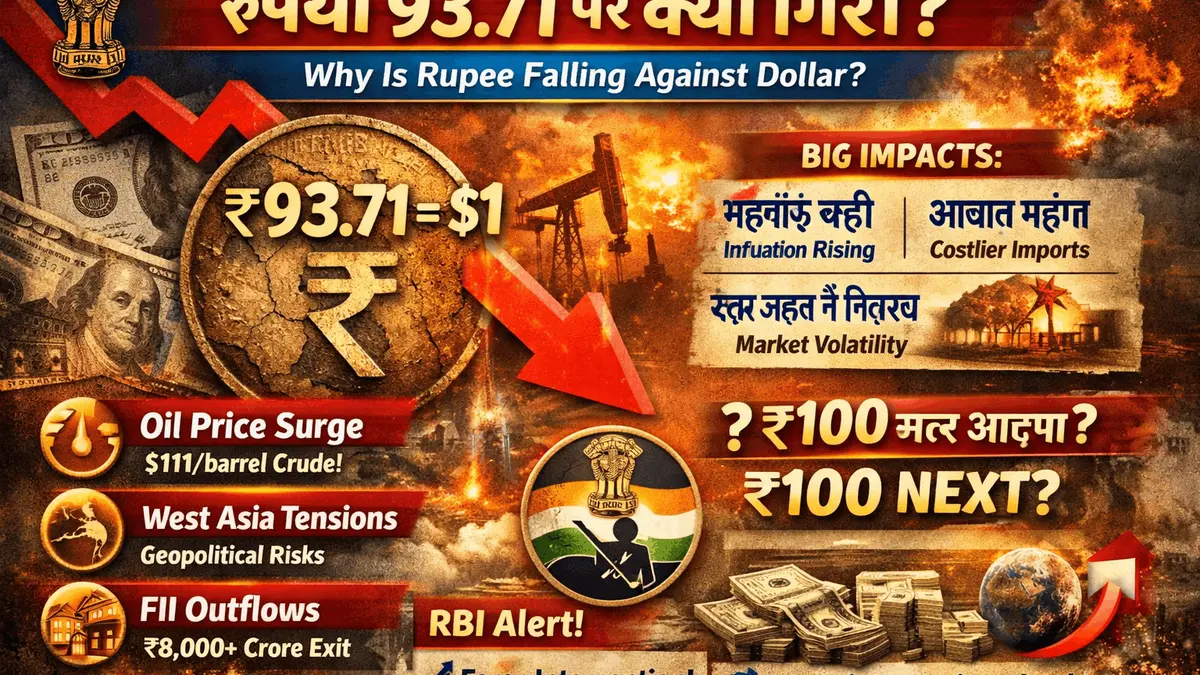
The rupee fall against the US dollar has once again become a major concern for the Indian economy. Recently, the Indian rupee weakened sharply from ₹90.95 to ₹93.38 per dollar, mainly due to rising global tensions after the Iran conflict. This sudden depreciation has raised questions among investors, businesses, and common citizens.
In this article, we will explain why the rupee is falling, its impact on the economy, and what it means for you.
Why Is the Indian Rupee Falling?
1. Global Geopolitical Tensions
The primary reason behind the recent rupee fall is the Iran conflict. Any instability in the Middle East affects global markets because:
- Oil prices rise
- Investors move to safer assets like USD
- Emerging market currencies weaken
2. Strong US Dollar
The US dollar is strengthening globally due to:
- Higher US interest rates
- Strong economic data
- Increased demand for safe investments
This makes the rupee weaker in comparison.
Impact of Iran Conflict on Currency
Oil Price Shock
India imports most of its crude oil. When conflict arises:
- Oil prices increase
- Import bills rise
- Demand for dollars increases
This directly weakens the rupee.
Forex Market Reaction
The forex market reacted quickly to global uncertainty:
- Investors sold emerging market currencies
- Demand for USD surged
- INR dropped rapidly
Key Movement
- ₹90.95 ➝ ₹93.38 (sharp fall)
Impact on Indian Economy
1. Expensive Imports
A weak rupee means:
- Higher fuel prices
- Costlier electronics
- Increased inflation
2. Pressure on Inflation
As import costs rise, inflation may increase, affecting:
- Household budgets
- Food and fuel prices
3. Benefit for Exporters
Not all effects are negative:
- Exporters earn more in rupees
- IT and pharma sectors benefit
Who Is Affected the Most?
Common People
- Higher petrol and diesel prices
- Expensive imported goods
Businesses
- Increased raw material costs
- Lower profit margins
Investors
- Market volatility increases
- Foreign investment may reduce
Step-by-Step: How Rupee Depreciation Happens
Global crisis begins
Investors shift to USD
Demand for dollar increases
Rupee supply rises in market
Rupee value falls
What Government and RBI Can Do
Possible Measures
- RBI may sell dollars to stabilize rupee
- Interest rate adjustments
- Import control policies
Future Outlook
Experts believe the rupee may remain volatile due to:
- Continued global tensions
- Oil price fluctuations
- US monetary policy
However, strong domestic fundamentals can limit extreme fall.
Rupee Movement Analysis
| Factor | Impact on Rupee |
|---|---|
| Iran Conflict | Negative |
| Rising Oil Prices | Negative |
| Strong US Dollar | Negative |
| Export Growth | Positive |
| RBI Intervention | Stabilizing |
The Indian rupee is falling due to global tensions, rising oil prices, and a strong US dollar. The Iran conflict increased demand for dollars, causing the rupee to drop from ₹90.95 to ₹93.38, impacting imports, inflation, and the overall economy.
See goverment scheme Government Schemes - LabhGrow
Gold rate Today 👇👇👇👇👇👇
PM Kisan Sammannidhi👇👇👇👇
Disclaimer: The information provided on Labhgrow.in is for educational purposes only. We are not affiliated with the Income Tax Department, NSDL (Protean), or UTIITSL. Delivery times and tracking processes are subject to government portal functionality. Please never share your PAN details or OTPs with unauthorized third-party websites.

Head of Content & Lead Writer
Senior financial & news writer specializing in Indian government schemes, market rates, and banking policies.
lakshyabhardwaj.hoc@labhgrow.in
Senior Research Analyst (Fact-Checker)
Dedicated researcher and data verifier ensuring 100% authenticity and fact-checking from primary government and financial feeds.
harshitsharma.sra@labhgrow.in