PM SHRI Schools 2026: List, Eligibility & Facilities
Overview
PM SHRI upgrades 14,500+ govt schools under NEP 2020 with smart classrooms, green campuses. Check eligibility, state list and admission process.
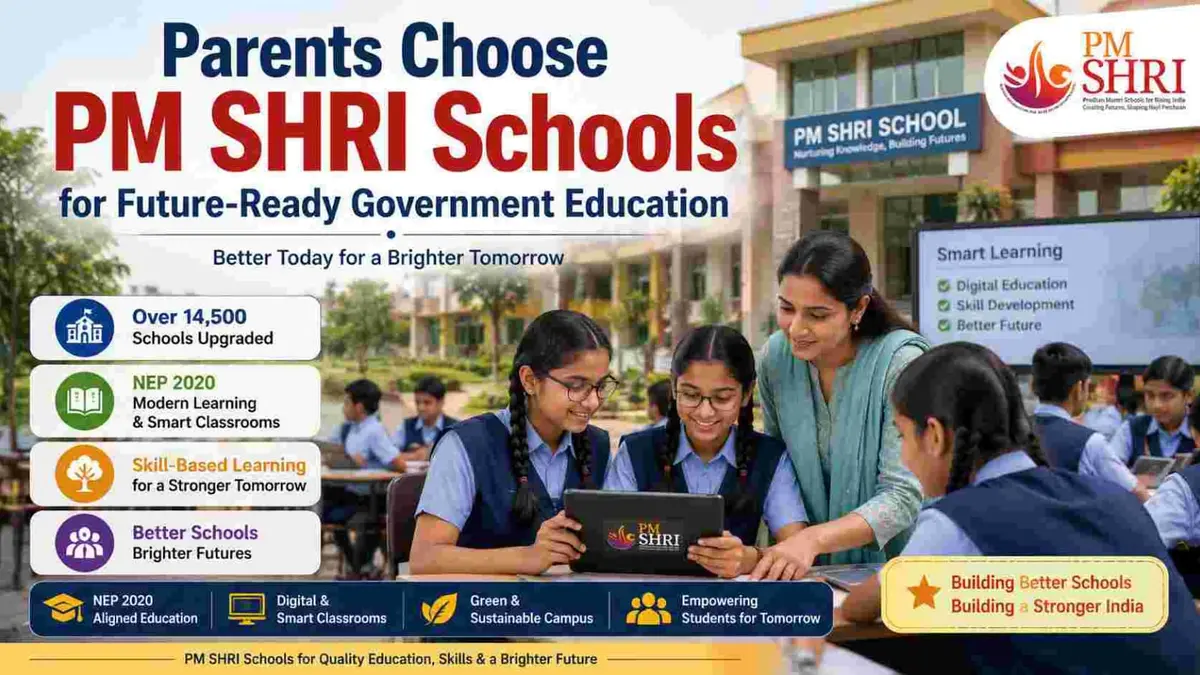

For lakhs of parents who send their children to government schools, the biggest worry has always been the same: will my child get the same quality of education as a private school student? The Pradhan Mantri Schools for Rising India (PM SHRI) scheme is the Centre's answer to that question, and it is now visible on the ground in thousands of schools across the country.
Approved by the Union Cabinet on September 7, 2022, PM SHRI is a Centrally Sponsored Scheme designed to upgrade select government schools into model institutions that reflect the vision of the National Education Policy (NEP) 2020. Instead of building new schools, the scheme strengthens existing government and local body-run schools that already meet basic infrastructure and governance standards.
What Is the PM SHRI Scheme
PM SHRI stands for "PM Schools for Rising India." The scheme aims to develop more than 14,500 schools across India as model institutions between 2022-23 and 2026-27. These schools are meant to act as "lead schools" for their region, showcasing NEP 2020 practices such as experiential learning, multilingual education, and skill-based teaching to nearby institutions.
The total project outlay is approximately ₹27,360 crore, with the Central government's share estimated at around ₹18,128 crore over the five-year period. Funding is shared between the Centre and states on a 60:40 basis for most states, 90:10 for northeastern and Himalayan states, and fully funded by the Centre for union territories without a legislature, along with Kendriya Vidyalayas (KVS) and Navodaya Vidyalayas (NVS).
Where the Scheme Stands Today
According to Ministry of Education data, a total of 13,076 PM SHRI schools had been established across 33 states and union territories as of late 2025. Uttar Pradesh leads with 1,725 selected schools, the highest of any state. Of the total schools selected so far, 9,373 are located in rural areas and 4,003 in urban centres, showing a clear focus on strengthening rural government education.
States continue to add new schools to the list. Gujarat's Kutch district, for instance, recently approved 18 additional schools under the scheme, to be developed with state government support alongside 16 schools already receiving central grants.
What Makes a School Eligible
PM SHRI does not create new schools; it upgrades existing ones. Government and local body-managed elementary, secondary and senior secondary schools can apply if they meet minimum infrastructure, governance and performance benchmarks set by the Ministry of Education.
Selection happens through a seven-stage "Challenge Mode" process:
1. State onboarding
2. Eligibility screening
3. Self-assessment through the School Quality Assessment Framework (SQAF)
4. Field verification
5. State-level recommendation
6. Central appraisal
7. Final approval
Typically, up to two schools per block — one elementary and one secondary or senior secondary — are selected based on around 60 point-based criteria, including availability of drinking water, playgrounds and boundary walls.
Facilities Students Can Expect
Once selected, schools are upgraded with a mix of infrastructure and teaching resources appropriate to their level:
- For younger students: child-friendly furniture, outdoor play equipment, and early-learning tools like the "Bala" feature and "Jaadui Pitara" kits
- For secondary and senior secondary students: smart classrooms, integrated science labs (physics, chemistry, biology), computer/ICT labs, skill labs, and well-equipped sports facilities
- Across all levels: green campus initiatives, digital libraries, and teacher training aligned with NEP 2020 goals
Why This Matters for Parents and Students
For a family relying on government schooling, a PM SHRI upgrade can mean access to facilities that were once limited to private institutions — without the accompanying fee burden. Students get exposure to smart classrooms and skill-based learning, while teachers receive structured training to deliver the NEP 2020 curriculum effectively.
Parents planning ahead for their child's broader education journey, including future higher studies, can also explore financial planning tools such as an education loan EMI calculator to estimate costs well in advance.
The scheme runs only until 2026-27, after which states and union territories are expected to independently maintain the standards achieved. This makes the next couple of years critical for schools still in the pipeline to secure PM SHRI status.
Key Takeaways
- PM SHRI aims to upgrade 14,500+ government schools by 2026-27 under NEP 2020
- 13,076 schools have been established so far across 33 states and UTs
- Uttar Pradesh has the highest number of selected schools at 1,725
- Schools get smart classrooms, science labs, digital libraries and green campus facilities
- Existing government/local body schools are upgraded — no new schools are built
- Selection follows a seven-stage Challenge Mode process based on around 60 criteria
Conclusion
PM SHRI is steadily reshaping government school education across India, giving students in both rural and urban areas access to modern classrooms and NEP-aligned teaching. With over 13,000 schools already functional and more being added each year, parents keen on a PM SHRI school for their child should track their state education department's updates closely as the scheme moves toward its 2026-27 deadline.
For More Information -
PM SHRI Schools — India Central Scheme 2026
> Disclaimer: The content provided on LabhGrow is for educational and informational purposes only. We are not a SEBI-registered investment advisor. Please consult a qualified financial advisor before making any investment or financial decisions. LabhGrow is not responsible for any loss or damage arising from the use of this information.

Head of Content & Lead Writer
Senior financial & news writer specializing in Indian government schemes, market rates, and banking policies.
lakshyabhardwaj.hoc@labhgrow.in
Senior Research Analyst (Fact-Checker)
Dedicated researcher and data verifier ensuring 100% authenticity and fact-checking from primary government and financial feeds.
harshitsharma.sra@labhgrow.in