KVP 2026: Post Office Scheme Doubles Money in 115 Months
Overview
Kisan Vikas Patra pays 7.5% interest in 2026, doubling your money in 115 months. Check eligibility, documents, calculator and how to apply at the post office.
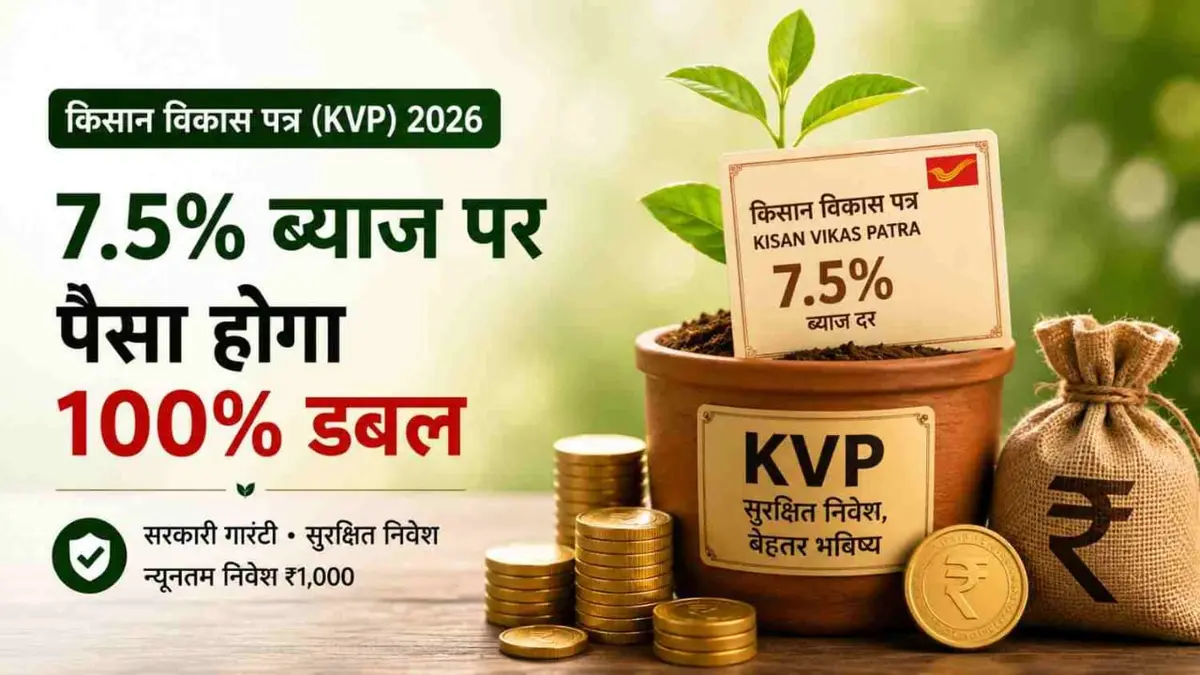

If you are looking for a savings option where the government guarantees your returns and the market has no say in the outcome, Kisan Vikas Patra continues to be one of the most straightforward choices available at your local post office in 2026.
Kisan Vikas Patra, or KVP, is a fixed-tenure, government-backed savings certificate sold through India Post and select banks that doubles a one-time lump-sum investment over a fixed period, and it traces its roots back to 1988, though it is now open to every resident Indian adult, not just farmers. For someone who has a windfall, a bonus, or idle savings sitting in a low-interest account, KVP offers a simple promise: put your money in once, and walk away knowing exactly what you will get and when.
What Is the Current KVP Interest Rate in 2026?
For the July–September 2026 quarter, the Government of India has retained the KVP interest rate at 7.5% per annum, allowing investments to double in approximately 115 months, which works out to 9 years and 7 months. This rate is set by the Ministry of Finance every quarter and has stayed unchanged for eight consecutive quarters, giving investors a fair amount of predictability.
Quick Take: Deposit ₹1,00,000 in KVP today, and at the current 7.5% rate, you can expect roughly ₹2,00,000 back after 115 months — with the government standing behind every rupee.
Why the "115 Months" Number Matters
This figure is not a marketing gimmick. The doubling period is derived mathematically from the rate itself — at 7.5% compounded annually, money takes roughly 115 months to double, and the government prints this exact maturity period on the certificate so savers know their payout date in advance. The maturity proceeds continue to accrue interest even after the 115-month period if you choose not to withdraw immediately.
How Much Do You Need to Start?
You can begin investing in KVP with as little as ₹1,000, and there is no upper limit on how much you can put in. Certificates are available in denominations of ₹1,000, ₹5,000, ₹10,000, and ₹50,000, though the ₹50,000 denomination is generally available only at the head post office of a city.
Illustrative Returns at 7.5% (approximate, based on the 115-month doubling rule):
| Investment Amount | Expected Maturity Value | Approx. Maturity Period |
|---|---|---|
| ₹1,000 | ₹2,000 | 115 months |
| ₹1,00,000 | ₹2,00,000 | 115 months |
| ₹5,00,000 | ₹10,00,000 | 115 months |
Note: These figures assume the 7.5% rate holds through the tenure of your specific certificate, since the rate applicable at the time of purchase remains locked in for that certificate.
Can You Withdraw Before Maturity?
KVP does carry a lock-in period of 30 months, or two years and six months, and early encashment is generally not permitted before that except in cases such as the death of the account holder or under a court order. This makes KVP better suited to money you genuinely don't need in the near term, rather than a short-term parking option.
Does the Rate Change After You Invest?
No. Once you invest, the applicable interest rate remains fixed for your certificate until maturity, and future quarterly revisions to the KVP rate will not affect certificates you already hold. This is one of the reasons conservative investors continue to favour the scheme even though it does not offer any tax deduction on the investment itself.
How to Open a KVP Account: Step-by-Step
1. Visit your nearest post office — or an authorised bank branch that offers KVP — and ask for Form A, either in person or by downloading it beforehand.
2. Fill in your details, including your name, nominee information, and whether you want a single or joint account.
3. Attach KYC documents — Aadhaar, PAN, and address proof are typically required.
4. Make your deposit through cash, cheque, demand draft, or another accepted payment mode.
5. Collect your certificate — after verification, the post office issues your KVP certificate (or an electronic record) showing the investment amount and exact maturity date.
6. Add a nominee, if you haven't already, so the payout process stays smooth in case of any unforeseen event.
Is the Interest From KVP Taxable?
Yes. The interest earned from KVP is taxable, though no TDS is deducted at the time of maturity — investors are responsible for declaring this interest when filing their income tax return. Unlike schemes such as PPF, KVP does not come with any special tax deduction benefit under the Income Tax Act.
Who Can Invest in KVP?
Any eligible resident Indian can invest in the Kisan Vikas Patra Scheme through India Post or authorised banks. It can be opened as a single account, jointly with another adult, or on behalf of a minor.
Conclusion
Kisan Vikas Patra remains one of the simplest ways to grow a lump sum with zero market risk. At the current 7.5% rate, your money is set to double in 115 months, and once you invest, that rate is locked in regardless of what happens to interest rates afterward. It won't suit someone chasing high growth or needing liquidity soon, but for a saver who wants certainty and government backing, KVP still does exactly what it promises.
> Disclaimer: The content provided on LabhGrow is for educational and informational purposes only. We are not a SEBI-registered investment advisor. Please consult a qualified financial advisor before making any investment or financial decisions. LabhGrow is not responsible for any loss or damage arising from the use of this information.

Head of Content & Lead Writer
Senior financial & news writer specializing in Indian government schemes, market rates, and banking policies.
lakshyabhardwaj.hoc@labhgrow.in
Senior Research Analyst (Fact-Checker)
Dedicated researcher and data verifier ensuring 100% authenticity and fact-checking from primary government and financial feeds.
harshitsharma.sra@labhgrow.in