Best Zero-Balance Student Savings Account Guide 2026
Overview
Compare top student savings account options for 2026 with zero balance, RBI rules, and DICGC insurance cover. Find the best bank and apply now.
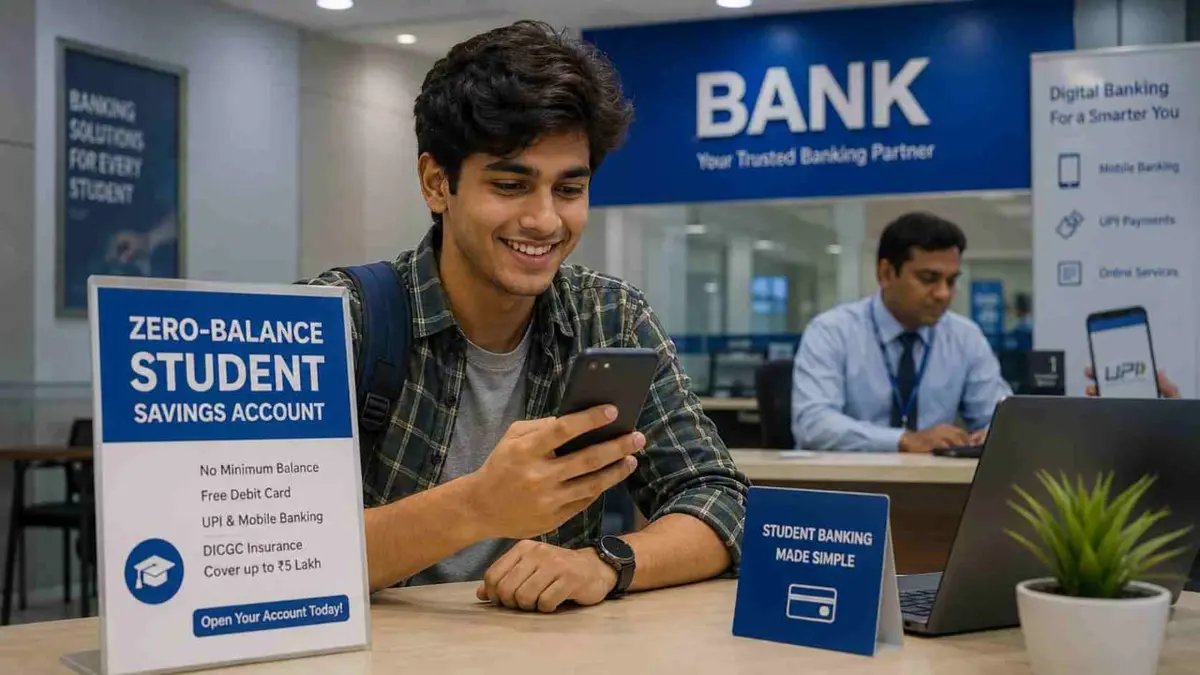

For most college students, the first bank account isn't about big investments. It's about a safe place to receive pocket money, scholarship transfers, or that first internship stipend, without a bank quietly deducting fees for not maintaining a balance. That's exactly the gap a zero balance student savings account is meant to fill, and in 2026, the options have actually gotten better.
What Is a Zero-Balance Student Savings Account?
A zero-balance account is a savings account that doesn't require you to maintain a minimum monthly balance. If your account dips to ₹0, you won't be charged a penalty, and you can still use most core banking services like UPI, debit cards, and fund transfers.
For students managing anywhere between ₹0 and ₹10,000 at a time, this structure removes the constant worry of balance-related deductions eating into small savings.
RBI's BSBDA Framework: Why Zero-Balance Accounts Exist
Every zero-balance account in India traces back to the Reserve Bank of India's Basic Savings Bank Deposit Account (BSBDA) framework. Under this rule, every bank operating in India must offer a savings account with no minimum balance requirement, along with a set of free basic services.
The RBI has recently strengthened this framework further. Amended BSBDA directions are set to take effect from April 1, 2026, expanding the list of free services available on these accounts, including free ATM-cum-debit cards, free chequebooks, free digital banking, and a minimum number of free cash withdrawals every month. Importantly, UPI, NEFT, RTGS, and IMPS transactions will not count toward these withdrawal limits, which is good news for students who rely heavily on digital payments.
One condition to keep in mind: you're allowed to hold only one BSBDA-type zero-balance account across all banks at a time, so it's worth comparing your options before opening one.
ICICI Bank Student Savings Account: Features You Should Know
ICICI Bank offers a dedicated Student Savings Account, often bundled as a 3-in-1 account combining savings, demat, and trading facilities, though students can also opt for just the savings component.
Here's what makes it useful for students:
- No minimum balance requirement for eligible student accounts
- Access to iMobile Pay app for UPI payments, fund transfers, and balance checks
- A credit card option with no joining or annual fee for eligible students
- Easy upgrade path to a regular or salary account once you graduate and start earning
Students typically need to be enrolled at a participating institute to access some student-specific benefits, so it's worth checking with your college or the bank branch on eligibility. You can explore the account details directly on the bank's official page: ICICI Bank Savings Account.
Kotak Zero-Balance Account for Students: What's on Offer
Kotak Mahindra Bank's 811 digital account line is one of the most popular zero-balance options in India, largely because it can be opened entirely online using just PAN and Aadhaar, without visiting a branch.
For students specifically, Kotak also runs the UNI Student Account, built as a digital-first banking product with Video KYC-based account opening, so there's no need to step into a branch at all.
A quick note if you're opening through a promotional or referral link: some Kotak account variants may ask for an initial deposit of around ₹2,000 at the time of opening. This amount isn't a fee — it stays in your account as your own balance, and several referral offers credit back this exact amount as a joining bonus. Always read the specific terms shown at the time of account opening before proceeding.
Open Kotak Bank Zero Balance Account
Quick Tip: If you're a student who transacts mostly through UPI and rarely visits a branch, a fully digital account like Kotak 811 or ICICI's mobile-first student account will likely serve you better than a traditional branch-based account.
ICICI vs Kotak: Which One Should Students Choose?
Both banks serve slightly different needs. Here's a simple comparison to help you decide:
| Feature | ICICI Student Savings Account | Kotak 811 / UNI Student Account |
|---|---|---|
| Minimum Balance | Zero (for eligible students) | Zero (₹2,000 for some referral offers) |
| Account Opening | Branch or eligible institute tie-up | Fully online, Aadhaar-based |
| Best For | Students wanting investment tools (demat/trading) | Students wanting a fully digital, branch-free account |
| Credit Card | No joining/annual fee for eligible students | Not a core feature |
| Mobile App | iMobile Pay | Kotak811 App |
If you're still deciding between a savings account and a fixed deposit for any surplus funds beyond your daily UPI balance, LabhGrow's free Savings & FD Calculator can help you quickly compare returns before you decide where to park extra money.
How Safe Is Your Money? Understanding DICGC Insurance
Whichever bank you choose, your deposits are protected under the Deposit Insurance and Credit Guarantee Corporation (DICGC), a wholly-owned subsidiary of the RBI. Every eligible bank deposit, including savings accounts, is insured up to ₹5 lakh per depositor per bank, covering both principal and interest.
So even in the rare event of a bank running into trouble, your student savings account balance, as long as it's within ₹5 lakh, remains protected. For most students managing ₹0 to ₹10,000, this is far more coverage than you're ever likely to need, but it's reassuring to know the safety net exists.
Step-by-Step Guide: How to Open a Zero-Balance Student Account Online
1. Choose your bank and account type Decide between a branch-assisted student account (like ICICI's) or a fully digital option (like Kotak 811 or UNI Student Account) based on how you prefer to bank.
2. Keep your documents ready You'll typically need your PAN card, Aadhaar card, a recent passport-size photo, and college ID or admission proof for student-specific accounts.
3. Start the online application Visit the bank's official website or download its app, then select the student or zero-balance savings account option.
4. Complete Aadhaar-based verification Enter your Aadhaar number and verify using the OTP sent to your Aadhaar-linked mobile number.
5. Complete Video KYC Most digital accounts require a short video call with a bank representative to verify your identity in real time. Keep your original PAN card handy during this step.
6. Fund your account (if required) Some account variants may need an initial deposit. Check the exact terms shown during opening, especially if you're using a referral or promotional link.
7. Start banking Once your account is active, you can generate a virtual debit card, set up UPI, and begin using mobile banking immediately.
Key Takeaways
- Zero-balance student accounts remove the pressure of maintaining a minimum balance while still offering full digital banking access.
- RBI's revised BSBDA rules from April 1, 2026 add more free services, including free debit cards, chequebooks, and unrestricted digital transactions.
- ICICI suits students who want investment tools alongside banking; Kotak suits students who want a fully digital, branch-free experience.
- All eligible deposits are protected up to ₹5 lakh under DICGC insurance, regardless of which bank you choose.
- You can hold only one BSBDA-type zero-balance account at a time across banks, so compare before opening.
Conclusion
Choosing a zero-balance student savings account in 2026 isn't just about avoiding penalty charges anymore, it's about picking a bank that fits how you actually use money as a student: mostly through UPI, occasionally through a debit card, and rarely through a physical branch. Both ICICI and Kotak offer solid, RBI-backed zero-balance options built for exactly this kind of usage, and with DICGC insurance backing your deposits, either choice keeps your savings safe while you focus on college.
The content provided under the Bank Schemes category on LabhGrow is for educational and informational purposes only, intended to give readers a general understanding of bank schemes, interest rates, offers, and financial products available in the market. LabhGrow is not a bank, NBFC, or SEBI-registered investment advisor, and is not affiliated with, endorsed by, or representing any bank or financial institution mentioned in this article. LabhGrow does not sell, promote, or facilitate any banking or financial product on behalf of any institution. Interest rates, scheme terms, and eligibility conditions mentioned here are based on publicly available information at the time of publishing and are subject to change by the respective bank or the Reserve Bank of India (RBI) without prior notice. Please consult the official bank branch, customer care, or authorised representative, and a qualified financial advisor, before making any investment, deposit, loan, or other financial decision. LabhGrow is not responsible for any loss or damage arising from the use of this information.

Head of Content & Lead Writer
Senior financial & news writer specializing in Indian government schemes, market rates, and banking policies.
lakshyabhardwaj.hoc@labhgrow.in
Senior Research Analyst (Fact-Checker)
Dedicated researcher and data verifier ensuring 100% authenticity and fact-checking from primary government and financial feeds.
harshitsharma.sra@labhgrow.inFrequently Asked Questions
Related News & Articles

RBI Repo Rate 2026: Effect on EMI, FD and Loans
Jul 23, 2026

BOI Mudra Loan Chhattisgarh: Eligibility & Process
Jul 17, 2026
India Post Payments Bank: How Doorstep Banking Is Transforming Financial Access in Rural India
Jul 2, 2026

IPPB Launches Zero Balance Account for Women SHGs — Big Banking Relief for Rural Women
May 6, 2026