Credit Card Masterclass Part 1: Plastic Money or Plastic Trap? The Ultimate Beginner’s Guide (2026)
Overview
Scared of Credit Cards? This Part 1 guide explains everything: Interest-free period, Minimum Due calculations, and Credit vs. Debit cards. Learn to use plastic money to your advantage without falling into debt.

Introduction: The Call You Always Reject We have all been there. You are in the middle of a meeting or enjoying your lunch, and your phone rings. "Sir, hum Bank se bol rahe hain. Aapke liye ek Pre-Approved Life Time Free Credit Card offer hai."
What do most Indians do? We say "No thanks" and cut the call immediately. Why? Because our parents taught us one golden rule: "Udhaar ki zindagi mat jiyo" (Don't live a life of debt).
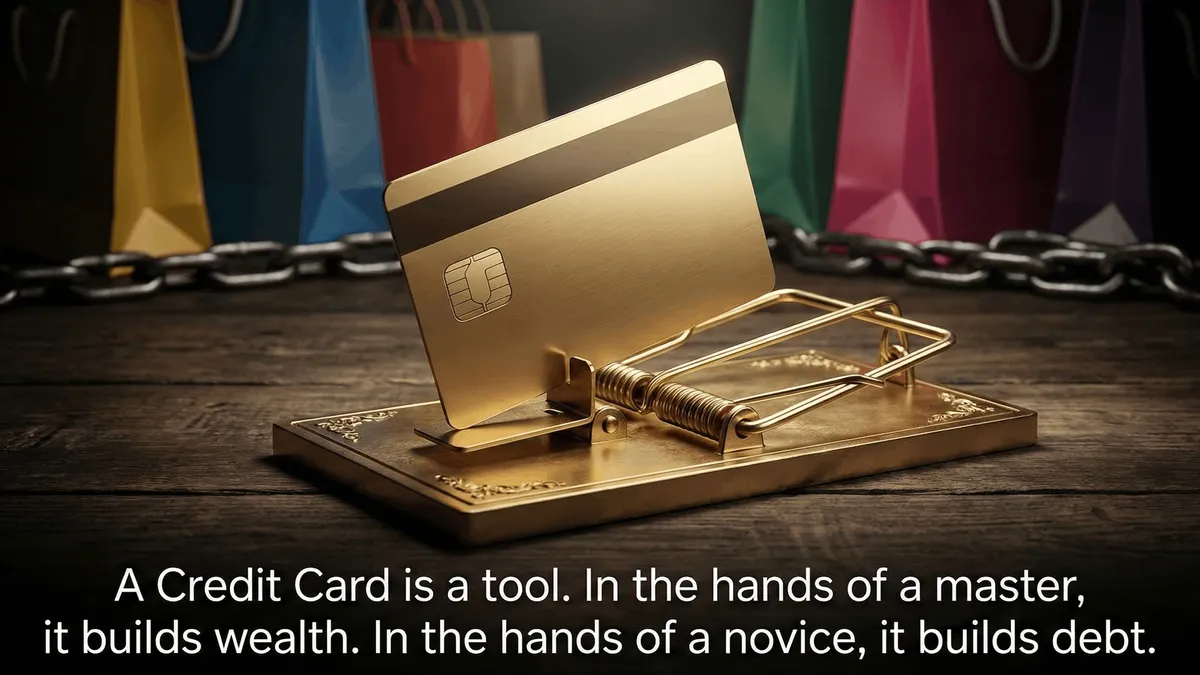
But here is the truth in 2026: Being scared of Credit Cards is a financial mistake. A Credit Card is not inherently "evil." It is just a sharp knife. In the hands of a surgeon, a knife saves lives. In the hands of a child, it causes injury.
Welcome to Part 1 of the Labhgrow Credit Card Masterclass. Over the next 4 blogs, we will transform you from a scared beginner to a Credit Card Expert. We will not sell you any card; we will only sell you the knowledge to beat the banks at their own game.
Section 1: What Actually is a Credit Card? (De-Mystified)
Let’s strip away the jargon. When you use a Debit Card, you are spending Your Own Money.
- You swipe the card -> The bank checks your savings account -> Money is deducted instantly.
- If your account is empty, the transaction fails. Simple.
When you use a Credit Card, you are spending The Bank’s Money.
- You swipe the card -> The bank pays the shopkeeper on your behalf.
- You promise the bank: "I will pay you back after 45 days."
- Essentially, it is a Short-Term, Interest-Free Loan that requires zero documentation for every transaction.
Why does the bank do this? Is the bank your friend? No. The bank hopes that you will spend more than you can repay. The moment you fail to pay back on time, they charge you an interest rate that is higher than any other loan in the world (we will discuss this in the 'Trap' section).
Section 2: The "Interest-Free Period" (The Golden Goose)
This is the single biggest advantage of a credit card. If you take a Personal Loan, interest starts from Day 1. If you use a Credit Card, you get a "Grace Period" of usually 45 to 50 days where the bank charges you ₹0 Interest.
How the Calculation Works: Let’s assume your Statement Date (Bill Date) is the 15th of every month.
- Scenario A: You buy a phone on May 16th.
- Since your bill just generated on May 15th, this new purchase will show up in the next bill (June 15th).
- You usually get 20 days after the bill date to pay (Due Date: July 5th).
- Total Time: May 16 to July 5 = Approx 50 Days Interest-Free.
- Scenario B: You buy a phone on June 14th.
- Your bill generates the very next day on June 15th.
- Due Date is July 5th.
- Total Time: June 14 to July 5 = Approx 21 Days Interest-Free.
Pro Tip: Smart users make big purchases (like Laptops, TV) immediately after their statement date to get the maximum time to pay.
Section 3: The Psychology of Spending (The "Pain of Paying")
Why do people fall into debt? It’s not math; it’s psychology. Behavioral economists call it the "Pain of Paying."
- Cash: When you count ₹500 notes and hand them to a cashier, you feel a physical sense of loss. Your brain registers the "pain." You hesitate.
- Credit Card: You swipe a piece of plastic. You get the product immediately, but the money doesn't leave your pocket. Your brain doesn't register the pain until the bill arrives 30 days later.
This "decoupling" of buying and paying causes people to spend 15% to 20% more on average when using credit cards compared to cash.
- Self-Check: Have you ever ordered extra food on Zomato just because you were paying online? That’s the psychology at work.
Section 4: The "Minimum Amount Due" (The Biggest Trap)
This is the most critical part of this blog. If you understand this, you will never be poor.
When your Credit Card bill arrives, you will see two numbers:
Total Amount Due: ₹20,000 (What you actually spent)
Minimum Amount Due (MAD): ₹1,000 (Usually 5% of total)
The bank will subtly highlight the "Minimum Due" option. Why? Because if you pay only the Minimum Due, the bank considers your payment "On Time" (so no late fee), BUT they start charging interest on the remaining ₹19,000 immediately.
The Horror of Credit Card Interest:
- Home Loan Interest: 8.5% per year.
- Personal Loan Interest: 12% per year.
- Credit Card Interest: 3.5% PER MONTH (42% Per Year).
If you keep paying only the minimum due on a ₹1 Lakh balance, it can take you 10 to 12 years to clear the debt, and you will end up paying 3 times the original amount.
Rule #1 of Labhgrow Academy: Always, Always, Always pay the "Total Amount Due". Ignore the "Minimum Due" button like it’s a virus.
Section 5: The "Cash Withdrawal" Suicide
Never, ever go to an ATM and withdraw cash using your Credit Card. This is called a Cash Advance.
- The Trap: Unlike shopping, there is NO Interest-Free Period for cash withdrawal.
- The Cost: The bank charges interest from the exact minute you withdraw the cash. Plus, they charge a "Cash Advance Fee" of ₹500 or more immediately.
- The Verdict: If you need cash, use your Debit Card. If you are broke, ask a friend. But never use a Credit Card at an ATM.
Section 6: Why Should You Still Use It? (The Good Side)
After reading the dangers, you might want to cancel your card. Don’t do that. If used correctly (paying the full bill on time), Credit Cards are powerful wealth-building tools.
CIBIL Score Builder: This is the only way to build a credit history without taking a loan. A good CIBIL score (750+) saves you lakhs in interest when you eventually take a Home Loan. (More on this in Part 2).
Rewards & Cashback: Imagine getting 1% to 5% money back on everything you buy. Debit cards rarely offer this.
Emergency Buffer: It acts as an interest-free emergency fund for medical issues or urgent travel.
Chargeback Protection: If a merchant cheats you or delivers a broken product, you can dispute the transaction on a credit card. You can't do that easily with UPI or Cash.
Conclusion: The Man vs. The Lion
Using a credit card is like taming a lion. If you control it, it performs for you (Rewards, Flights, CIBIL Score). If you let it control you, it eats you alive (42% Interest, Debt Trap).
In Part 1, we have cleared the basics. You now know that it is not free money; it is a loan. But wait, simply paying the bill is not enough. You need to know how to maximize your Credit Score and how to read those confusing Statements.
Coming Up in Part 2: Decoding the CIBIL Score, Understanding Billing Cycles like a Pro, and How to check if your bank is overcharging you.
Stay tuned to Labhgrow.in!
Disclaimer: The information provided in this series is for educational purposes only. Labhgrow.in does not promote any specific bank or credit card product. Credit limits and interest rates vary by user profile. Please use credit responsibly to avoid financial distress.

Head of Content & Lead Writer
Senior financial & news writer specializing in Indian government schemes, market rates, and banking policies.
lakshyabhardwaj.hoc@labhgrow.in
Senior Research Analyst (Fact-Checker)
Dedicated researcher and data verifier ensuring 100% authenticity and fact-checking from primary government and financial feeds.
harshitsharma.sra@labhgrow.in