Small Shop Owners: Use Digital Rupee for Safer QR Payments
आढावा (Overview)
India's RBI is promoting its Digital Rupee (e₹) as a secure, official Central Bank Digital Currency (CBDC) for small shop owners and consumers. Fully backed by the RBI and holding the same value as physical cash, e₹ offers instant, QR-based payments, distinct from cryptocurrencies. This new option expands India's digital ecosystem beyond UPI, providing an additional secure, familiar, and convenient way for merchants to accept payments as the CBDC pilot program continues to grow nationwide.
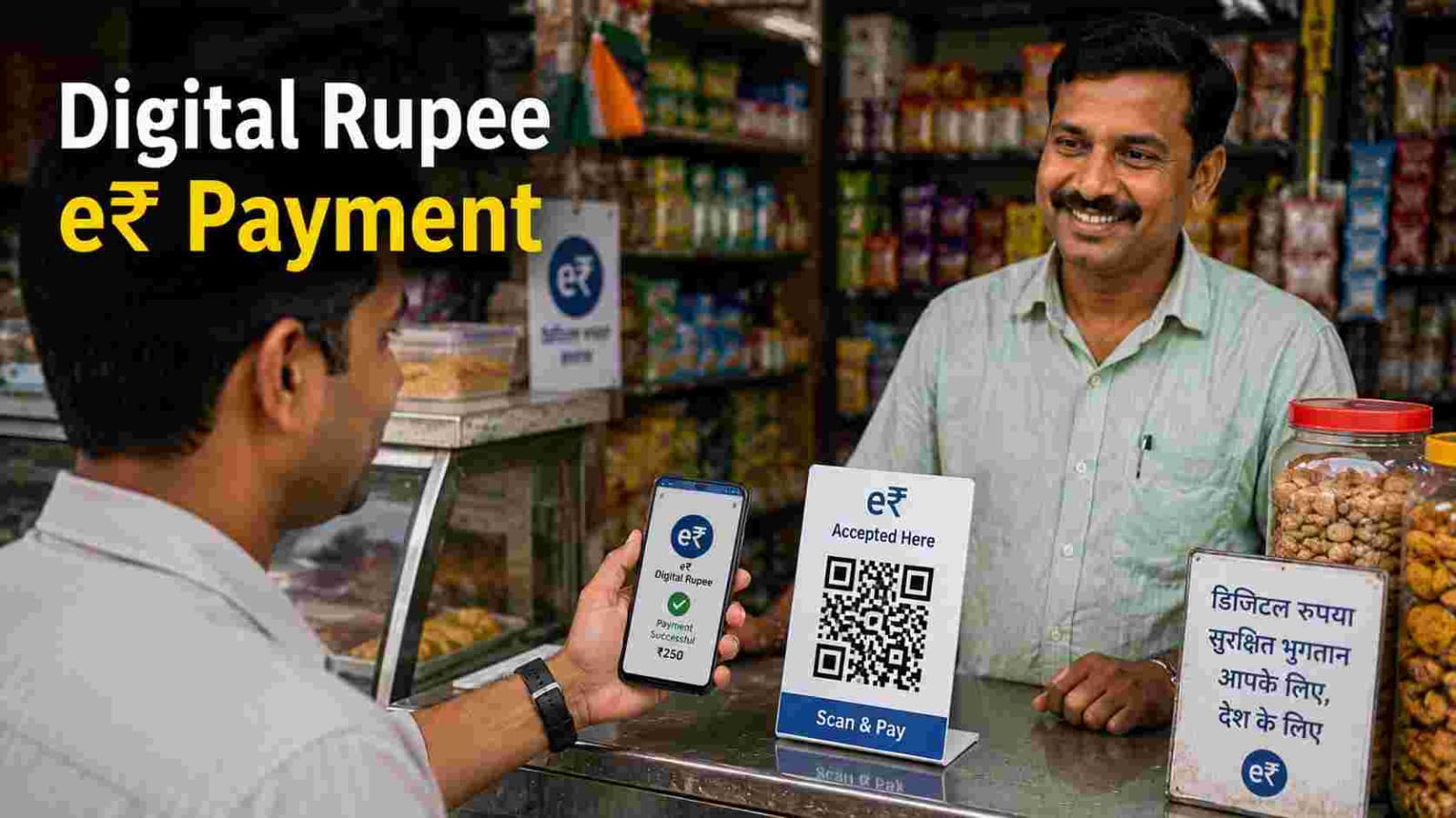

Small Shop Owners: Use Digital Rupee for Safer QR Payments
India's digital payments ecosystem is expanding beyond traditional UPI transactions with the Reserve Bank of India's Digital Rupee (e₹). Designed as India's official Central Bank Digital Currency (CBDC), the Digital Rupee offers a cash-like payment experience in digital form while remaining fully backed by the RBI.
For small shop owners, kirana stores, local businesses, and everyday consumers, the Digital Rupee provides another secure payment option that can work through supported e₹ wallets and compatible QR codes. As the RBI continues expanding its CBDC pilot, more banks and payment providers are joining the ecosystem, making adoption easier across the country.
What is the Digital Rupee (e₹)?
The Digital Rupee is India's official digital currency issued by the Reserve Bank of India. Unlike cryptocurrencies, it is a sovereign currency backed by the central bank and carries the same value as physical Indian Rupee notes.
Key features include:
- Issued and guaranteed by the RBI
- Equal in value to physical cash
- Not a cryptocurrency
- Stored in an approved Digital Rupee wallet
- Can be used for person-to-person and merchant payments
How QR Payments Work with e₹
Customers who have an eligible Digital Rupee wallet can pay merchants by scanning:
- A CBDC QR code, or
- Compatible UPI QR codes supported under the RBI's interoperability framework.
After scanning the QR code, the payment is completed using Digital Rupee tokens stored in the customer's wallet. Depending on the transaction route, settlement may occur directly between e₹ wallets or through interoperable payment infrastructure.
Why It Matters for Small Shop Owners
Digital Rupee aims to combine the convenience of digital payments with features similar to cash.
Potential benefits include:
- Secure RBI-backed digital money
- Instant digital payments
- Familiar QR-based payment experience
- Additional payment option alongside cash and UPI
- Support for India's growing digital payment ecosystem
Supported Banks and Wallet Availability
The RBI currently operates the retail Digital Rupee under a phased pilot involving selected banks and approved non-bank participants. Availability may differ from one state to another depending on participating institutions.
Several major banks participating in the retail e₹ ecosystem include:
| Bank | e₹ Wallet Availability* |
|---|---|
| State Bank of India | Yes |
| HDFC Bank | Yes |
| ICICI Bank | Yes |
| Axis Bank | Yes |
| Bank of Baroda | Yes |
| Punjab National Bank | Yes |
| Union Bank of India | Yes |
| Canara Bank | Yes |
| YES Bank | Yes |
| IDFC FIRST Bank | Yes |
| IndusInd Bank | Yes |
| Federal Bank | Yes |
| Indian Bank | Yes |
| Karnataka Bank | Yes |
| Kotak Mahindra Bank | Yes |
*Availability may depend on customer eligibility, pilot rollout, and bank-specific policies. Users should check with their bank before registering.
How to Activate an e₹ Wallet
Customers generally need to follow these steps:
Confirm that their bank supports the Digital Rupee.
Download the bank's official e₹ wallet app.
Register using the linked mobile number and complete the required verification.
Load Digital Rupee into the wallet from the linked bank account.
Start making payments by scanning compatible merchant QR codes.
Digital Rupee vs Cryptocurrency
Many users confuse the Digital Rupee with cryptocurrencies such as Bitcoin, but the two are fundamentally different.
| Digital Rupee | Cryptocurrency |
|---|---|
| Issued by RBI | Not issued by RBI |
| Legal tender | Generally not legal tender in India |
| Value equals ₹1 for ₹1 | Value fluctuates based on market demand |
| Government-backed | Not government-backed |
The RBI clearly states that the Digital Rupee is a digital form of the Indian Rupee and should not be treated as cryptocurrency.
Current Rollout Status
The Digital Rupee remains under a controlled pilot programme. The RBI continues to expand participation by adding banks, payment providers and new use cases, including government benefit distribution and cross-border payment experiments. Wider public adoption is expected to grow gradually as the pilot evolves.
Conclusion
The RBI's Digital Rupee is gradually becoming another important payment option for India's digital economy. For small shop owners, accepting e₹ through compatible QR codes can provide customers with an additional RBI-backed payment method while maintaining the convenience of QR-based transactions.
Although availability still depends on participating banks and pilot coverage, merchants and consumers interested in cash-like digital payments should monitor announcements from their banks as the RBI continues expanding the Digital Rupee ecosystem.
For More Information -
Disclaimer: The information provided on Labhgrow.in is for educational purposes only. We are not affiliated with the Income Tax Department, NSDL (Protean), or UTIITSL. Delivery times and tracking processes are subject to government portal functionality. Please never share your PAN details or OTPs with unauthorized third-party websites.

कंटेंट हेड आणि मुख्य लेखक
भारतीय सरकारी योजना, बाजार भाव आणि बँकिंग धोरणांचे तज्ञ असलेले ज्येष्ठ वित्तीय आणि वृत्त लेखक.
lakshyabhardwaj.hoc@labhgrow.in
वरिष्ठ संशोधन विश्लेषक (तथ्य तपासक)
सरकारी आणि वित्तीय डेटा स्रोतांकडून 100% अचूकता आणि तथ्य पडताळणी करणारे समर्पित संशोधक.
harshitsharma.sra@labhgrow.in