UP Rural Families: Check PMAY-G House Eligibility Before Applying
आढावा (Overview)
Planning to apply for PMAY-G in Uttar Pradesh? Check the latest eligibility rules, financial assistance, required documents, beneficiary status process, and common rejection reasons before submitting your application.
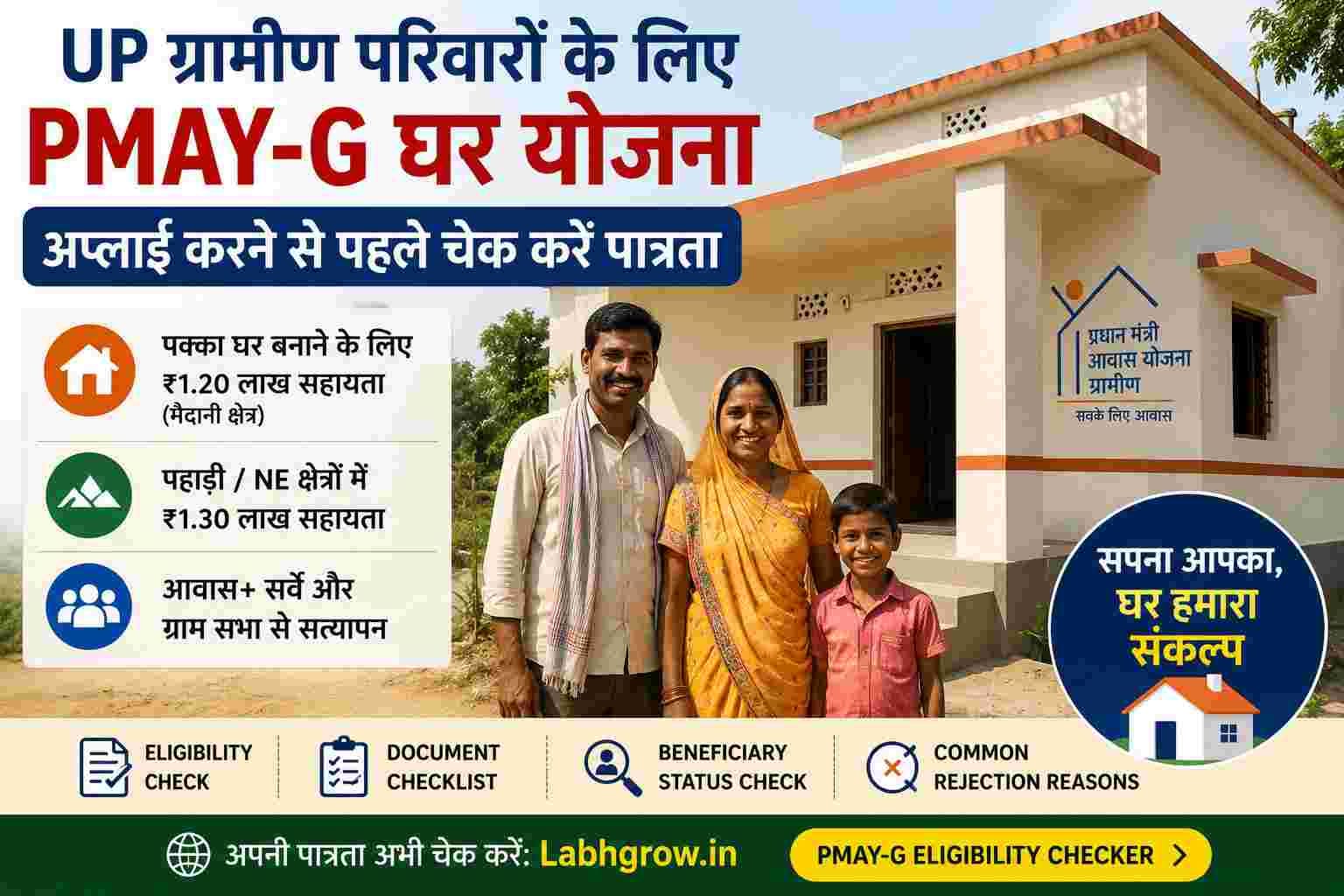

PMAY-G continues to support rural families without permanent homes
The Pradhan Mantri Awaas Yojana–Gramin (PMAY-G) is one of the Government of India's flagship rural housing programmes. It aims to provide financial assistance to eligible rural households that either do not own a pucca house or live in dilapidated kutcha houses.
The Union Cabinet has approved the continuation of PMAY-G for the 2024–29 period, with a target of constructing 2 crore additional rural houses. The scheme also includes an updated beneficiary identification process through the revised Awaas+ survey.
For rural families in Uttar Pradesh, checking eligibility before applying can save time and improve the chances of successful verification.
Who is eligible for PMAY-G?
Although the scheme is available across India, beneficiary selection follows uniform guidelines.
Generally, a household may qualify if it:
- Lives in a rural area.
- Does not own a pucca house.
- Lives in a kutcha or severely damaged house.
- Meets the housing deprivation criteria prescribed under the scheme.
- Is included in the eligible beneficiary list after verification.
Beneficiaries are identified using the SECC 2011 database, the Awaas+ survey, and verification by the Gram Sabha, followed by the prescribed appellate process where applicable. The government has also approved updating the Awaas+ list using modified exclusion criteria to identify additional eligible households.
Financial assistance available under PMAY-G
Eligible beneficiaries receive financial assistance for constructing a pucca house.
| Area | Assistance |
|---|---|
| Plain areas | ₹1.20 lakh |
| North Eastern & notified hill states/UTs | ₹1.30 lakh |
Apart from housing assistance, eligible beneficiaries may also receive support through convergence with other government schemes, including wages under MGNREGS and assistance for toilet construction under Swachh Bharat Mission (Gramin), subject to applicable guidelines.
Documents generally required
Applicants should keep the following documents ready during the survey or verification process:
- Aadhaar Card
- Aadhaar-linked bank account details
- Mobile number
- Identity proof
- Address or residence details
- Photographs (where required)
- Any documents requested by local authorities during verification
The government has strengthened Aadhaar-based e-KYC and digital verification to improve transparency in beneficiary identification.
How beneficiaries are selected
Unlike many schemes, PMAY-G does not work on a simple first-come, first-served application system.
The selection process generally includes:
1. Identification through SECC and Awaas+ data.
2. Survey of eligible households.
3. Verification by the Gram Sabha.
4. Preparation of the final beneficiary list.
5. Sanction of houses and release of funds through Direct Benefit Transfer (DBT).
How to check your PMAY-G beneficiary status
If you have already been surveyed or believe you are eligible, you can check your status through the official PMAY-G portal using the beneficiary search options or by contacting your Gram Panchayat or Block Development Office.
You should verify:
- Whether your name appears in the beneficiary list.
- Whether verification has been completed.
- The current stage of your application.
- Whether any document or verification is pending.
Common reasons for rejection
Many applicants assume they qualify automatically, but applications may not proceed if:
- The household already owns a pucca house.
- Information provided during the survey is incorrect.
- Aadhaar or bank details are not properly linked.
- Eligibility conditions are not met.
- Verification by the Gram Sabha is not completed successfully.
- Required documents remain incomplete.
Providing accurate information during the survey is important, as false declarations can lead to rejection.
Why this matters for rural families in Uttar Pradesh
For thousands of eligible families in Uttar Pradesh, PMAY-G can significantly reduce the financial burden of constructing a permanent home.
A pucca house not only improves safety and living conditions but also provides better protection against weather, improved sanitation through convergence with other schemes, and greater long-term social security.
Since beneficiary identification is being updated under the latest Awaas+ process, eligible households that were previously left out may have another opportunity to be considered, subject to official verification.
Conclusion
PMAY-G remains an important rural housing programme for families that do not own a permanent house. Before expecting benefits, rural households in Uttar Pradesh should verify their eligibility, ensure their Aadhaar and bank details are correct, keep required documents ready, and check whether their names appear in the official beneficiary records after Gram Sabha verification. Relying only on official announcements and government records is the best way to avoid misinformation during the application process.
For More Information -
Disclaimer: The information provided on Labhgrow.in is for educational purposes only. We are not affiliated with the Income Tax Department, NSDL (Protean), or UTIITSL. Delivery times and tracking processes are subject to government portal functionality. Please never share your PAN details or OTPs with unauthorized third-party websites.

कंटेंट हेड आणि मुख्य लेखक
भारतीय सरकारी योजना, बाजार भाव आणि बँकिंग धोरणांचे तज्ञ असलेले ज्येष्ठ वित्तीय आणि वृत्त लेखक.
lakshyabhardwaj.hoc@labhgrow.in
वरिष्ठ संशोधन विश्लेषक (तथ्य तपासक)
सरकारी आणि वित्तीय डेटा स्रोतांकडून 100% अचूकता आणि तथ्य पडताळणी करणारे समर्पित संशोधक.
harshitsharma.sra@labhgrow.in