Private Employees: Avoid EPF Withdrawal Mistakes Before Job Change
વિહંગાવલોકન (Overview)
Learn the latest EPF withdrawal rules, tax implications, eligibility, documents, claim timelines, and common mistakes to avoid before changing jobs.
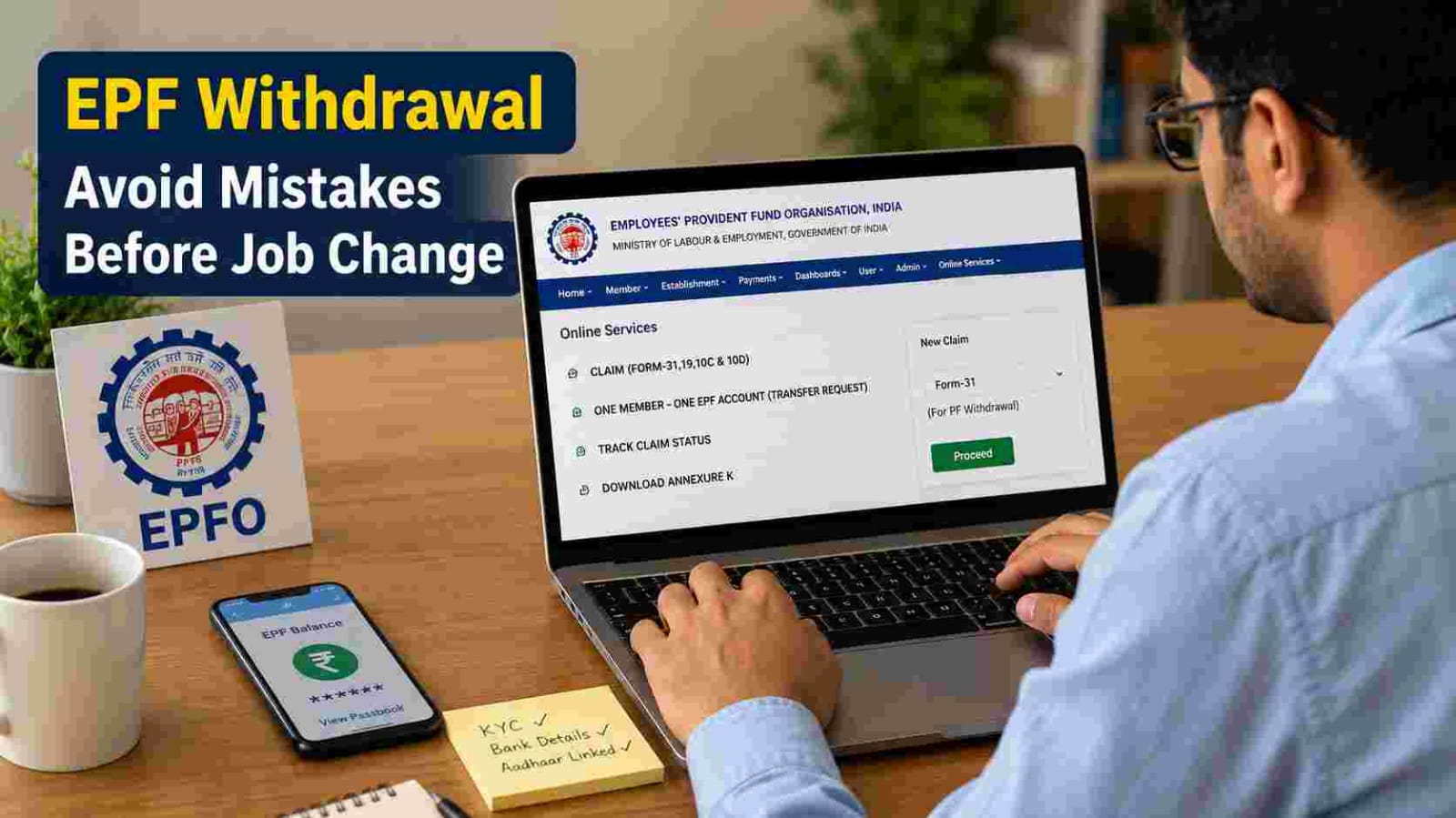

Private Employees: Avoid EPF Withdrawal Mistakes Before Job Change
Changing jobs often brings an important financial decision—whether to withdraw your Employees' Provident Fund (EPF) balance or transfer it to your new employer. Many employees make this decision without understanding the applicable EPF rules, which can result in unnecessary tax liability, delayed settlements, or even claim rejection.
The Employees' Provident Fund Organisation (EPFO) allows both full and partial withdrawals under specific conditions. However, eligibility depends on factors such as your employment status, years of service, and the purpose of withdrawal. Understanding these rules before submitting a claim can help you protect your retirement savings while ensuring a smooth claim process.
Should You Withdraw EPF After Changing Jobs?
In most cases, employees who are joining another EPF-covered organisation should transfer their EPF account instead of withdrawing the balance. Keeping your EPF account active helps maintain continuous service, which is important for retirement benefits and tax purposes.
A full EPF withdrawal is generally permitted only after retirement or after remaining unemployed for the prescribed period under EPFO rules.
When Is Full EPF Withdrawal Allowed?
You may be eligible for complete withdrawal in situations such as:
- Retirement after reaching the eligible retirement age.
- Remaining unemployed for the prescribed period after leaving employment.
- Certain other situations permitted under EPFO regulations, such as permanent disability or migration abroad, where applicable.
If you are simply switching employers, transferring your balance is generally the preferred option.
Partial EPF Withdrawal: When Can You Apply?
EPFO permits partial withdrawals (also known as advances) for specific approved purposes. These include:
- Medical treatment for self or eligible family members.
- Higher education expenses.
- Marriage-related expenses.
- Purchase, construction, or renovation of a house.
- Repayment of an eligible home loan.
- Certain unemployment-related situations.
Eligibility conditions, withdrawal limits, and required service period may vary depending on the purpose.
Documents and KYC Checklist
Before applying online, ensure the following details are updated:
| Requirement | Why It Matters |
|---|---|
| Aadhaar linked with UAN | Identity verification |
| Verified PAN | Required in many taxable withdrawal cases |
| Active bank account | Direct credit of claim amount |
| Correct IFSC and account number | Prevents payment failure |
| Updated mobile number | OTP verification and claim alerts |
| Employer exit date updated | Necessary for eligible final settlement |
Incorrect KYC information is among the most common reasons for claim delays or rejection.
Tax Rules You Should Know
Tax treatment depends mainly on your period of continuous service.
- EPF withdrawals after completing the prescribed continuous service period (generally five years) are usually tax-exempt, subject to applicable conditions.
- Early withdrawals before completing five years of continuous service may become taxable under the Income Tax Act.
- In eligible cases, Tax Deducted at Source (TDS) may also apply if applicable conditions are met.
If you have transferred your EPF balance while changing jobs, the previous service period is generally considered for calculating continuous service.
Common Reasons EPF Claims Get Rejected
Many online claims are delayed because of avoidable errors, including:
- Aadhaar not linked with UAN.
- Name or date of birth mismatch.
- Incorrect bank account details.
- Employer has not updated the date of exit.
- PAN not verified where required.
- Applying for a withdrawal category without meeting eligibility conditions.
Checking these details before filing the claim can significantly improve processing speed.
How Long Does an EPF Claim Take?
Claim processing time may vary depending on verification and workload.
In many cases, properly submitted online claims with complete KYC are processed within 7 to 20 working days, although actual timelines can differ across regions and individual cases. Claims requiring manual verification may take longer.
State-Wise Claim Timeline
EPFO does not prescribe different withdrawal rules for different states. The eligibility criteria remain the same across India.
However, processing time may vary because of:
- Regional EPFO office workload.
- Employer verification delays.
- KYC mismatches.
- Banking verification.
Employees should therefore focus on submitting accurate documents rather than expecting identical processing times across all states.
Practical Tips Before Filing Your Claim
- Transfer your EPF instead of withdrawing if you are joining a new employer covered under EPF.
- Verify Aadhaar, PAN, and bank KYC before applying.
- Ensure your employer has updated your date of exit.
- Check whether your withdrawal may attract tax.
- Apply under the correct withdrawal category to avoid rejection.
These simple precautions can save both time and unnecessary financial loss.
Conclusion
EPF is designed primarily as a long-term retirement savings scheme, not just a source of emergency funds. Before changing jobs, understand whether transferring your balance is a better choice than withdrawing it. If you are eligible for withdrawal, ensure your KYC details are updated, choose the correct claim category, and be aware of the applicable tax rules. A little preparation can help you avoid delays, claim rejection, and unnecessary tax deductions while keeping your retirement savings secure.
For More Information -
EPF Transfer When Changing Jobs: 2026 Guide
Disclaimer: The information provided on Labhgrow.in is for educational purposes only. We are not affiliated with the Income Tax Department, NSDL (Protean), or UTIITSL. Delivery times and tracking processes are subject to government portal functionality. Please never share your PAN details or OTPs with unauthorized third-party websites.

કન્ટેન્ટ હેડ અને મુખ્ય લેખક
ભારતીય સરકારી યોજનાઓ, બજાર ભાવ અને બેંકિંગ નીતિઓના નિષ્ણાત વરિષ્ઠ નાણાકીય અને સમાચાર લેખક.
lakshyabhardwaj.hoc@labhgrow.in
સીનિયર રિસર્ચ એનાલિસ્ટ (તથ્ય ચકાસણી)
સરકારી અને નાણાકીય સ્ત્રોતોમાંથી 100% સચોટતા અને તથ્યોની ચકાસણી કરતા સમર્પિત સંશોધક.
harshitsharma.sra@labhgrow.in