TN Women's ₹1,000 Scheme: Full Eligibility Guide
అవలోకనం (Overview)
Check who qualifies for Tamil Nadu's ₹1,000 monthly Kalaignar Magalir Urimai Thogai scheme, required documents, rejection reasons, and DBT status steps.
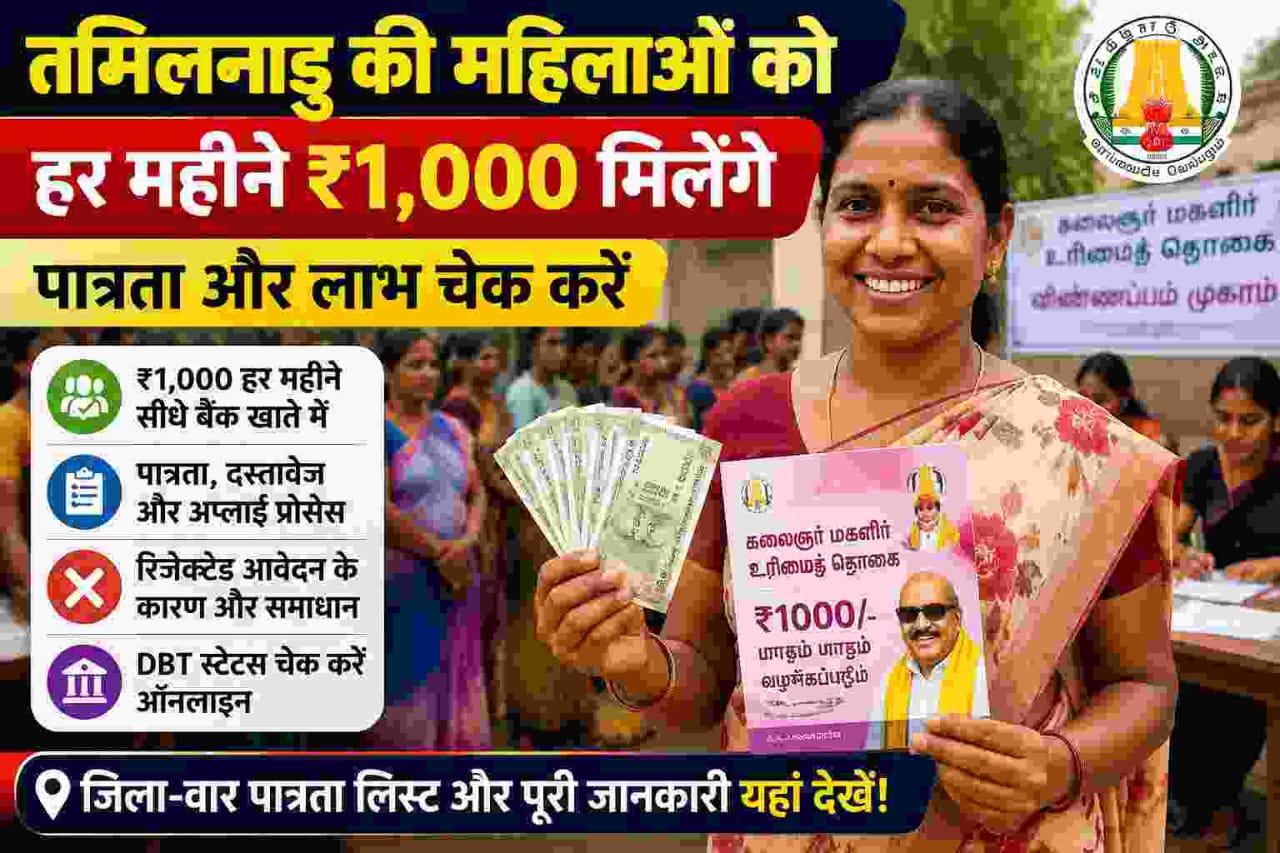

For more than a crore women across Tamil Nadu, the 15th of every month means one thing: an SMS confirming that ₹1,000 has landed in their bank account. That payment comes from the Kalaignar Magalir Urimai Thogai (KMUT) scheme, one of the state's largest direct cash transfer programmes for women heads of households.
The scheme has continued without interruption even as Tamil Nadu got a new government this year. After the Tamilaga Vettri Kazhagam (TVK), led by actor-turned-politician C. Joseph Vijay, won the April 2026 assembly election and formed the government in May, officials confirmed the ₹1,000 monthly payout would carry on as before. TVK's own election manifesto had promised to raise the amount to ₹2,500 for women below 60, and the state government has said this increase is under review as part of a broader restructuring of welfare schemes. Until an official notification changes the amount, ₹1,000 remains the confirmed monthly entitlement.
What Is the Kalaignar Magalir Urimai Thogai Scheme
Launched on September 15, 2023, in Kancheepuram, the scheme provides ₹1,000 every month, or ₹12,000 a year, to eligible women who are recognised as the head of their family on the ration card. The money is transferred directly into the beneficiary's bank account through Direct Benefit Transfer, cutting out middlemen and paperwork delays. The state government has since expanded coverage in phases, bringing the total number of beneficiaries past 1.15 crore, with an additional 17 lakh women added in a later phase.
Who Is Eligible
Eligibility is checked against ration card, income, and property records held by the Tamil Nadu government. Based on the scheme's official criteria, a woman generally qualifies if she:
- Is 21 years of age or older
- Is listed as the head of the family on the ration card
- Is a permanent resident of Tamil Nadu
- Belongs to a family with annual income below ₹2.5 lakh
- Does not own a four-wheeler, more than 5 acres of wetland, or more than 10 acres of dry land
Widows, single women heading a household, and transgender persons who head a family are also covered under the scheme. Women from families where a member is a central or state government employee, bank or PSU staff, an income taxpayer, a professional taxpayer, a pensioner, or an elected local body representative are not eligible, since these categories are treated as financially better placed.
Why District-Wise Verification Matters
Because eligibility depends on land and income records that are maintained locally, verification often plays out differently from one district to another. Revenue officials at the taluk level cross-check ration card, land, and income data before an application is cleared, which is why processing timelines can vary between districts even for similar applications. If your application has been pending for an unusually long time compared to others in your area, it is worth confirming with your local Village Administrative Officer or e-Sevai centre whether any district-specific document or verification step is outstanding.
Documents You Will Need
- Aadhaar card, linked to an active mobile number
- Ration card showing you as the head of the family
- Bank passbook, with the account linked to Aadhaar
- Income certificate or supporting income records
- Proof of residence in Tamil Nadu
Aadhaar-bank linkage is non-negotiable here. Without it, the DBT transfer simply fails even if the application itself is approved.
How to Apply
1. Visit the official portal at kmut.tn.gov.in.
2. Register using your Aadhaar number and verify with the OTP sent to your registered mobile.
3. Fill in personal details exactly as they appear on your ration card, including name and father's or husband's name.
4. Upload clear scans of Aadhaar, ration card, and bank passbook.
5. Submit the form to generate an Application Reference Number, which you should save for status tracking.
Applications can also be submitted offline at the nearest e-Sevai centre or ration shop for women who are not comfortable applying online.
Common Reasons Applications Get Rejected
A large share of rejections trace back to a handful of avoidable issues:
- The applicant is not listed as the head of the family on the ration card
- Family income records show earnings above the ₹2.5 lakh limit
- Land or property records linked to the family exceed the permitted limit
- A family member has filed an income tax return recently, even if the applicant herself does not pay tax
- Bank account details are inactive, incorrect, or not linked to Aadhaar
- Uploaded documents are blurry, incomplete, or mismatched with ration card details
If your application is rejected, you will typically receive an SMS stating the reason. You have 30 days from that message to file an appeal with the Revenue Divisional Officer, along with documents supporting your eligibility. Women who believe they were rejected wrongly, especially over disputed land or income records, should keep scanned copies of supporting documents such as Patta or Chitta ready when filing the appeal.
How to Check Your DBT Status
1. Go to the official KMUT portal or the Chief Minister's public grievance portal.
2. Select the option to check application or payment status.
3. Enter your Aadhaar number or ration card number as prompted.
4. The screen will show your status as pending, approved, or rejected, along with the reason if rejected.
Checking status periodically, particularly in the weeks right after applying, helps catch document or verification issues early rather than waiting for a rejection SMS.
What This Means for Household Budgets
For many families, this ₹1,000 is not treated as extra money but as a fixed part of the monthly budget, going toward groceries, school fees, medicines, or transport. Because the amount is credited on a fixed date through DBT, women have reported that it removes some of the unpredictability that comes with informal or seasonal financial support.
Conclusion
The Kalaignar Magalir Urimai Thogai scheme continues to be one of Tamil Nadu's most far-reaching welfare measures for women, and it remains active and unchanged in amount even under the new state government. Getting the benefit reliably comes down to three things: making sure your ration card correctly lists you as head of the family, keeping your bank account properly linked to Aadhaar, and responding quickly if you receive a rejection SMS. For any proposed increase to ₹2,500, rely only on official confirmation from the Tamil Nadu government rather than unofficial claims.
For More Information -
TN Ladies 1000 Scheme Apply Online 2026, Eligibility & Status
Disclaimer: The information provided on Labhgrow.in is for educational purposes only. We are not affiliated with the Income Tax Department, NSDL (Protean), or UTIITSL. Delivery times and tracking processes are subject to government portal functionality. Please never share your PAN details or OTPs with unauthorized third-party websites.

కంటెంట్ హెడ్ & ప్రధాన రచయిత
భారతీయ ప్రభుత్వ పథకాలు, మార్కెట్ రేట్లు మరియు బ్యాంకింగ్ విధానాలలో నిపుణులైన సీనియర్ రచయిత.
lakshyabhardwaj.hoc@labhgrow.in
సీనియర్ రీసెర్చ్ అనలిస్ట్ (ఫాక్ట్ చెకర్)
ప్రభుత్వ మరియు అధికారిక వనరుల నుండి 100% ఖచ్చితత్వాన్ని పరిశోధించి ధృవీకరించే నిపుణుడు.
harshitsharma.sra@labhgrow.in