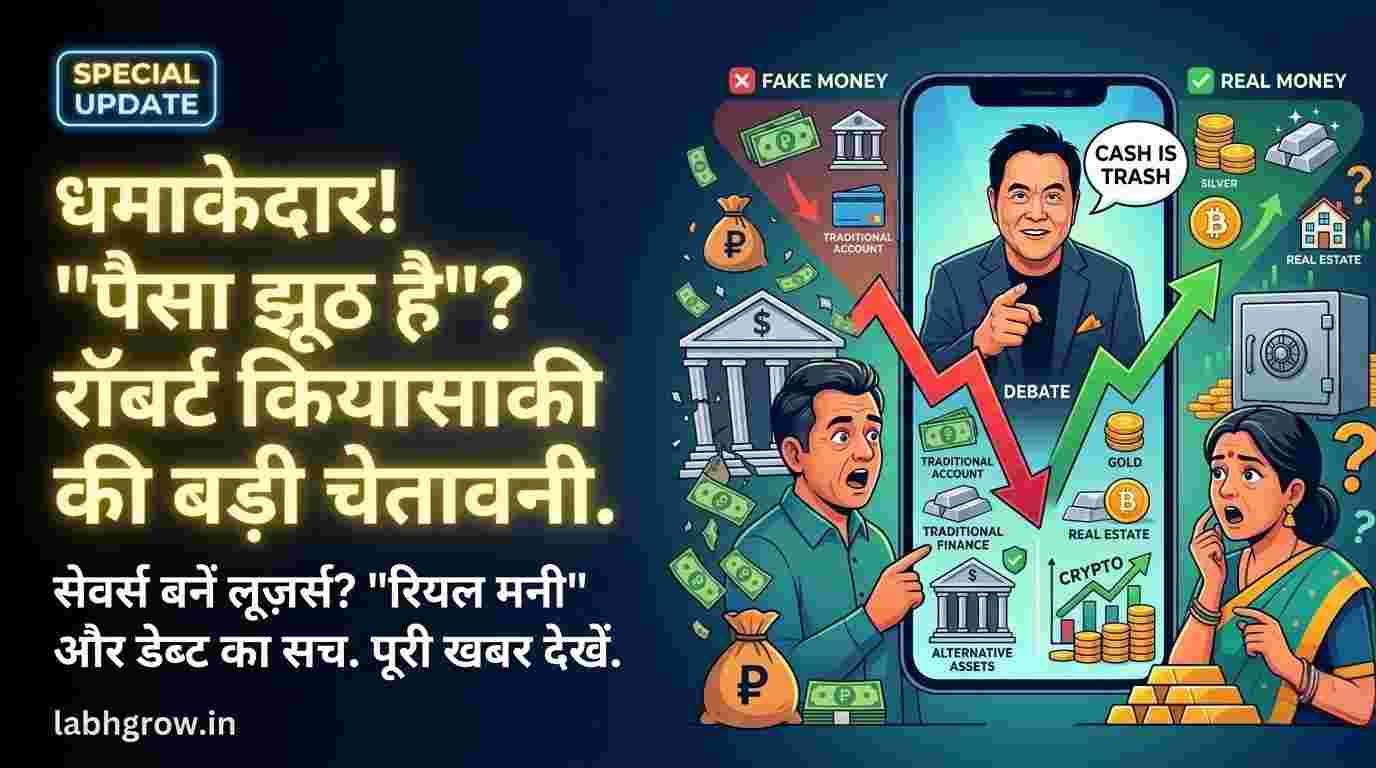
Robert Kiyosaki’s Bold Money Advice Is Going Viral Again — But Should Indians Really Follow It?
There’s a reason why every time Robert Kiyosaki speaks about money, the internet suddenly wakes up.
Some people call him a financial genius. Others say his advice is too risky for common people. But one thing is clear — whenever the author of Rich Dad Poor Dad talks about cash, gold, real estate, or Bitcoin, millions listen carefully.
And now, his latest comments are again creating a storm online.
This time, the debate is not just happening in America. Indian users on YouTube, Instagram, and finance groups are also discussing whether Kiyosaki’s advice actually makes sense in today’s economy. Especially at a time when inflation is rising, bank FD returns feel “okay but not exciting,” and many young Indians are trying to figure out how to build wealth faster.
So what exactly did he say?
Recently, Robert Kiyosaki once again warned people against depending too much on traditional savings and paper money. According to him, assets like gold, silver, and Bitcoin could become more valuable in the future, especially if global economies face financial pressure.
Now naturally, this statement triggered strong reactions.
Because for the average Indian family, “safe money” has always meant something simple — bank FD, LIC, savings account, maybe a small plot of land, and gold jewellery kept safely in the locker. Risk lena is not everybody’s style. Parents still proudly say, “Beta, FD kara do. Safe rahega.”
But the younger generation is thinking differently now.
A 24-year-old working professional in Bengaluru might already have SIPs, crypto exposure, US stocks, and a side hustle income. Meanwhile, his father may still trust fixed deposits more than anything else. That gap in thinking is exactly why Kiyosaki’s advice becomes such a hot topic in India.
The interesting part is that he doesn’t just talk about becoming rich. He talks about how money itself works.
And honestly, that’s where many people feel uncomfortable.
For example, imagine someone has ₹5 lakh sitting in a savings account for years. Technically the money is “safe.” But if inflation keeps increasing faster than the interest earned, the actual purchasing power slowly drops. Things become more expensive — groceries, school fees, petrol, rent, medical bills — while the money grows very slowly.
This is the exact fear Kiyosaki often highlights.
He believes people should focus on owning assets that can grow over time instead of simply storing money.
Now does that mean every Indian should suddenly put all savings into Bitcoin or gold?
Absolutely not.
That’s where the internet sometimes misunderstands his message.
Even financial experts in India keep repeating that aggressive investing without understanding risk can backfire badly. We’ve already seen this during crypto crashes when many young investors entered at peak prices after watching viral videos and later panicked when markets fell sharply.
Kiyosaki’s statements work well as “wake-up calls,” but blindly copying them is a different story.
Take gold, for example.
Indian families have trusted gold for generations, but mostly emotionally — weddings, festivals, family security. Today, younger investors are seeing gold differently. Not just jewellery, but digital gold, gold ETFs, sovereign gold bonds. They see it as a hedge during uncertain times.
And honestly, recent years have strengthened that belief. Whenever global tensions rise or markets become unstable, gold prices often attract attention again.
But even gold has limits.
It may protect value over long periods, but it doesn’t create regular income like a business or rental property. So depending only on gold also has disadvantages.
The same debate applies to Bitcoin.
For some Indians, Bitcoin represents freedom and future technology. For others, it feels like pure gambling.
And truthfully, both views exist for valid reasons.
A college student in Delhi may proudly talk about buying crypto during dips, while a retired government employee may refuse to touch it entirely. Different life stages create different risk capacities. That’s something social media discussions often ignore.
One thing Kiyosaki does very effectively is challenge the traditional “study hard, get a job, save money forever” formula.
In India, this hits differently.
Because millions of middle-class families were raised with exactly that mindset. A stable salary, government job if possible, controlled spending, and retirement security. There’s nothing wrong with that approach. In fact, for many families, it created stability after years of financial struggle.
But the world has changed.
Today’s young earners face rising living costs, expensive housing, unstable job markets, and constant digital influence. They see influencers talking about financial freedom at 30, early retirement, passive income, and multiple income streams. Naturally, they start questioning older financial rules.
And this is where Kiyosaki becomes relevant again.
Not because every prediction he makes turns out correct, but because he forces people to think differently about money.
Even in India, awareness around investing has exploded after the pandemic. Earlier, stock market discussions were limited to a few people. Now even small-town users regularly check SIP returns, mutual fund apps, and market news on their phones.
UPI changed spending habits.
Fintech apps changed investing habits.
And social media changed financial conversations completely.
But there’s another side to this trend that nobody talks about enough.
Many young users now feel pressure to become rich very quickly.
That pressure can become dangerous.
When people hear bold statements like “cash is trash” or “buy assets immediately,” some take emotional decisions without understanding basics like emergency funds, insurance, debt management, or diversification.
A person struggling with high-interest credit card debt probably doesn’t need risky investments first. They need financial stability.
A family paying heavy EMIs may need better budgeting before chasing aggressive wealth strategies.
This practical side matters a lot in India because financial realities here are very different from Western countries.
For most Indian households, stability still matters more than “fast wealth.”
And maybe that balance is the real lesson hidden behind the debate.
Not blind fear.
Not blind excitement either.
Just smarter awareness.
Instead of treating Robert Kiyosaki like a guru whose every sentence must be followed, it may be better to treat his advice as a starting point for questioning old money habits.
Should inflation be ignored? Probably not.
Should people learn investing earlier? Definitely yes.
Should Indians depend on only one source of income forever? In today’s world, maybe not.
But should common families suddenly abandon savings, FDs, or secure investments entirely? That’s probably unrealistic too.
In fact, most successful Indian investors quietly follow a mixed approach.
Some money stays safe.
Some money grows slowly.
Some money takes calculated risk.
That balance may not look exciting on Instagram reels, but in real life, it often works better.
And perhaps that’s why Robert Kiyosaki’s advice keeps sparking debate every few months. Because deep down, people know the financial world is changing rapidly — but nobody is fully sure what the perfect strategy looks like anymore.
For Indian users especially, the smarter approach may not be choosing between “old-school saving” and “modern investing.”
The smarter approach could simply be learning how to combine both wisely.
| Traditional Indian Money Habits | New-Age Financial Thinking |
|---|---|
| Fixed Deposits | SIPs & Mutual Funds |
| Gold Jewellery | Gold ETFs & Digital Gold |
| Single Salary Dependence | Multiple Income Streams |
| Savings First | Investing Early |
| Low Risk | Balanced Risk Approach |
Robert Kiyosaki’s latest money advice has triggered debate in India because he encourages people to focus more on assets like gold and Bitcoin instead of depending only on savings. While many young investors find his ideas exciting, experts warn that blindly taking high risks without financial planning can be dangerous.
You can also read this -
Disclaimer: The information provided on Labhgrow.in is for educational purposes only. We are not affiliated with the Income Tax Department, NSDL (Protean), or UTIITSL. Delivery times and tracking processes are subject to government portal functionality. Please never share your PAN details or OTPs with unauthorized third-party websites.