Best Post Office Monthly Income Schemes for Indian Retirees: MIS vs SCSS Compared
கண்ணோட்டம் (Overview)
Looking for a safe monthly income after retirement? Compare Post Office MIS and SCSS based on eligibility, returns, taxation, payouts, and suitability for Indian retirees in 2026.
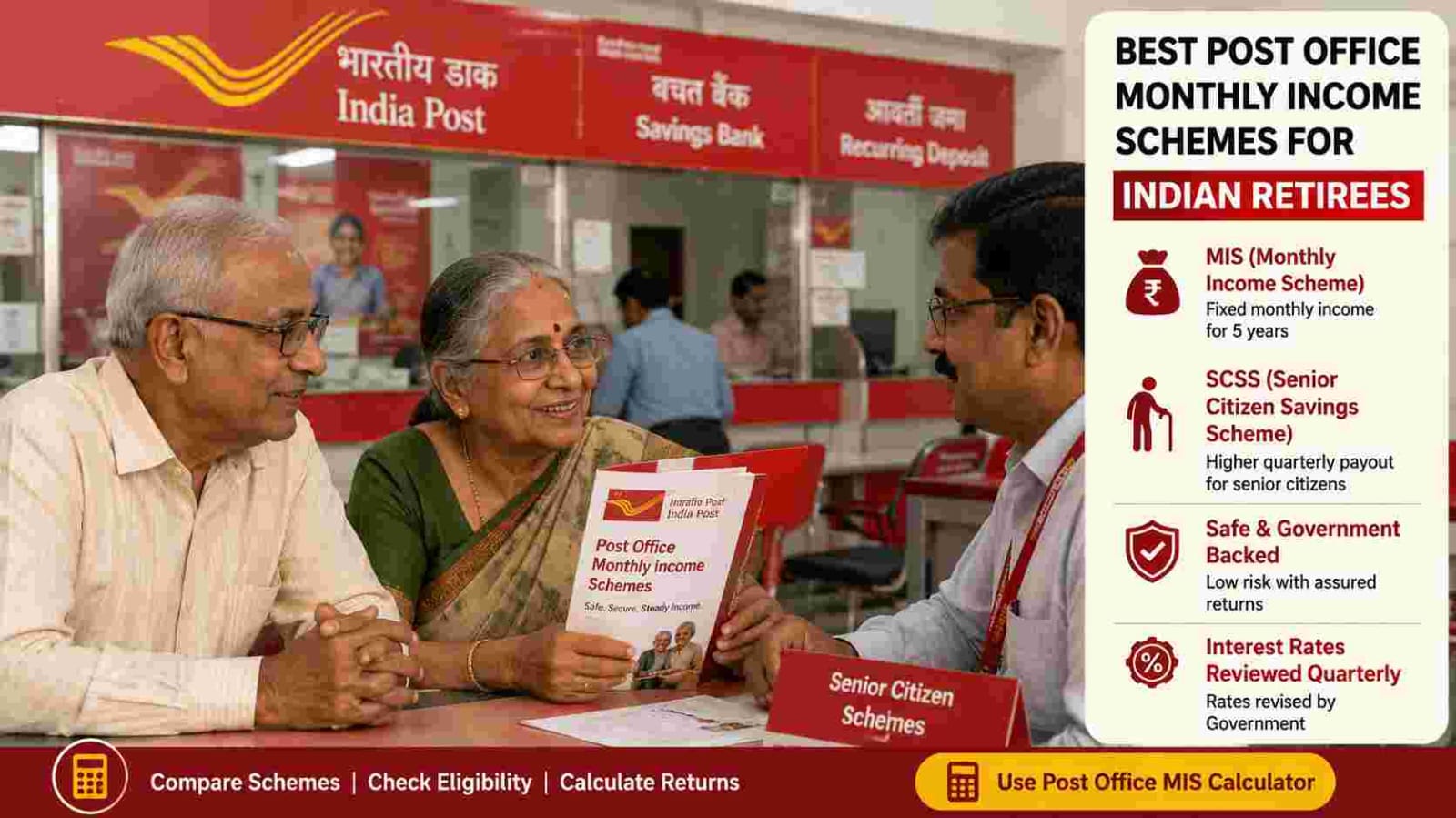

Why Post Office schemes remain popular after retirement
Many retirees prioritize capital protection over high returns. Unlike market-linked investments, Post Office small savings schemes are backed by the Government of India, making them one of the safest options for generating regular income.
Another advantage is that the interest rates on these schemes are reviewed every quarter by the Ministry of Finance. Existing investments generally continue at the rate applicable when the account was opened, subject to scheme rules.
Post Office MIS vs SCSS at a glance
| Feature | Post Office MIS | SCSS |
|---|---|---|
| Tenure | 5 Years | 5 Years (extendable as per prevailing rules) |
| Interest Payment | Monthly | Quarterly |
| Current Interest Rate | 7.4% p.a. | 8.2% p.a. |
| Risk | Government-backed | Government-backed |
| Best For | Monthly household expenses | Higher retirement income |
*Interest rates shown reflect the current government-notified rates and are subject to quarterly review for new investments.
Understanding the Post Office Monthly Income Scheme (MIS)
The Monthly Income Scheme is designed for investors who want a fixed amount credited every month.
Key Features
- Fixed tenure of five years.
- Monthly interest payout.
- Government-backed investment.
- Suitable for retirees who need regular monthly cash flow for household expenses.
A retiree receiving a pension may use MIS to supplement monthly expenses such as groceries, medicines, electricity bills, or maintenance charges.
Understanding the Senior Citizens Savings Scheme (SCSS)
The Senior Citizens Savings Scheme is specifically designed for eligible senior citizens and certain retirees under notified conditions.
Its biggest advantage is the higher interest rate compared to most traditional fixed-income products.
Key Features
- Higher interest rate than MIS.
- Interest paid every quarter.
- Five-year maturity with extension permitted under existing rules.
- Investment qualifies for tax deduction under Section 80C (subject to applicable tax laws and limits). Interest remains taxable.
Eligibility difference
Post Office MIS
MIS is available to eligible resident individuals and is not restricted to senior citizens.
SCSS
SCSS is primarily meant for:
- Individuals aged 60 years or above.
- Certain retired civilian employees aged 55–60 years meeting prescribed conditions.
- Certain retired defence personnel subject to government rules.
Applicants should always verify the latest eligibility conditions before investing.
Which scheme offers better regular income?
The answer depends on how you receive and use your retirement income.
Choose MIS if you need:
- Monthly cash flow.
- Predictable household budgeting.
- Income every month instead of every quarter.
Choose SCSS if you want:
- Higher overall returns.
- Better income potential.
- Government-backed safety with quarterly payouts.
For many retirees, quarterly income is sufficient because they combine SCSS with pension income or savings.
Example payout comparison
Suppose a retiree invests the same amount in both schemes.
| Scheme | Interest Payment Frequency |
|---|---|
| MIS | Every month |
| SCSS | Every quarter |
Although SCSS generally generates a higher annual income because of its higher interest rate, MIS provides smoother monthly cash flow.
Tax mistakes many retirees make
One common misconception is that all Post Office income is tax-free.
In reality:
- Interest earned under MIS is taxable according to the investor's applicable income tax slab.
- Interest received from SCSS is also taxable.
- Investments in SCSS may qualify for deductions under Section 80C, subject to prevailing tax provisions and eligibility.
Consulting a qualified tax professional can help retirees avoid unnecessary tax liabilities.
Which scheme suits retirees in Tier-2 cities?
Retirees living in cities such as Indore, Jaipur, Lucknow, Nagpur, Coimbatore, Ranchi, Mysuru, or Bhopal often prioritize stable cash flow over aggressive investment returns.
A practical approach could be:
- Use MIS to meet monthly living expenses.
- Allocate eligible retirement savings to SCSS for higher quarterly income.
This combination can help balance regular cash flow with better long-term returns while keeping investment risk low.
Important points before investing
Before opening either account, consider the following:
- Interest rates are reviewed every quarter for new deposits by the Government of India.
- Both schemes carry a five-year tenure.
- Premature closure is permitted under specified conditions and may attract penalties.
- Read the latest scheme rules before investing, as limits and operational guidelines can change.
Key Takeaways
- Both MIS and SCSS are among India's safest income-generating investments because they are government-backed.
- MIS is better for retirees who require monthly income.
- SCSS generally offers higher returns but pays interest quarterly.
- Tax treatment differs from the investment deduction available under SCSS, so understanding taxation is important.
- Choosing between the two depends on your cash-flow needs, eligibility, and retirement goals.
Conclusion
For most Indian retirees, the decision is not about choosing the "best" scheme but selecting the one that matches their financial needs.
If regular monthly income is your priority, the Post Office Monthly Income Scheme remains a dependable option. If you qualify for the Senior Citizens Savings Scheme and want higher returns with quarterly payouts, SCSS is generally the stronger choice.
Many financial planners also recommend using both schemes together to create a balanced retirement income strategy while keeping investments protected under government-backed savings products.
Disclaimer: The information provided on Labhgrow.in is for educational purposes only. We are not affiliated with the Income Tax Department, NSDL (Protean), or UTIITSL. Delivery times and tracking processes are subject to government portal functionality. Please never share your PAN details or OTPs with unauthorized third-party websites.

உள்ளடக்கத் தலைவர் & முதன்மை எழுத்தாளர்
இந்திய அரசு திட்டங்கள் மற்றும் சந்தை நிலவரங்களில் நிபுணத்துவம் பெற்ற முதன்மை எழுத்தாளர்.
lakshyabhardwaj.hoc@labhgrow.in
மூத்த ஆராய்ச்சி ஆய்வாளர் (உண்மை சரிபார்ப்பாளர்)
அரசு மற்றும் அதிகாரப்பூர்வ ஆதாரங்களில் இருந்து தகவல்களை ஆய்வு செய்து சரிபார்க்கும் உண்மை ஆய்வாளர்.
harshitsharma.sra@labhgrow.in