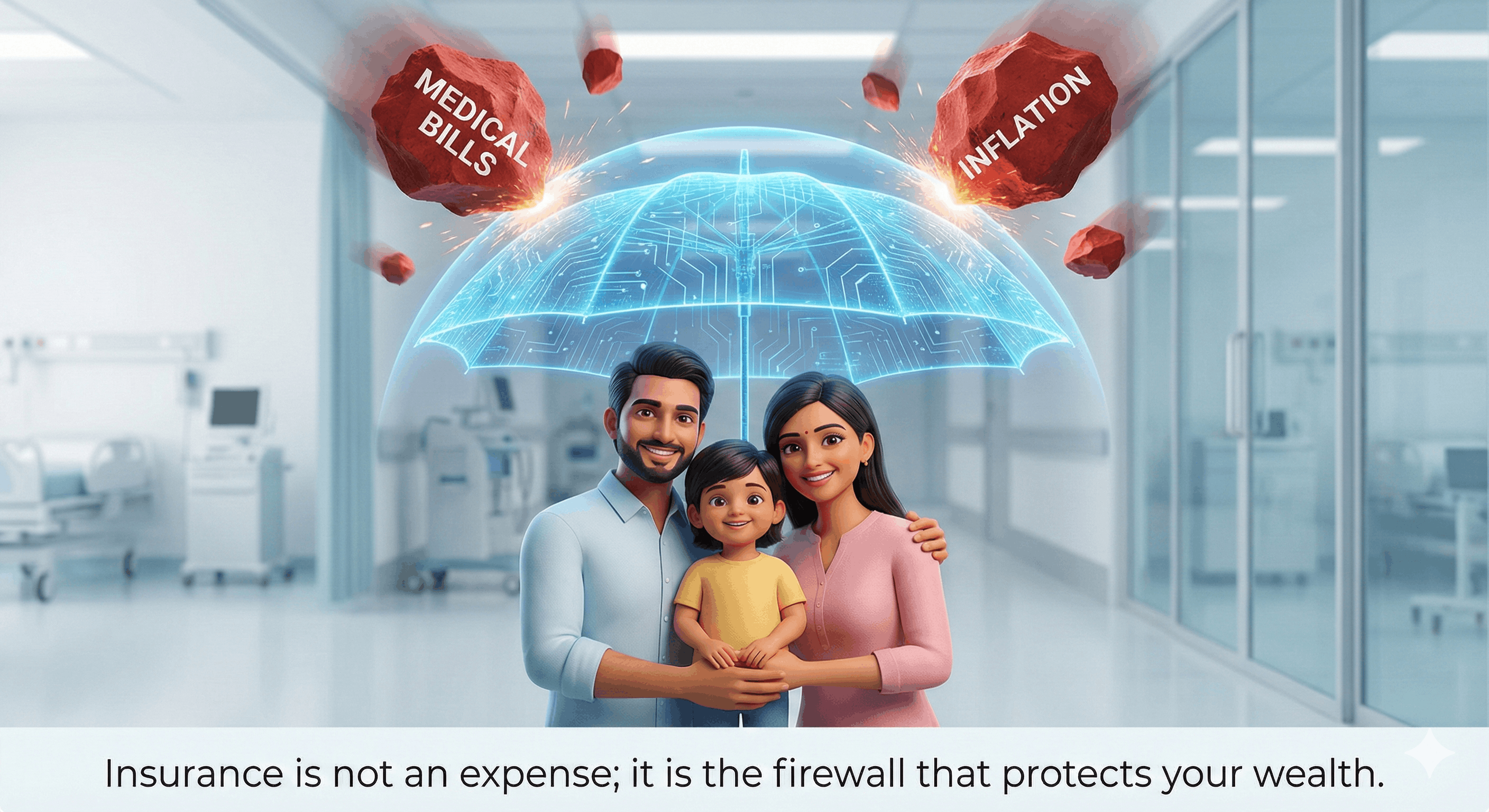
The Ultimate Guide to Buying Health Insurance in India (2026): Don't Let a Hospital Bill Bankrupt You
If you don't have a good Health Insurance policy (Mediclaim), you are just one bad day away from poverty. But buying insurance is tricky. Agents will sell you what gives them the highest commission, not what you need. Today, I will decode the fine print and help you buy a policy that actually pays when you need it.
Part 1: The "Corporate Cover" Trap
"Bhai, I don't need insurance. My company provides ₹3 Lakhs cover." This is the biggest mistake salaried people make.
Why Corporate Insurance is NOT Enough:
It is linked to your job: If you get laid off (which is common in 2026) or switch jobs, your cover vanishes instantly. Who will insure you in that gap month?
It is too small: ₹3 Lakhs is nothing today. A simple Dengue hospitalization in a metro city can cost ₹1.5 Lakhs. A heart surgery costs ₹5-10 Lakhs.
Retirement Shock: When you retire at 60, getting a new policy will be extremely expensive because of your age and pre-existing diseases.
The Golden Rule: Always have a Personal Health Insurance Policy separate from your employer.
Part 2: Family Floater vs. Individual (Which one to pick?)
When buying a personal policy, you have two options:
1. Individual Policy:
- Everyone has a separate cover (e.g., Husband ₹5L, Wife ₹5L).
- Pros: If both get sick, both get full cover.
- Cons: More expensive premium.
2. Family Floater Policy:
- The cover is shared by the family (e.g., Family shares ₹10L).
- Pros: Cheaper premium. Higher cover for a lower price.
- Cons: If one person uses the entire ₹10L, the others are left with zero cover for the rest of the year.
My Recommendation: For a young family (Husband, Wife, Kids), go for a Family Floater of at least ₹10 Lakhs. For parents (Senior Citizens), always buy a Separate Individual Policy. Why? Because the premium is calculated based on the oldest member. If you add your 65-year-old father to your floater plan, your premium will skyrocket.
Part 3: The "Hidden Clauses" (Where Claims Get Rejected)
This is the most important section. Agents will never tell you this. Before signing the cheque, check these 3 clauses in the brochure. If the policy has these, RUN AWAY.
1. Room Rent Capping (The Silent Killer) Many cheap policies have a rule: "Room Rent limit is 1% of Sum Insured."
- Example: You have a ₹3 Lakh policy. Room Rent limit = ₹3,000/day.
- Reality: A private room in a good hospital costs ₹8,000/day.
- The Trap: If you choose the ₹8,000 room, the insurance company won't just deduct the difference. They will reduce your entire claim proportionately!
- Advice: Only buy policies with "No Room Rent Capping" (Single Private AC Room eligibility).
2. Co-Payment (Sharing the Bill) Some policies say: "10% or 20% Co-Pay."
- This means YOU have to pay 20% of the bill from your pocket.
- Example: On a ₹5 Lakh bill, you pay ₹1 Lakh.
- Advice: Never buy a policy with Co-Payment unless you are above 65 years old (where it is mandatory).
3. Waiting Period for Pre-Existing Diseases (PED) If you have Diabetes or BP today, the policy won't cover it immediately.
- Standard Waiting Period: 3 to 4 years.
- Good Policies: 1 to 2 years.
- Advice: Buy when you are young and healthy so you serve the waiting period without needing a claim.
Part 4: The "Super Top-Up" Hack (Get ₹1 Crore Cover Cheaply)
You might be thinking, "Bhai, a ₹20 Lakh policy is too expensive!" Here is a secret hack used by smart investors.
Instead of buying a huge base policy, use a Base + Super Top-up combination.
- Step 1: Buy a Base Policy of ₹5 Lakhs. (Premium: ₹8,000)
- Step 2: Buy a Super Top-up Policy of ₹95 Lakhs with a ₹5 Lakh deductible. (Premium: Only ₹2,000)
- Total Cover: ₹1 Crore.
- Total Cost: ₹10,000.
How it works: If your bill is ₹4 Lakhs, the Base Policy pays. If your bill is ₹15 Lakhs, the Base Policy pays the first ₹5 Lakhs, and the Super Top-up pays the remaining ₹10 Lakhs. This is the smartest way to protect your wealth against critical illnesses like Cancer.
Part 5: Cashless vs. Reimbursement
In 2026, cash is outdated. Always check the "Network Hospital List" of the insurer.
- Cashless: You walk into the hospital, show your Health Card, get treated, and walk out. The insurer pays the hospital directly.
- Reimbursement: You pay ₹5 Lakhs from your pocket first, collect documents, submit them to the insurer, and wait 30 days for the money.
Advice: Choose an insurer that has tie-ups with the big hospitals near your home.
Conclusion: Don't Buy It to Save Tax
Many people buy health insurance just to save tax under Section 80D (up to ₹25,000 deduction). That is the wrong mindset.
Buy Health Insurance to save your Dignity.
Disclaimer: The information provided on Labhgrow.in is for educational purposes only. Insurance is a subject matter of solicitation. Policy terms, premiums, and exclusions vary by insurer. Please read the sales brochure carefully before concluding a sale. We are not IRDAI-registered advisors.