Maharashtra ₹2 Lakh Loan Waiver: Aadhaar Steps Explained
अवलोकन (Overview)
Maharashtra's ₹2 lakh farm loan waiver is rolling out. Know eligibility, Aadhaar verification steps, DBT process and how to check your name.
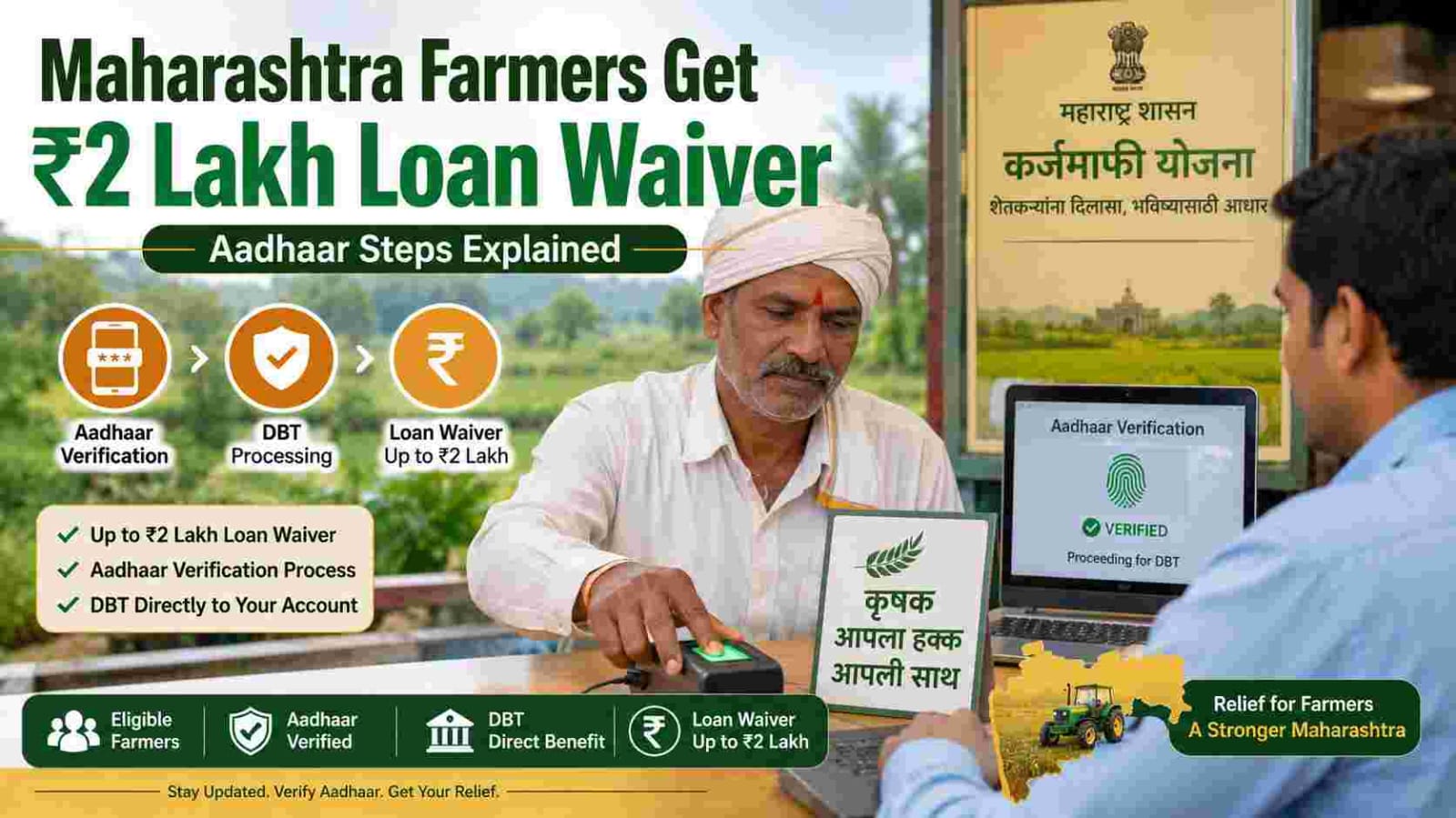

Maharashtra has begun rolling out one of its biggest farm relief programmes in recent years, with the state government releasing the first list of beneficiaries under the Punyashlok Ahilyadevi Holkar Shetkari Karjmukti Yojana 2026. The scheme offers a loan waiver of up to ₹2 lakh to eligible farmers, and Aadhaar-based verification has now become a mandatory step for anyone hoping to receive the benefit.
Cooperation Minister Babasaheb Patil released a representative beneficiary list covering seven districts, describing it as the symbolic start of a much larger exercise. According to the government, close to 56 lakh farmer families across Maharashtra are expected to benefit once the scheme is fully implemented.
What the Scheme Actually Covers
The state cabinet cleared this waiver on June 2, 2026, and eligibility norms were later fine-tuned through a government order issued on July 15, 2026. The scheme has three parts: a full loan waiver for eligible farmers, a one-time settlement (OTS) option, and an incentive benefit for those who have been repaying their loans on time.
Under the core waiver component, farmers whose outstanding short-term crop loans, including interest, add up to ₹2 lakh or less will get complete debt relief. To qualify, the loan must have been taken between April 1, 2019, and March 31, 2025, remained overdue as of September 30, 2025, and stayed unpaid until March 31, 2026. Importantly, there is no landholding limit attached to this eligibility, which widens the scheme's reach compared to some earlier waiver programmes.
The waiver applies across nationalised banks, private banks, regional rural banks, district central cooperative banks (DCCBs), and primary agricultural credit societies (PACS), meaning farmers don't need to worry about which type of institution their loan is with.
There's also good news for disciplined repayers. Farmers who were part of the 2019 Mahatma Jyotirao Phule Farm Loan Waiver Scheme and repaid on time can now claim an incentive of up to ₹2 lakh, a sharp jump from the earlier ₹50,000 benefit. The government has also eased the repayment condition — farmers who repaid crop loans in any two previous years now qualify, rather than needing to have repaid specifically during 2026-27.
How the Aadhaar Verification Process Works
This is where the scheme's rollout has become a genuine step-by-step process rather than a one-time announcement.
1. SMS Notification: Eligible farmers first receive an SMS on their registered mobile number informing them of their provisional eligibility.
2. AgriStack Registration: Before authentication, farmers must complete registration on the AgriStack platform, the government's digital farmer database.
3. Aadhaar Authentication: Each beneficiary is given a unique identification number that can be used alongside their Aadhaar number for authentication.
4. Verification Centres: Authentication can be completed at nearly 32,000 Aaple Sarkar Seva Kendras spread across the state, so farmers don't need to travel far.
5. DBT Credit: Once Aadhaar authentication is successfully completed, the waiver amount is credited directly into the farmer's loan account through Direct Benefit Transfer (DBT), rather than a cash payout.
Beneficiary lists are also being displayed at gram panchayat offices, cooperative societies, and local bank branches, giving farmers an offline way to check their names alongside the digital process.
Timeline for Rollout
The government has set July 31, 2026, as the target date to complete the process for farmers linked to District Central Cooperative Banks. Once that phase is done, the benefit transfer process for farmers associated with commercial banks is expected to begin. Given that only 533 beneficiaries from seven districts have been listed so far as a representative sample, the bulk of the verification and disbursal work is still ahead.
Who Won't Be Eligible
The scheme excludes certain categories from claiming the waiver, including former and current public representatives, office-bearers of urban and rural local bodies, government and semi-government employees, individuals who pay income tax on non-agricultural income, and office-bearers or employees of district-level cooperative institutions.
Why This Matters for Farmers
For a farmer waiting on loan relief, the practical impact comes down to three things: check your SMS and registered mobile number regularly, complete AgriStack registration as soon as possible, and visit an Aaple Sarkar Seva Kendra for Aadhaar authentication rather than waiting for the bank to reach out first. Since the waiver flows through DBT into the loan account itself, there is no separate bank account or cash disbursal to track — the outstanding loan balance should simply reflect the adjustment once processing is complete.
Farmers can also use tools like the Agriculture Loan EMI Calculator to understand how a partial or full waiver would change their existing repayment schedule while they wait for confirmation.
It's worth noting that opposition parties, including the Congress, have flagged concerns based on past experience with the Ladki Bahin Yojana, where a large number of women were later found ineligible after initial rollout. This makes it advisable for farmers to independently verify their status rather than assume automatic inclusion once the SMS arrives.
Conclusion
Maharashtra's ₹2 lakh farm loan waiver is moving from announcement to implementation, but the actual benefit depends on farmers completing AgriStack registration and Aadhaar authentication correctly. With district-wise lists being rolled out in phases and a July 31 deadline for cooperative bank beneficiaries, farmers should treat the coming weeks as the critical window to verify their eligibility rather than waiting passively for confirmation.
For More Information -
> Disclaimer: The content provided on LabhGrow is for educational and informational purposes only. We are not a SEBI-registered investment advisor. Please consult a qualified financial advisor before making any investment or financial decisions. LabhGrow is not responsible for any loss or damage arising from the use of this information.

कंटेंट हेड एवं मुख्य लेखक
भारतीय सरकारी योजनाओं, बाजार भाव और बैंकिंग नीतियों के विशेषज्ञ वरिष्ठ वित्तीय एवं समाचार लेखक।
lakshyabhardwaj.hoc@labhgrow.in
सीनियर रिसर्च एनालिस्ट (तथ्य परीक्षक)
सरकारी और वित्तीय डेटा स्रोतों से 100% प्रामाणिकता और तथ्यों की पुष्टि करने वाले समर्पित शोधकर्ता व विश्लेषक।
harshitsharma.sra@labhgrow.in